

A pre-made chicken coop can look plenty big enough on a product page.
Then you put four full-size hens inside, add a roost, a nest box, bedding, and on a rainy afternoon when nobody wants to leave the house—and suddenly that “large” coop feels very small.
This is why I would not choose a prefab coop by the bird count in the title.
The enclosed sleeping area matters more. So do the roosts, ventilation, access doors, nest boxes, cleaning points, and the quality of the latches. A long attached run can make a product look huge without giving your chickens much more indoor room at all.
Penn State Extension currently uses roughly 1.5 square feet of indoor floor space for laying hens and 2 square feet for larger chickens in its small-scale housing guidance. Another Penn State guide uses 2 square feet per bird as a simple starting point. I would rather have a little extra room than try to make the minimum work.
And do not count the open run as indoor coop space. If a storm keeps the flock inside for hours, only the enclosed house is helping you.
If you are still deciding whether buying is better than building, see our DIY vs. prefab chicken coop guide. I would also read the predator-proof coop guide before trusting any ready-made setup overnight.
Quick Comparison
| Coop | Material | Published size | Where it fits best | Amazon |
|---|---|---|---|---|
| Formex SnapLock Large | Double-wall polyethylene | 64 × 39 × 42 in | Low-maintenance sleeping house | Check |
| Omlet Eglu Cube | Plastic + steel | About 39 × 37 × 26 in | Premium modular setup | Check |
| OverEZ Classic Medium | Wood | 50.25 × 52.5 × 62.25 in | Modest backyard flock | Check |
| OverEZ Classic Large | Wood | 74 × 60 × 72.5 in | Larger standard-breed flock | Check |
| OverEZ Classic XL | Wood | 98 × 60 × 72.5 in | Large permanent flock | Check |
| Aivituvin AIR31 | Wood | 55 × 21.3 × 33.4 in | Bantams or two hens | Check |
| Aivituvin 103-inch Coop + Run | Wood + wire | 103 × 67 × 28 in overall | Small flock needing an attached run | Check |
| GUTINNEEN AIR66-U | Wood + wire | 69.8 × 42 × 54.6 in | Flexible smaller setup | Check |
| Ketive Mobile Coop | Wood + wire | 78.7 × 23.6 × 38.6 in | Small mobile flock | Check |
1. Formex SnapLock Large Chicken Coop

As an Amazon Associate I earn from qualifying purchases. This article contains affiliate links. If you buy through these links, I may earn a commission at no extra cost to you.
If I wanted a coop that was easy to wash and did not need painting every few seasons, this is the type I would look at first.
The SnapLock Large uses a double-wall polyethylene shell instead of timber. The body measures about 64 × 39 × 42 inches and weighs around 65 pounds.
Inside are four laying spaces and three 36-inch roosts. The litter tray pulls out from the back, which is much nicer than trying to scrape bedding through a small side opening. You can also adjust the ventilation.
The plastic body is the big advantage here. Wet bedding, spilled water, and rain are much less likely to turn into a rot problem along the base.
I would still keep the flock size conservative. The house is useful for sleeping and laying, but it is not the whole setup. Your birds still need a secure run or another safe outdoor area during the day.
Features: double-wall plastic shell, removable litter tray, adjustable vents, four laying spaces, three long roosts.
Pros: easy cleaning, no wood rot, little exterior maintenance.
Cons: no large run included; plastic look may not suit every backyard.
Check the Formex SnapLock Large on Amazon
2. Omlet Eglu Cube
As an Amazon Associate I earn from qualifying purchases. This article contains affiliate links. If you buy through these links, I may earn a commission at no extra cost to you.
The Eglu Cube is expensive. I would get that out of the way first.
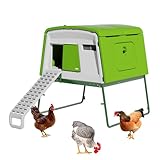
What you are paying for is a very different type of coop from the usual thin wooden hutch. The Cube is built as part of a larger system, so you can add Omlet runs, wheels, doors, and other accessories later.
The house is roughly 3 feet 3 inches wide, 3 feet 1 inch deep, and 2 feet 2 inches high. It is not huge inside, but the space is arranged efficiently.
The part I like most about the design is cleaning access. The rear panel comes off and the droppings tray slides out. There are also fewer wooden joints and cracks holding dust, dried manure, and moisture.
Omlet markets the Cube for up to six large hens, but I would still think about breed size before using that number. Six smaller laying hens and six big Orpingtons do not take up the same space.
If you want something basic for two or three hens, the Cube can be more money than you need to spend. If you hate maintaining wood and want a setup you can expand later, it makes more sense.
Features: molded plastic house, removable rear panel, pull-out droppings tray, optional run and wheels.
Pros: easy to clean, no rot, useful accessory system.
Cons: high upfront cost; accessories add more cost.
Check the Omlet Eglu Cube on Amazon
3. OverEZ Classic Medium
As an Amazon Associate I earn from qualifying purchases. This article contains affiliate links. If you buy through these links, I may earn a commission at no extra cost to you.
The first thing that separates the OverEZ Medium from a lot of prefab coops is the access.
You are not crawling through a little hatch every time bedding gets wet.
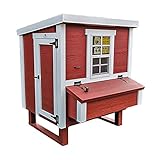
The coop measures 50.25 × 52.5 × 62.25 inches. Inside are three nest boxes and two roosts. Two gable vents sit high on the structure, and there is also an opening screened window.
Both the chicken door and the human door use lockable latches. The roof is designed to send water away from the nesting side rather than straight over it.
That is the kind of detail you appreciate after the first long rainy week.
It is still a wooden coop, though. I would check the bottom edges, roof fasteners, hinges, and exposed wood every year. Prefab does not mean maintenance-free.
OverEZ gives the Medium a fairly generous capacity. I would not treat that number as something you need to fill. With bigger breeds, or birds that spend a lot of winter time indoors, fewer hens will be easier to manage.
Features: three nest boxes, two roosts, two high vents, screened window, full access door.
Pros: easier cleaning, practical ventilation, much more usable than a low hutch.
Cons: needs a separate run; wood needs upkeep.
Check the OverEZ Classic Medium on Amazon
4. OverEZ Classic Large

As an Amazon Associate I earn from qualifying purchases. This article contains affiliate links. If you buy through these links, I may earn a commission at no extra cost to you.
If you already know the Medium will be tight, I would move up rather than plan to replace the whole coop later.
The Large measures 74 × 60 × 72.5 inches. That extra floor area matters when rain, snow, or wind keeps the flock inside longer than usual.
You also get five nest boxes, two screened windows, two gable vents, and two roosts. The doors are lockable, and the treated floor and siding are paired with the same roof design that moves water away from the nest-box side.
I would think of this as a permanent backyard structure.
Put it on a level, well-drained base. Build or attach a proper run. Then leave it there.
The benefit of that bigger structure is access. Bedding changes are easier. Checking corners is easier. Catching a hen that has decided she does not want to come out is easier.
The manufacturer advertises room for up to 15 chickens. I would use the upper number carefully and pay more attention to breed size and how much outdoor time the flock gets.
Features: five nest boxes, two windows, two gable vents, two roosts, full-size access.
Pros: noticeably more indoor room, easy human access, good layout for standard hens.
Cons: takes up real yard space; difficult to move; wood needs routine care.
Check the OverEZ Classic Large on Amazon
5. OverEZ Classic XL
As an Amazon Associate I earn from qualifying purchases. This article contains affiliate links. If you buy through these links, I may earn a commission at no extra cost to you.
Once you get to the XL, you are really shopping for a chicken house rather than a little backyard hutch.
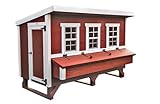
It measures 98 × 60 × 72.5 inches and has six nest boxes, three screened windows, two gable vents, and two roosts.
The thing I would care about most here is not the advertised bird count. It is the human access.
When a coop gets this large, you need to be able to reach the dirty corners, lift out wet bedding, inspect the roof, work on hardware, and get hold of a bird if something is wrong. A bigger door makes all of that less frustrating.
OverEZ markets the XL for up to 20 chickens. That may sound attractive if your flock is growing, but I would still leave some breathing room. Large dual-purpose breeds fill a house much faster than small production layers.
The XL needs a serious spot in the yard. You need a good base, a secure run, and enough room around the structure to maintain it. This is not something you buy if you expect to move the coop every season.
Features: six nest boxes, three windows, two gable vents, two roosts, large access door.
Pros: generous interior, easier cleaning and repairs, suited to a bigger long-term flock.
Cons: large footprint, high cost, difficult to relocate.
Check the OverEZ Classic XL on Amazon
6. Aivituvin AIR31

As an Amazon Associate I earn from qualifying purchases. This article contains affiliate links. If you buy through these links, I may earn a commission at no extra cost to you.
The AIR31 is only about 21 inches wide, so I would not buy it for four or five full-size hens.
That is simply too much bird for this little house.
For two hens, a few bantams, quail, or temporary housing, though, the compact footprint can be useful. The full structure measures about 55 × 21.3 × 33.4 inches.
You get a pull-out tray, a ramp, lockable access, and a pitched roof. The design can also be expanded by connecting another unit.
Just remember that the visible footprint includes wire space. The enclosed sleeping section is smaller. This is another reason I would not use the maximum seller capacity as your target.
If you have a small yard and only keep a couple of birds, the AIR31 can make sense. If your flock is already growing, I would skip it and buy more enclosed space from the beginning.
Features: pull-out tray, ramp, pitched roof, lockable access, expandable design.
Pros: compact, easy to fit into a small yard, simple cleaning access.
Cons: very limited indoor room; easy to overcrowd.
Check the Aivituvin AIR31 on Amazon
7. Aivituvin 103-Inch Chicken Coop with Run
Aivituvin 103-Inch Chicken Coop with Run
This one looks much bigger than the AIR31 because it is much longer.
But most of that extra length is the run.
The full setup is about 103 × 67 × 28 inches. The enclosed hutch is much smaller than the overall footprint, while the attached run gives the flock daytime room to move around.
For a beginner, that can be convenient. You do not have to buy a coop and then immediately build a separate pen.
I would still look closely at the wire and hardware before the first night. Check the latches. Check where the mesh meets the wooden frame. Check the bottom edge where a digging predator may work.
If the supplied mesh is light, our hardware cloth guide explains where stronger wire is most useful.
And again, do not use the entire 103-inch length when deciding how many birds fit. The run is outdoor space. The enclosed hutch is what matters at night.
Features: enclosed sleeping hutch, attached wire run, multiple access points.
Pros: house and run together, convenient for a small starter flock.
Cons: sleeping space is much smaller than the overall dimensions suggest; predator upgrades may be needed.
Check the Aivituvin 103-inch coop on Amazon
8. GUTINNEEN Folding AIR66-U

As an Amazon Associate I earn from qualifying purchases. This article contains affiliate links. If you buy through these links, I may earn a commission at no extra cost to you.
The AIR66-U makes more sense if you expect the coop to move occasionally.
It is not a lightweight chicken tractor, but the foldable multi-level design is easier to reposition than one of the big OverEZ houses.
The frame measures about 69.8 × 42 × 54.6 inches and weighs around 64 pounds. You get a divider, nesting box, ramp, removable tray, and stand.
The thing I would watch here is the extra hardware.
Folding sections mean more hinges. More hinges mean more screws and more joints. After a windy week or heavy rain, those are the places I would check first.
The multi-level layout can also make the coop sound roomier than it really is. Chickens still need enough sheltered sleeping and roosting room. Do not count every wire section and platform as nighttime housing.
Features: foldable multi-level frame, divider, nesting box, ramp, removable tray.
Pros: easier to reposition, flexible layout, smaller footprint than a shed-style coop.
Cons: more hinges and joints to maintain; not designed for daily tractor-style moves.
Check the GUTINNEEN AIR66-U on Amazon
9. Ketive Mobile Chicken Coop

As an Amazon Associate I earn from qualifying purchases. This article contains affiliate links. If you buy through these links, I may earn a commission at no extra cost to you.
If one part of your yard turns muddy every time it rains, a movable coop starts to look a lot more useful.
The Ketive has two wheels and a handle, so you can move the setup to fresh ground or pull it into shade.
It measures about 78.7 × 23.6 × 38.6 inches and weighs around 63 pounds. Inside are three perches, a nesting box, and a pull-out tray.
The narrow width tells you how I would use it.
This is a two- or three-hen type of coop, not a rolling home for a big flock.
Move it when the ground needs a break, but inspect the wheel brackets and frame afterward. A coop that rolls easily still needs to sit solidly once your birds are inside.
If you want to move a larger flock regularly, I would look at a purpose-built tractor instead. Our chicken tractor wheel guide can help if you are building one.
Features: wheels, handle, three perches, nesting box, pull-out tray.
Pros: easy to relocate, useful for resting worn ground, compact.
Cons: narrow sleeping area; wheels and frame hardware need checking.
Check the Ketive Mobile Coop on Amazon
Do the Space Math Before You Order
This is the part I would check before looking at color, roof style, or whether the coop has cute little shutters.
How much enclosed floor space do your birds actually get?
Penn State currently lists about 1.5 square feet indoors for laying hens and 2 square feet for larger chickens. Another Penn State guide uses 2 square feet per bird as a simple backyard rule.
I would treat those numbers as a starting point, not a challenge to see how tightly you can pack the coop.
Large breeds need more room. Chickens that spend long winter days indoors need more room. Birds are also easier to manage when the bedding is not overloaded with droppings and moisture.
And remember: an attached wire run does not become indoor housing just because it is under the same roofline.
Roosting Space Matters More Than Many Product Listings Suggest
Chickens do not simply stand on the floor all night.
They want to roost.
Penn State uses about six inches of roost space per standard bird, while University of Minnesota cold-weather guidance uses around nine inches. I would rather have spare roost space than watch birds push each other off the bar every evening.
Also check where the roost sits. If the nest box is higher and more comfortable than the roost, do not be surprised when hens start sleeping in the nests and leaving droppings where you want clean eggs.
You Should Be Able to Clean the Coop Without Fighting It
A pull-out tray looks great in a product photo.
It does not help much if you still cannot reach the corner behind the roost.
Before buying, picture a wet winter morning. Bedding has stuck to the floor. One hen has laid in the wrong place. You need to reach the back wall.
Can you actually get in there?
This is where the larger OverEZ models have an advantage. Plastic coops such as the Formex and Eglu go the other direction: smaller interiors, but smooth surfaces that are easier to wash.
Ventilation Should Work Even When the Weather Is Bad
Do not choose a coop because it looks sealed and cozy.
Chickens produce moisture all night. Damp bedding and poor airflow can become a bigger winter problem than cold air itself.
You want stale, moist air to escape without a strong draft blowing directly across sleeping birds. High vents and screened openings are useful for that.
If you are not sure what good airflow looks like, see our chicken coop ventilation guide.
Do Not Assume a Prefab Coop Is Predator-Proof
I would check every new coop before putting chickens inside overnight.
Pull on the latches. Push on the wire. Look under the doors. Check where panels meet the roof and where the run touches the ground.
A raccoon does not care that the product page says “secure.” A dog does not care either.
Utah State Extension recommends tight-fitting doors and windows and sealing gaps that rodents can use. If a prefab run uses light wire, reinforcing vulnerable sections with hardware cloth is often worth doing.
Plastic or Wood?
If you hate maintenance, plastic has an obvious advantage.
You can wash it. It does not rot. Wet bedding is less likely to soak into the structure.
Wood is easier to modify. You can add a vent, replace a board, move a latch, or attach a homemade run without much trouble.
I would not choose between them by material alone.
A roomy, well-ventilated wooden coop is better than a cramped plastic one. An easy-clean plastic house is better than a wooden hutch that stays damp in every storm.
A Run Is Not the Same Thing as a Coop
This sounds obvious until you start shopping online.
Large wire enclosures are often mixed into the same search results as actual chicken houses.
A run gives your flock daytime space. It does not give them a dry enclosed sleeping area, roosts, or nest boxes.
If you already own a secure hen house, a separate walk-in run can be a good purchase. If you are starting from nothing, make sure the product actually includes the house your birds need at night.
Frequently Asked Questions
Are pre-made chicken coops worth buying?
They can be if you do not want to build from scratch. The biggest mistake is buying from the product photo alone. Check the enclosed dimensions, roosts, ventilation, access doors, and hardware first.
How many hens can I keep in a prefab coop?
Use the enclosed indoor floor area, breed size, and roost space instead of relying only on the seller’s maximum number. If the coop includes a run, do not count that open area as indoor sleeping space.
Is plastic better than wood?
Plastic is easier to wash and does not rot. Wood is easier to repair and modify. I would choose based on the whole design, not the material alone.
Do I still need a chicken run?
Yes, unless your flock already has another secure outdoor area. The coop is mainly for sleeping, laying, and weather protection. Birds still need room to walk, scratch, dust bathe, and get away from each other during the day.
Should I add hardware cloth to a ready-made coop?
If the supplied mesh is light, openings are large, or predators are common where you live, I would reinforce the weak areas. Pay close attention to the run base, doors, corners, and vents.
Which type is easiest to clean?
Plastic models with smooth interiors and removable trays are usually the quickest to wash. On wooden coops, a large access door may be more useful than a small slide-out tray because you can reach the corners properly.
Final Verdict
If you want the least wood maintenance, I would start with the Formex SnapLock Large. The Omlet Eglu Cube is the more expensive plastic choice, but the modular accessories may be worth it if you want to build the setup out over time.
If you prefer a proper wooden chicken house, look at the OverEZ Medium, Large, and XL according to flock size and yard space. They need more maintenance, but they also give you much better human access than the small hutch-style coops.
The Aivituvin, GUTINNEEN, and Ketive models make more sense for smaller flocks and tighter yards.
Whatever you choose, measure the sleeping area before you order.
That one step will save you from a lot of disappointing “it looked bigger online” purchases.
Sources and Product References
- Penn State Extension — Small Scale Poultry Housing
- Penn State Extension — Successfully Raising a Small Flock of Laying Chickens
- University of Minnesota Extension — Caring for Chickens in Cold Weather
- Utah State University Extension — Housing Backyard Chickens
- Hatching Time — Formex SnapLock Large specifications
- Omlet — Eglu Cube specifications
- OverEZ — Medium Coop specifications
- OverEZ — Large Coop specifications
- OverEZ — XL Coop specifications
- Aivituvin — 103-inch Coop with Run specifications
