
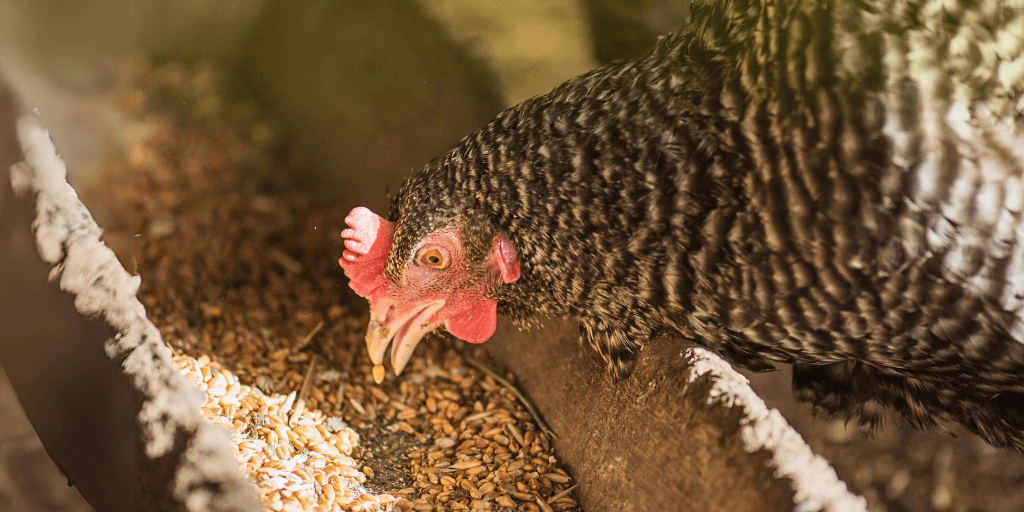
Organic chicken feed is not automatically healthier, safer, or more nutritious than conventional feed. In the United States, “organic” is mainly a regulated production and labeling standard. The feed still has to do the same basic job: provide the bird with the right energy, amino acids, vitamins, minerals, calcium, phosphorus, and other nutrients for its age and purpose.
If you prefer organic ingredients or want to raise birds under USDA organic standards, certified organic feed can make sense. Just do not choose a bag by the word “organic” alone. Read the guaranteed analysis, check whether it is a complete feed, and make sure it matches chicks, growers, layers, breeders, or meat birds appropriately.
This guide focuses on what organic chicken feed actually means, how it differs from “natural” or “non-GMO,” how to read the label, and why homemade organic rations are much harder to balance than they look.
What Does “Organic Chicken Feed” Mean in the United States?
USDA organic rules apply to how agricultural ingredients are produced and how certified organic livestock are managed.
USDA Agricultural Marketing Service guidance states that certified organic livestock operations must feed agricultural ingredients that are organically produced and handled. Organic feed can still contain certain allowed vitamins, minerals, enzymes, microorganisms, and other additives under the National Organic Program rules.
That is an important detail because a balanced poultry feed often needs small amounts of nutrients that cannot simply be supplied by throwing together organic grains and vegetables.
Organic Does Not Mean “No Vitamins, Minerals, or Synthetic Nutrients”
One of the most common misunderstandings is that an organic feed must contain only whole grains and “natural” ingredients.
USDA rules allow certain vitamins, trace minerals, and approved feed additives in organic livestock feed. Synthetic DL-methionine is a good example. Methionine is an essential amino acid for poultry, and federal organic rules have specifically allowed its use under defined conditions because maintaining adequate methionine is important for bird health and feathering.
So a premix on an organic-feed label is not automatically a red flag. It may be exactly what makes the ration nutritionally complete.
Organic vs. Non-GMO vs. Natural
| Label | What it tells you |
|---|---|
| USDA Organic | Refers to a regulated production and certification system. Organic agricultural feed ingredients must meet USDA organic requirements, with allowed supplements and additives handled under National Organic Program rules. |
| Non-GMO | Addresses genetic-engineering status. It does not by itself tell you whether the feed is organic, nutritionally complete, pesticide-free, or better balanced. |
| Natural | A much looser marketing term. It should not be treated as equivalent to USDA Organic certification. |
| Complete feed | A nutritional term. It means the product is intended to provide the diet when fed as directed. This is often more important to flock health than the marketing claims on the front of the bag. |
If your goal is certified organic production, the certification status matters. If your goal is simply healthy backyard hens, nutritional completeness matters first.
Does Organic Feed Make Chickens Healthier?
Not simply because it is organic.
A properly formulated organic layer feed can support healthy hens. So can a properly formulated conventional layer feed. A poorly balanced homemade organic ration can cause more problems than a good conventional feed.
Bird health depends on the whole system: nutrient balance, feed freshness, water, housing, ventilation, disease exposure, parasites, genetics, weather, and management.
The word “organic” does not protect a flock from calcium deficiency, poor amino-acid balance, moldy feed, obesity, heat stress, respiratory disease, or parasites.
Does Organic Feed Produce More Nutritious Eggs?
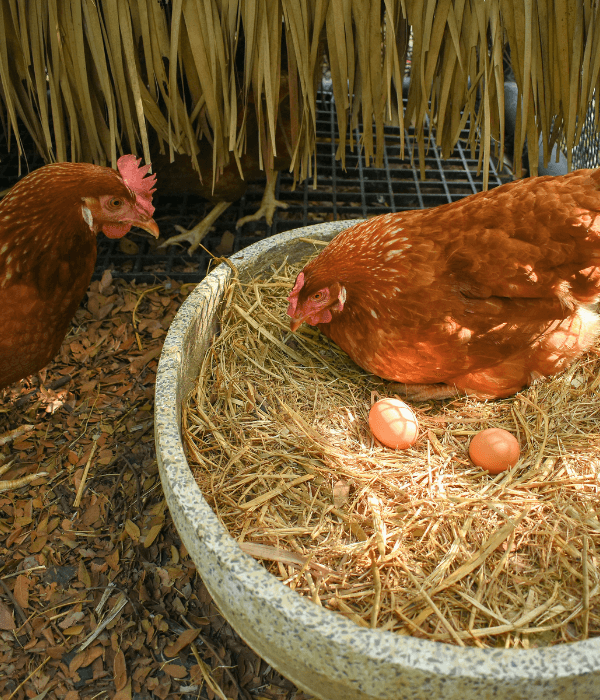
Organic and conventional eggs can differ in some nutritional measurements, but production system alone does not guarantee that one egg is always nutritionally superior.
Published egg studies have found differences in minerals, fatty acids, albumen quality, or other traits between production systems, but results are not consistent across every nutrient. Reviews also point out that hen genetics, age, the actual diet, forage quality, and housing system can affect egg composition.
For example, yolk color is strongly influenced by pigments in the diet. A conventional feed rich in corn or carotenoid-containing ingredients can produce a darker yolk than an organic ration with fewer pigments. A darker yolk does not prove that an egg is more nutritious or safer.
So I would not tell backyard keepers that switching to organic feed will automatically create “healthier eggs,” stronger shells, better taste, or longer shelf life.
Does Organic Feed Produce Better Meat?
The same caution applies to meat.
Meat quality depends on genetics, growth rate, age at processing, diet composition, activity, processing, and storage. Organic certification describes the production system. It does not guarantee a particular flavor, tenderness, nutrient profile, or food-safety advantage in every bird.
Choosing Organic Feed by Life Stage
Organic Chick Starter
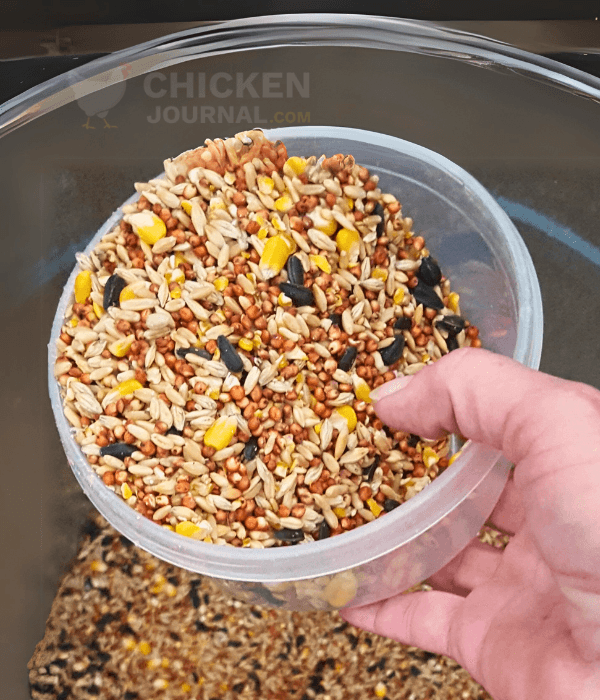
Chicks need a complete starter ration formulated for rapid growth. Do not choose chick feed by comparing protein percentage alone. Amino acids, energy, minerals, vitamins, and feed form all matter.
If chicks received a coccidiosis vaccine at the hatchery, check the hatchery’s feed instructions before automatically buying a medicated starter. The vaccine and the feed program should be compatible.
Organic Grower Feed
Growing pullets need a ration formulated for skeletal and muscle development without the high calcium intended for active laying hens.
Do not switch young pullets to layer feed simply because the bag is organic or because you want to “prepare” them for laying. Follow the feed manufacturer’s age or production-stage directions.
Organic Layer Feed
Layer feed is formulated for hens producing eggs and therefore contains substantially more calcium than starter or grower feed.
Many backyard keepers also offer oyster shell separately so active layers can consume additional calcium as needed.
Organic Meat-Bird Feed
Fast-growing meat chickens have different energy and amino-acid requirements from laying hens. If you are raising broilers, use a ration formulated for the strain and production stage rather than relying on a generic layer or all-flock feed.
How to Read an Organic Chicken Feed Label
The front of the bag is marketing. The feed tag is where the useful information lives.
- Species and life stage: confirm the feed is intended for chickens of the age and purpose you keep.
- Complete feed statement: check whether the product is meant to be the full ration or only a supplement.
- Guaranteed analysis: review protein, fat, fiber, calcium, phosphorus, salt, and other listed nutrients.
- Ingredient list: this tells you the feed ingredients, but ingredient order alone does not tell you whether the amino-acid and mineral balance is adequate.
- Organic certification information: if organic status matters to you, look for legitimate USDA organic labeling and certification details.
- Feeding directions: follow the life-stage and management instructions rather than substituting a homemade percentage from a blog.
- Manufacture or lot information: useful if quality problems or a feed recall arise.
Do Organic Chickens Need Probiotics, Herbs, or “Natural Boosters”?
Not routinely just because the feed is organic.
Some feeds include probiotics, enzymes, yeast products, herbs, or plant extracts. These can be legitimate feed ingredients when included for a defined purpose and used at appropriate levels.
What I would not do is add a second layer of homemade “boosters” on top of a complete ration and assume more natural ingredients create better health.
Garlic is not a replacement for antibiotics, oregano is not a dewormer, apple cider vinegar is not required for digestion, turmeric is not proven to prevent poultry disease, and diatomaceous earth should not be promoted as an internal parasite treatment.
We have separate evidence-based guides on garlic for chickens and oregano for chickens.
Can You Make Organic Chicken Feed at Home?
You can formulate poultry feed at home, but “mix some grains, peas, seeds, oyster shell, kelp, and herbs” is not a balanced recipe.
A proper ration has to meet energy, digestible amino-acid, calcium, available phosphorus, sodium, vitamin, trace-mineral, and other requirements simultaneously. Ingredients also vary from batch to batch.
For that reason, I am not giving a 10-pound DIY organic feed recipe here. The old style of recipe may look precise while still being deficient or excessive in important nutrients.
If you want to formulate a large part of your flock’s diet yourself, work with a poultry nutritionist or use a ration-balancing service based on laboratory or reliable ingredient analyses.
Why “50% Grain + 20% Protein + Supplements” Is Not Enough
Poultry do not need ingredients by category. They need nutrients in the correct amounts and ratios.
Two ingredients with the same crude-protein percentage can have very different digestible amino-acid profiles. Calcium and phosphorus also interact, and trace minerals and vitamins are needed in much smaller but important amounts.
This is why commercial organic feeds often contain vitamin-mineral premixes and allowed amino-acid supplementation. Those ingredients are not evidence that the feed is “less natural.” They are part of making it nutritionally adequate.
Free Range Does Not Replace Organic Feed
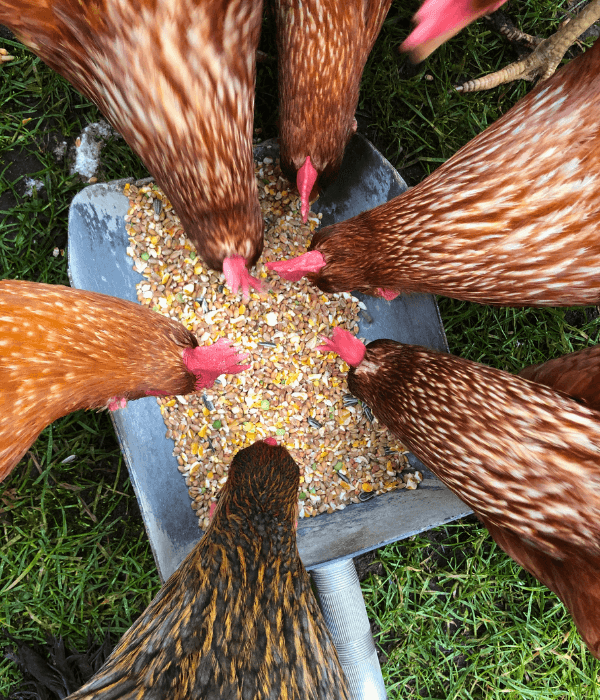
Pasture can add insects, seeds, greens, exercise, and normal foraging behavior. It usually does not provide a predictable complete ration for modern laying hens.
If you are raising poultry under certified organic rules, the pasture and forage requirements are part of the organic management system. For an ordinary backyard flock, free-ranging is useful enrichment but should not become an excuse to leave the feeder empty.
Our free-range chicken guide covers the management trade-offs in more detail.
Is Organic Feed Automatically Free of Pesticide Residues?
No food-production system should be described as guaranteeing “zero chemical exposure.”
Organic crop production restricts many synthetic pesticides and prohibits genetic engineering and other excluded methods, but organic farming can use certain approved pesticides and production inputs.
If avoiding particular production methods is important to you, organic certification provides a regulated standard. It should not be marketed as proof that every bag is residue-free or inherently safer than all conventional feed.
Organic Feed and Antibiotics
Organic livestock rules restrict prohibited drug use, but animal welfare still comes first.
USDA standards specifically state that treatment cannot be withheld from a sick or injured organic animal just to preserve organic status. If a prohibited medication is medically necessary, the bird must be treated even though products from that animal may no longer qualify for organic marketing under the program.
That is a much more accurate principle than saying organic chickens simply “do not receive antibiotics.”
How to Switch to a New Organic Feed
Most chickens can switch feeds without a complicated transition, but a short gradual change can reduce feed refusal when texture, pellet size, smell, or ingredients are noticeably different.
There is no rule that organic feed itself causes a two-week egg-production slump. If egg production drops after a feed change, check how much the hens are actually eating, whether the new product is appropriate for layers, whether the feed is fresh, and whether another factor such as molt, heat, broodiness, or daylight changed at the same time.
How to Store Organic Chicken Feed
Store organic feed the same way you would protect any quality poultry ration: cool, dry, clean, and away from rodents and moisture.
- Keep bags off damp floors.
- Use a clean, dry, rodent-resistant container after opening.
- Do not continually pour new feed on top of old fines.
- Use older feed first.
- Clean spilled feed around storage areas.
- Watch for insects, condensation, mold, clumping, and rancid odors.
- Discard feed that is moldy or badly spoiled.
Do not place silica-gel packets, mothballs, peppermint oil, or loose diatomaceous earth inside feed bins as improvised pest-control measures.
For storage-pest problems, see our updated guide to bugs in chicken feed.
Is Organic Feed Worth It for a Backyard Flock?
It depends on what you value.
Organic feed may be worth choosing if you prefer certified organic crop-production standards, want to raise birds under an organic management system, or simply prefer a particular organic feed that performs well in your flock.
It is not necessary to switch a healthy backyard flock from a good conventional complete feed because you have been told organic feed will automatically create stronger immunity, more eggs, better meat, or toxin-free food.
Choose the feed your birds eat well, that fits their life stage, remains fresh in your storage conditions, and provides a complete nutrient profile.
A Simple Organic Feed Checklist
- Is the product genuinely certified organic if that matters to you?
- Is it labeled for chickens and the correct life stage?
- Is it a complete feed or only a supplement?
- Does the guaranteed analysis match the bird’s purpose?
- Are feeding directions clear?
- Is the feed fresh, dry, and free of mold or heavy infestation?
- Are treats, scratch, and forage staying secondary to the complete ration?
- If you are mixing feed yourself, has the whole ration actually been balanced?
Frequently Asked Questions
Is organic chicken feed healthier than conventional feed?
Not automatically. Organic describes a regulated production system. Either organic or conventional feed can support a healthy flock when it is fresh, nutritionally complete, and appropriate for the bird’s age and purpose.
Is organic chicken feed the same as non-GMO feed?
No. USDA Organic certification includes restrictions on genetic engineering, but a non-GMO feed is not automatically organic. Non-GMO labeling also does not tell you whether a ration is nutritionally complete.
Does organic feed make eggs more nutritious?
Some studies find nutritional or physical differences between eggs from different production systems, but results vary. Hen genetics, age, diet composition, forage, and housing also affect egg quality. Organic labeling alone does not guarantee superior nutrition.
Can organic chicken feed contain vitamins and synthetic methionine?
Yes, under USDA organic rules certain vitamins, minerals, and approved additives can be used. Federal rules specifically address DL-methionine for organic poultry because adequate methionine is important to poultry nutrition.
Can I make complete organic chicken feed at home?
You can formulate feed at home, but a complete ration requires accurate energy, amino-acid, mineral, vitamin, calcium, phosphorus and sodium balance. A simple grain-and-seed recipe is not reliably complete. Use a poultry nutritionist or validated ration-balancing method if homemade feed will be a major part of the diet.
Do organic chickens have to be denied antibiotics?
No. USDA organic standards state that treatment must not be withheld from a sick or injured animal to preserve organic status. If a prohibited medication is medically necessary, the animal should be treated, although its products may no longer qualify for organic marketing.
Final Thoughts
Organic feed can be a perfectly good choice, but it does not need to be sold with exaggerated promises.
The USDA label tells you how the agricultural ingredients and production system are regulated. The feed tag tells you whether the ration is actually suitable for your birds.
For flock health, I would rather see chickens eating a fresh, complete, correctly formulated conventional feed than a homemade organic mixture that is short on essential amino acids, minerals, or calcium. If you can get both nutritional balance and the organic production standard you prefer, that is the best of both worlds.
Sources
- USDA AMS: Evaluating Allowed Ingredients and Sources of Vitamins and Minerals for Organic Livestock Feed
- USDA AMS: Organic Standards
- USDA AMS: National List of Allowed and Prohibited Substances
- 7 CFR §205.603: Synthetic Substances Allowed in Organic Livestock Production
- Poultry Science: Egg Quality Across Production Systems
- Systematic Review: Organic Eggs and Human Health
