
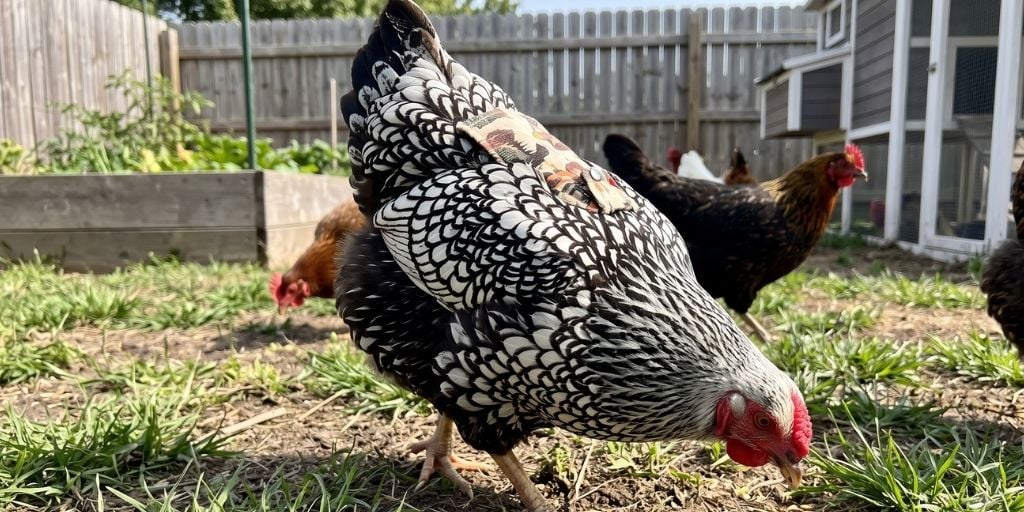
A rooster’s feet can wear a hen’s back feathers thin during repeated mating. If you have spotted a bare patch between her wings, a well-fitting chicken saddle, also called a hen apron, may protect that area from further contact while you work out what is happening.
You do not need one for every hen, and a saddle cannot treat a wound or fix an aggressive flock.
This guide compares nine hen-apron options for US backyard keepers and, more importantly, shows you how to choose the right coverage, check the fit, and recognize when a saddle is not the answer. Product features and availability can change, so use the current seller’s size chart before buying.
When is a chicken saddle useful
A saddle is a fabric covering that sits across the hen’s back and is generally held in position by straps around the wings. Its main purpose is to provide a physical barrier over feathers and skin affected by repeated rooster contact. It is an optional management aid, not a normal daily requirement for healthy hens.
Before buying, take a close look at why your bird is losing feathers. Mating wear, molting, parasites, feather pecking, and other problems can look similar at first glance. Our guide to chicken feather loss covers other possible explanations. When a rooster’s nails or spurs are contributing to damage, address that source too.
What a hen apron can and cannot do
- Can help: provide temporary coverage over a rubbed back and reduce direct contact with the affected feathers or skin when it fits correctly.
- Cannot do: guarantee feather regrowth, prevent respiratory illness, boost immunity, or protect every area of the body.
- Does not solve: overcrowding, severe feather pecking, excessive mating pressure, or a rooster that repeatedly injures hens.
- Is not wound care: bleeding, broken skin, discharge, swelling, or obvious pain calls for prompt assessment and, when appropriate, veterinary care.
If another chicken is actively pecking the injured bird, consider safe separation and address the flock conditions rather than hiding the injury under fabric.
See our advice on harmful feather pecking and flock behavior. Poultry extension guidance emphasizes space, suitable nutrition, enrichment, and timely action when pecking escalates.
How to choose the right chicken saddle
Size and body shape matter more than the label
A saddle marked ‘standard’ may be too long for a bantam or too narrow for a broad, heavy hen. Compare the maker’s actual back-panel dimensions, strap length, and size guidance with your own bird.
The panel should cover the vulnerable area without dragging toward her tail or pressing into the base of her wings. Never pull straps tight just to make a mismatched size stay put.
Consider the material and fastening design
Cotton, canvas, and synthetic fabrics vary in weight, drying time, and construction. There is no single fabric that suits every flock or season. Check for smooth edges, secure stitching, practical washing instructions, and fasteners you can inspect easily. Heavy or layered material deserves particular attention in hot or wet conditions. Avoid pieces that can dangle or snag on wire, branches, and equipment.
Choose only the coverage your hen needs
Basic designs cover the back; other listings have extended shoulder panels or detachable wings. Extra coverage may make sense if the damage lies near a shoulder, but it also adds material to inspect. If your hen simply has a small bare patch across the back, an uncomplicated, properly sized panel may be easier to manage.
Nine chicken saddles and hen aprons to compare
Below are nine different saddle designs and multipacks to consider. We compare their listed features and practical fit considerations, not results from hands-on or controlled product testing. Affiliate widgets may display cached prices, so check the seller’s current price, stock, materials, and sizing before buying.
1. Down Under Outdoors Premium Chicken Saddle

As an Amazon Associate I earn from qualifying purchases. This article contains affiliate links. If you buy through these links, I may earn a commission at no extra cost to you.
This is an option to examine if you want an adjustable apron for a medium or large hen. The important question is not whether its listing calls it premium, but whether its back panel covers the rubbed area while leaving the wings free. Check the precise size and fastening arrangement on the current listing before ordering. A larger-looking saddle is not automatically a better fit.
The adjustable construction may help accommodate body differences within the stated size range. Inspect the straps carefully for rubbing near the wing joints, and do not assume that a product advertised for medium-to-large hens will fit a bantam or a very broad-bodied bird.
Pros
- Adjustable straps give you room to fine-tune the fit within the listed medium-to-large range.
- The listed shoulder cover may be useful when wear extends forward from the back.
Cons
- Not sized for every bantam or broad-bodied hen; check the maker’s dimensions.
- Additional coverage needs regular checks for rubbing near the wing joints.
Check current price and availability on Amazon
2. Adjustable Chicken Apron Back Protector (Three-Color Set)

As an Amazon Associate I earn from qualifying purchases. This article contains affiliate links. If you buy through these links, I may earn a commission at no extra cost to you.
This multipack may suit a keeper who needs spare aprons for washing or has several hens of similar size. The listing offers adjustable straps, but a multipack does not guarantee that each apron will fit every bird. Compare each hen’s body dimensions with the seller’s measurements rather than relying on a generic standard-size label.
Additional color choices are cosmetic, not a health advantage. The useful features are adequate coverage, secure fastening and the ability to wash and dry the fabric completely before reuse.
Pros
- A three-color set provides spare covers while another apron is being washed.
- Adjustable straps let you check the fit on hens within the stated size range.
Cons
- One size in a multipack may not suit all your hens.
- Extra fabric can fold under a wing if the panel is too large.
Check current price and availability on Amazon
3. Twisted 2 Perfection Reversible Standard Size Chicken Saddles

As an Amazon Associate I earn from qualifying purchases. This article contains affiliate links. If you buy through these links, I may earn a commission at no extra cost to you.
This reversible five-pack may appeal to keepers who want a clean spare or need aprons for multiple similarly sized hens. Reversibility matters only if either side feels smooth against the bird. Confirm fabric composition and washing instructions with the seller rather than assuming every patterned apron is constructed the same way.
Do not confuse ‘standard size’ with a universal fit. A hen with a short back, narrow body or prominent wings may need a different cut. Check that no fastening edge digs into the shoulder area.
Pros
- Five reversible aprons offer clean spares for several similarly sized hens.
- You can inspect both sides and use the smoother side against your bird as appropriate.
Cons
- The standard-size label does not establish a fit for bantams or large breeds.
- Inspect reversed seams and elastic for wear or rubbing.
Check current price and availability on Amazon
4. Pranovo Two-Pack Standard Chicken Saddle

As an Amazon Associate I earn from qualifying purchases. This article contains affiliate links. If you buy through these links, I may earn a commission at no extra cost to you.
The two-pack format gives you a backup while one cover is being washed. That can be convenient when a particular hen needs temporary protection, although you should remove the apron and examine her skin regularly. Check the current fabric, panel dimensions, and care instructions before ordering. The pack quantity is helpful, but the right size is what matters most to your hen.
A saddle can cover a vulnerable patch on the back. It will not eliminate severe pecking, make an injured bird safe to leave with aggressive flockmates, or replace an investigation into why feathers are disappearing.
Pros
- Two aprons allow you to rotate a clean spare during washing.
- A simple back-covering design may suit a hen whose wear is limited to that area.
Cons
- The listed standard cut may be too narrow or long for your hen.
- Inspect stitching and ensure the material is completely dry before reuse.
Check current price and availability on Amazon
5. Seidens Five-Pack Cotton Chicken Saddles

As an Amazon Associate I earn from qualifying purchases. This article contains affiliate links. If you buy through these links, I may earn a commission at no extra cost to you.
The Seidens listing describes a set of five cotton aprons for medium-sized poultry with elastic straps and decorative hen-themed patterns. Multiple covers can be useful when you need to rotate clean aprons, but elastic is not a substitute for checking pressure points. Measure your hen and confirm the current seller’s size chart before buying.
Bows, frills and other decorative details deserve an extra safety check: they should be secure and must not snag on fencing, feeders or branches. You want the back covered without pulling at the wing bases. Remove a cover that repeatedly slips sideways or makes your hen reluctant to walk.
Pros
- The five-pack gives you replacement aprons to rotate between washes.
- The listing describes cotton fabric and elastic straps for medium-sized poultry.
Cons
- Bows and frills can snag if decorative pieces are loose.
- Elastic may stretch over time, so check the fit regularly.
Check current price and availability on Amazon
6. Esmorah Chicken Saddle with Wing and Shoulder Coverage

As an Amazon Associate I earn from qualifying purchases. This article contains affiliate links. If you buy through these links, I may earn a commission at no extra cost to you.
This product’s extended coverage may interest keepers whose hens lose feathers near the shoulders as well as across the back. More fabric also means more surfaces to inspect.
Check whether the listed dimensions refer to the whole item or only the back panel, and make sure the additional coverage does not interfere with natural wing movement.
The prior description promised accelerated regrowth and improved confidence. Those promises are not established benefits of wearing an apron. A properly fitting cover is a temporary protective barrier, not a treatment for the reason feathers were lost.
Pros
- Extended shoulder and wing coverage may suit a hen with wear beyond the middle of her back.
- Adjustable straps allow you to assess how the cover sits on your hen.
Cons
- The larger panel creates more areas to check for trapped dirt and moisture.
- Extra coverage may be unsuitable for a smaller hen or a bird that cannot move freely in it.
Check current price and availability on Amazon
7. The Chicken Chick Hen Mating Saddle

As an Amazon Associate I earn from qualifying purchases. This article contains affiliate links. If you buy through these links, I may earn a commission at no extra cost to you.
This listing includes a specific size designation rather than a single fit for all chickens. Use that sizing information: a narrow hen may need a different cut from a large, broad hen even when both are adult laying birds. Check the present seller details for the exact design and care recommendations.
This model has a named Skinny / Medium size option. Check that size against your hen’s shape rather than treating it as one-size-fits-all. If she has a particularly broad or narrow back, compare measurements carefully and observe whether the straps remain comfortable as she moves.
Pros
- The Skinny / Medium sizing gives you a more specific option to compare with a narrow hen.
- A back-focused design avoids adding unnecessary coverage when only that area needs protection.
Cons
- The named size may not suit a broad or very large bird.
- Straps and panel edges still need checks for wing restriction and rubbing.
Check current price and availability on Amazon
8. HOUGXD Adjustable Hen Apron with Detachable Wings

As an Amazon Associate I earn from qualifying purchases. This article contains affiliate links. If you buy through these links, I may earn a commission at no extra cost to you.
A detachable shoulder section may be useful when a hen needs either basic back protection or a little extra coverage. Only attach additional panels when there is a clear reason; do not choose maximum coverage automatically. Check fasteners after fitting to make sure they cannot catch on fencing or coop furnishings.
If your hen has open wounds, bleeding, swelling or signs of infection, covering the area and leaving her in the flock is not adequate care. Separate her safely and seek poultry-veterinary guidance as appropriate.
Pros
- Detachable wing sections let you choose between basic and extended coverage.
- Adjustability may help you tailor the arrangement to the area that needs protection.
Cons
- Removable pieces and fasteners require extra snag and security checks.
- The layered design may hold dampness or create bulk if poorly fitted.
Check current price and availability on Amazon
9. COOPED UP Canvas Saddle for Medium-to-Large Hens

As an Amazon Associate I earn from qualifying purchases. This article contains affiliate links. If you buy through these links, I may earn a commission at no extra cost to you.
This canvas-style choice is aimed at medium-to-large birds and includes additional wing coverage in its listing. Durable construction can be useful in an outdoor run, but you still need to examine the underside for dampness, dirt, or rubbing. Never rely on ‘all-season’ marketing as a reason to leave a saddle on indefinitely.
A larger canvas panel may shield a broader area, but it cannot guarantee faster feather regrowth or prevent heat stress. Judge comfort by the actual fit and your hen’s behavior, and remove the cover regularly to inspect for dampness, rubbing, and debris.
Pros
- The canvas-style panel and larger wing cover provide an option for medium-to-large hens needing wider coverage.
- Adjustable straps can help position the panel over the worn area.
Cons
- A broad panel may be too bulky on a smaller hen.
- Check for damp canvas and friction, particularly after rain or in warm weather.
Check current price and availability on Amazon
Which apron should you choose?
For a single hen, start with the size chart and the location of her feather loss. A straightforward adjustable apron may be sufficient for back wear, while a design with shoulder panels might be worth considering when the affected area extends farther forward.
A multipack is convenient when you need a clean spare, not a reason to skip fit checks. I would not call any listing universally best for every breed: the best choice is the one your individual hen can wear without irritation or restricted movement.
For a medium-to-large hen with wear centered on the back, the Down Under Outdoors design is one adjustable option to compare; a shoulder-cover model may suit a different damage pattern.
None of these designs is guaranteed to fit every breed, and a higher price or larger panel does not establish better protection. Check current seller details and choose by fit rather than a universal ‘best’ label.
How to fit a chicken saddle safely
- Handle your hen calmly in a secure, quiet space. Check her back and wing bases before fitting anything; do not cover an active wound as a substitute for care.
- Follow the specific manufacturer’s illustrated instructions. Most common apron designs fit over the back with straps positioned around the wings; they should not be tied to the neck or placed around the legs.
- Check that the panel lies flat and that the straps do not twist or dig into skin. Let her walk, stretch, and move both wings under supervision.
- Watch her behavior closely after fitting. Remove the apron if she struggles persistently, loses balance, cannot move normally, or the fabric slips into an unsafe position.
- Take it off routinely to inspect the covered skin, feathers, and straps. Wash when soiled and let it dry completely before reuse.
Do not use a fixed number of days as a substitute for daily observation. At minimum, inspect the hen and access it every day, and remove the saddle regularly for a proper skin check. Wet fabric, rubbing, redness, debris, or signs of parasites are reasons to remove and reassess it.
When to remove a hen apron and ask for help
Remove the saddle if it creates pressure marks, becomes wet or heavily soiled, catches on objects, interferes with wing movement or appears to make the hen unusually distressed.
In hot weather, check her frequently and prioritize shade, ventilation, and fresh water; a saddle should never be treated as protection from temperature extremes. If feathers are missing because of a normal molt rather than mating wear, you may not need a cover at all.
A hen with bleeding, a deep scratch, discharge, swelling, lethargy, or persistent pecking needs more than a protective apron. Move her to a safe, clean setting if needed, and seek advice from a poultry veterinarian. Keep a well-stocked chicken first aid kit available, but do not use this article as a substitute for diagnosis or treatment.
Frequently asked questions
What is a chicken saddle, and why would a hen need one?
A chicken saddle, or hen apron, is a cover placed across a hen’s back. It may reduce additional rubbing from repeated rooster mating when the back feathers are already worn. Healthy hens do not routinely need one.
Can a saddle protect a hen from rooster mating injuries?
A correctly fitted apron can provide a physical barrier over part of the back, but it cannot prevent every scratch or injury. Look at rooster behavior and spurs, and separate an injured hen when necessary.
How do I choose the correct chicken saddle size?
Compare the manufacturer’s measurements with your hen’s body shape and the size of the affected area. The panel should lie flat while allowing normal walking and wing movement. Standard is not a universal size.
How do I put a hen apron on correctly?
Follow the instructions for that specific design. Common models position their straps around the wings and rest the fabric over the back. Do not secure a saddle to the neck or legs. Observe the hen after fitting.
Can chickens wear saddles overnight?
Some hens tolerate a suitable saddle overnight, but do not assume prolonged wear is safe without checks. Remove it regularly to examine the skin, check the fit and clean the fabric. Remove it promptly if it becomes unsafe or irritating.
Can a chicken saddle cause irritation or overheating?
Yes, a poor fit, rough seams, heavy fabric or damp material may cause discomfort. Check the skin and the hen’s behavior regularly, especially in warm or wet weather, and remove the saddle if there is a problem.
How often should I remove and clean a saddle?
Inspect the hen and fit daily and remove the cover regularly for a thorough skin check. Clean it whenever it becomes dirty or damp, follow the maker’s care instructions, and let it dry fully before putting it back on.
Video: hen apron demonstration
Final thoughts
Choose a chicken saddle for a specific need, not because every backyard hen should wear one. Match the size to the bird, give her room to move and check under the fabric regularly. An apron may protect a vulnerable patch, but lasting improvement also depends on understanding why the feathers were lost in the first place.
Sources and further reading
- Dr. Jacquie Jacob, University of Kentucky, via Extension Poultry: Feather Pecking and Cannibalism in Small and Backyard Poultry Flocks
- University of Maryland Extension: Feather Pecking and Cannibalism
- Dr. Jacquie Jacob, University of Kentucky, via Extension Poultry: Trimming Spurs on Roosters
- Ask Extension: Response on Back Feather Loss, Pecking and Hen Saddles
