
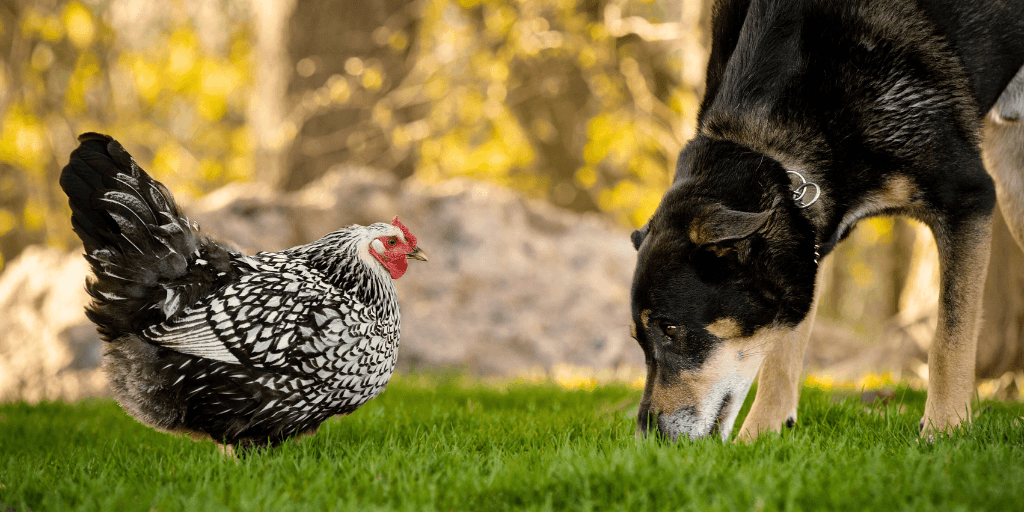
Chickens can live on the same property as dogs, cats, and other pets, but that does not mean every animal should eventually share the yard without a barrier. The safest goal is simple: your chickens can eat, forage, rest, and return to the coop without being chased or frightened.
Some dogs learn to ignore chickens after careful training. Some cats show little interest in full-size hens. Other pets remain a real risk no matter how many calm meetings you arrange. A strong fence between them can be a successful long-term setup, not a failed introduction.
The process should move at the pace of the most excitable animal. If a dog is staring, stalking, lunging, or trying to chase, you are too close or moving too quickly. Do not remove a safety barrier just to see what happens.
Can Dogs and Cats Safely Live With Chickens?
Yes, many households manage chickens alongside dogs and cats, but the level of contact varies. Some animals can eventually be near adult chickens under supervision. Others should always remain physically separated.
Dogs deserve the most caution because predation is part of normal canine behavior. Veterinary behavior references describe the sequence as watching or stalking, chasing, biting, and killing. Unlike fear-based aggression, predatory behavior can be quiet and may occur without growling, barking, or another dramatic warning.
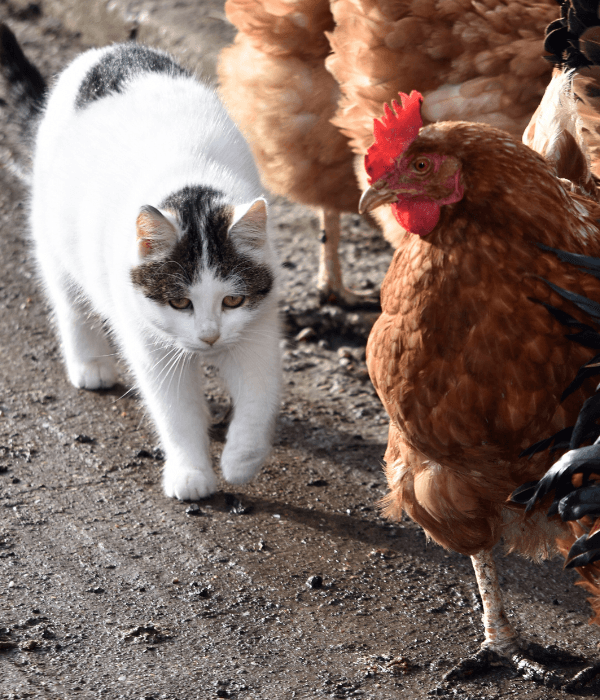
Cats are also predators. Many house cats ignore mature standard-size hens, but chicks, bantams, injured birds, and birds trapped in a corner are more vulnerable. Penn State specifically includes domestic dogs and cats with predatory instincts among causes of poultry wounds.
 Share on Pinterest
The Most Important Rule: Keep a Chicken-Only Safe Area
Before any introduction, your flock needs a coop and run that the other pet cannot enter. The chickens should never depend on your dog being obedient or your cat being uninterested for their basic safety.
Use strong predator-resistant material where pets or wildlife can reach through. Secure doors and latches, cover vulnerable openings, and inspect the run for gaps at ground level. A dog should not be able to push through a loose panel, dig under the fence, or grab a bird through large mesh.
Inside the run, give chickens places to move away from the side facing the pet. Covered sections, perches at sensible heights, solid visual barriers, shrubs outside the run, or panels that break the line of sight can help nervous birds settle.
Keep actual run doors secure. “Escape routes” should not mean leaving multiple exits open where a frightened chicken can run into the yard with the dog.
Before Introducing a Dog, Assess Its Chase and Prey Drive
Do not decide that a dog is safe based only on breed. Livestock guardian breeds may have useful tendencies, but individuals still vary. Herding breeds can be strongly motivated to control movement, and hunting or sighthound breeds may be strongly motivated to chase. Training, history, age, arousal level, and individual temperament all matter.
Look at what your dog already does around squirrels, rabbits, outdoor cats, birds, or fast-moving toys. A history of hard fixation, stalking, repeated chasing, grabbing small animals, or ignoring recall when excited deserves serious caution.
Basic leash control should be in place before you work near chickens. Useful cues include a reliable response to the dog’s name, “leave it,” “come,” “stay,” or a simple turn-away cue that lets you leave the area without a struggle.
10 Steps to Introduce a Dog to Chickens Safely
1. Start With Chickens Behind a Secure Barrier
For the first sessions, the chickens stay inside their secure run. Keep the dog on a leash outside. There is no need for nose-to-beak contact and no benefit in letting a dog “meet” a loose chicken on day one.
2. Begin Far Enough Away for the Dog to Stay Calm
Distance is one of your best safety tools. Start where the dog can notice the flock but can still take treats, respond to you, and move away willingly. If the dog freezes and stares, pulls hard toward the run, or cannot respond to familiar cues, increase the distance.
3. Reward Disengagement, Not Fixation
Reward the behavior you want to see: looking at the chickens and then looking back at you, walking past without pulling, sniffing the ground, sitting calmly, or choosing to turn away.
Do not stand next to the run while the dog stares intensely for several minutes. Watching, stalking, and chasing are parts of the predatory sequence. Repeated rehearsal can make chase behavior harder to manage.
4. Keep Early Sessions Uneventful
There is no universal five-minute or ten-minute rule. End while the dog is still responding well rather than waiting for excitement to build. A calm walk past the run can be more useful than a long session spent staring through the fence.
5. Reduce Distance Gradually
Move closer only after repeated calm sessions at the current distance. Progress is based on behavior, not the number of days on a calendar.
If the dog becomes harder to redirect as you approach, move farther away again. That is useful information, not a reason to force the next step.
6. Practice Normal Yard Activities Near the Run
Walk past the run, stop to do a chore, fill a waterer, or sit nearby while the dog remains leashed. The aim is to make chickens part of the background rather than the center of every training session.
Our guide to chicken fencing can help if your current setup allows too much direct access between the dog and the flock.
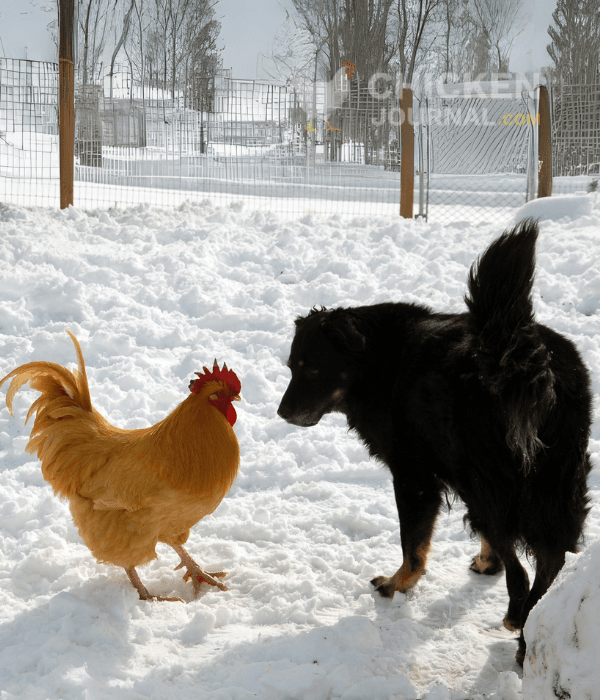
7. Stop Immediately if Stalking or Chasing Appears
End the session or create more distance if you see persistent hard staring, freezing, creeping or stalking, lunging, frantic pulling, sudden pursuit, or repeated attempts to get around the barrier.
Predatory behavior may be silent. Do not wait for a growl before taking it seriously.
8. Use a Leash or Long Line for Any Closer Work
If you eventually work in a larger shared area, keep physical control of the dog. The chickens should still have immediate access to a secure area the dog cannot enter.
Do not hold a chicken in your arms and bring it to the dog’s face. A flapping bird can suddenly increase arousal, and your hands are then directly in the middle of the interaction.
 Share on Pinterest
9. Do Not Rush Toward Unsupervised Access
A dog that has behaved well for several sessions has shown that it can behave well under those particular conditions. That does not prove it will make the same choice when a hen suddenly runs, squawks, flaps, or flies over a low barrier.
Continued supervision may be the right long-term plan. For some dogs, separation whenever you are not present is the safer choice for life.
10. Accept Permanent Separation When Needed
Some dogs should never be loose with poultry. Merck’s veterinary behavior guidance notes that predatory behavior can be dangerous, may occur without warning, and can have a guarded to poor prognosis when it is directed toward inappropriate targets.
If your dog has killed or seriously injured poultry, repeatedly stalks the flock, breaks through barriers, or becomes impossible to redirect around chickens, talk with your veterinarian or a qualified veterinary behavior professional. A secure physical separation may remain necessary even with training.
Signs a Dog Is Not Ready to Be Closer
- Hard, prolonged staring at one chicken
- Freezing when a bird moves
- Crouching, creeping, or stalking
- Lunging or repeated pulling toward the run
- Trying to circle behind or get around the barrier
- Sudden chasing when a chicken runs or flaps
- Ignoring cues that are normally reliable
- Grabbing, pinning, mouthing, or biting a bird
Raised hackles, barking, or tail position can provide context, but none of those signs alone tells you whether a dog is safe. Focus more on fixation, stalking, chasing, and whether the dog can disengage.
Watch the Chickens Too
A training session is not successful if the dog looks calm but the hens are panicking on the other side of the fence. Chickens need enough distance to continue normal behavior.
Signs that the flock may be too stressed include repeated alarm calls, frantic escape attempts, piling into corners, freezing or crouching, hiding whenever the pet appears, refusing to use part of the run, reduced feeding, or a persistent drop in laying after repeated stressful exposure.
If the flock cannot settle, add distance or block the view. Our guide to stress in chickens covers other causes and signs worth checking.
Introducing Chickens to Cats
 Share on Pinterest
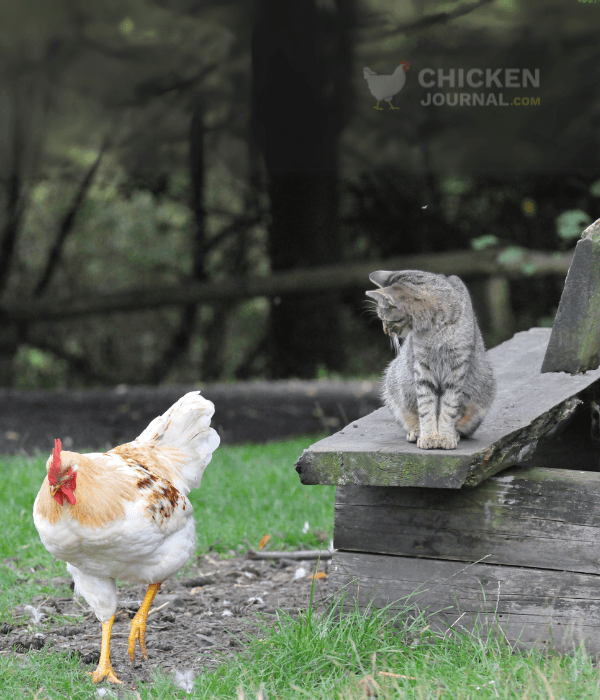
Adult standard-size hens and a familiar house cat may eventually ignore one another, but do not treat that as guaranteed. Start with the chickens securely enclosed and watch the cat’s behavior from outside the run.
Persistent stalking, crouching close to the ground, rushing the fence, pawing through mesh, or repeated attempts to enter the run mean you need stronger separation.
Never use a calm relationship with full-size hens as evidence that the cat is safe with chicks. Size and movement matter. Chicks, young bantams, injured birds, and weak chickens should remain physically protected from cats.
Chicks and Bantams Need Extra Protection
Young chicks should not be used for close pet introductions. Keep the brooder or chick enclosure where dogs and cats cannot enter, knock it over, reach through the sides, or sit on top of it.
There is no magic age such as six or eight weeks when a juvenile chicken suddenly becomes safe around another pet. Body size, feathering, the pet’s behavior, enclosure security, and the individual birds all matter.
Bantams deserve similar caution because their smaller size can make them more vulnerable than a large standard hen.
What About Rabbits, Goats, and Other Pets?
Not every mixed-species problem is predation. Larger animals can accidentally step on or kick a chicken, and feed competition can create new problems even when the animals appear friendly.
Keep species-specific feed separate. Chicken feed is formulated for chickens, and dog, cat, rabbit, goat, or other livestock rations should not become the flock’s regular diet. Separate feeding also reduces crowding and guarding behavior around bowls.
Provide each species with its own sleeping and retreat area. Chickens still need a predator-secure coop at night even when the other animals sharing the property have never bothered them.
What to Do if a Dog or Cat Attacks a Chicken
Separate the animals immediately and move the injured chicken somewhere quiet and secure. Dog and cat attacks can cause punctures, crushing injuries, internal trauma, and shock that are not obvious under feathers.
If there is active bleeding, gentle direct pressure with clean gauze or cloth can help while you arrange care. Contact a veterinarian promptly for puncture wounds, deep tears, breathing difficulty, inability to stand, severe lameness, eye injury, wounds over the chest or abdomen, ongoing bleeding, marked weakness, or any bird that seems shocked after an attack.
Keep an injured bird separated from flock mates while open wounds are visible because other chickens may peck at blood or damaged tissue. Penn State notes that poultry wounds can become infected and that flock mates may worsen an exposed wound.
Common Pet-Introduction Mistakes
- Testing the dog with a loose chicken: A good training plan does not require risking a bird to see what the dog will do.
- Assuming breed guarantees safety: Individual behavior matters more than a breed label.
- Waiting for growling: Predatory behavior may be silent.
- Allowing repeated chasing: Chasing can be rewarding to the dog and become harder to control.
- Punishing the dog around chickens: Veterinary behavior guidance favors controlled exposure and teaching an alternative response rather than yelling or harsh punishment.
- Using chicks for introductions: Small, fast-moving birds are especially vulnerable.
- Following a fixed timeline: Two weeks or four weeks means nothing if the behavior is not ready.
- Leaving food bowls together: Separate species-specific feed and reduce competition.
- Assuming supervision is temporary: Some dog-and-chicken combinations require lifelong supervision or separation.
Frequently Asked Questions
Can dogs and chickens live together safely?
Some dogs can learn to remain calm around chickens, but not every dog is safe for loose contact. Predatory behavior can be quiet and sudden. A secure chicken-only area and continued supervision may be necessary for life.
How long does it take to introduce a dog to chickens?
There is no reliable fixed timeline. Progress should depend on the dog’s behavior. Move closer only when the dog can notice the chickens, remain relaxed, respond to cues, and disengage without pulling, stalking, or chasing.
Which dog breeds are safest with chickens?
No breed is automatically chicken-safe. Livestock guardian breeds may have useful tendencies, while herding and hunting breeds may have stronger chase-related behaviors, but individual temperament, history, training, and management matter more than the breed name alone.
Can cats live with chickens?
Many cats ignore mature standard-size hens, but cats are still predators. Chicks, bantams, injured birds, and cornered chickens are more vulnerable. Start with a secure barrier and do not assume previous calm behavior guarantees future safety.
What are warning signs that a dog may chase a chicken?
Watch for hard staring, freezing, crouching or stalking, lunging, sudden pursuit, frantic pulling toward the run, attempts to get around the barrier, and loss of response to normally reliable cues. Predatory behavior may occur without growling.
Should chickens sleep separately from dogs and cats?
Yes. Chickens should have their own secure coop at night. A dog or cat that behaves calmly during the day should not have unsupervised access to sleeping chickens simply because previous interactions went well.
What should I do if my dog has already attacked a chicken?
Separate the animals and assess the chicken for punctures, bleeding, breathing problems, weakness, lameness, or hidden trauma. Seek veterinary care for significant wounds or abnormal behavior. Future access should be tightly managed, and permanent separation may be the safest option.
Final Thoughts
A good introduction is not measured by whether your dog, cat, and chickens eventually stand together for a photograph. It is measured by whether every animal can live without being chased, cornered, or chronically stressed.
For some homes, that means supervised shared yard time. For others, it means a dog calmly walking past a secure chicken run and never entering it. Both can be successful arrangements.
Use barriers first, reduce distance slowly, reward calm behavior, and take stalking or chasing seriously. If you are unsure about a dog’s predatory behavior, keeping the flock physically separated is the safer choice while you get professional guidance.
Sources
- Merck Veterinary Manual: Behavior Problems of Dogs
- VCA Animal Hospitals: Dog Behavior Problems – Chase Behaviors
- VCA Animal Hospitals: Behavior Management and Pet Selection
- Penn State Extension: Wounds in Poultry
- Penn State Extension: Small Scale Poultry Housing
- Merck Veterinary Manual: Behavior of Poultry
