

It is easy to give your chickens more room, until you remember what else lives in the yard. Loose dogs, foxes, raccoons, coyotes and other ground predators can be surprisingly quick to take an interest in a flock scratching through grass.
It’s not necessary to have a permanent fenced compound of your entire backyard. An electric chicken fence gives you an additional layer of protection.
Poultry netting is especially helpful when moving your birds onto fresh ground, opening up a temporary grazing area, or protecting a section of pasture for a few days at a time.
The fence itself is only part of the system, though. Some of the products below are netting only. Others are energizers.
You still need to properly match the net, charger, grounding, fence length, vegetation, and soil conditions. A great net connected to an undersized energizer can be a disappointment, and so can a strong charger connected to a fence buried in weeds.
The 10 picks below cover both sides of the setup: poultry netting for the boundary and energizers to power compatible fences. We’re not just calling every product “the best.” It’s to help you see which one really suits your coop, run, pasture and power situation.
Quick Comparison: Best Electric Chicken Fences and Energizers
| Product | Type | Best Use | Power Included? | Amazon |
|---|---|---|---|---|
| RentACoop Electric Poultry Netting | 48″ × 168′ netting | Portable poultry boundary | No | Check |
| Premier 1 PoultryNet Plus 12/48/3 | 48″ netting with closer posts | Better support and less sag | No | Check |
| Premier 1 PoultryNet 12/48/3 | 48″ × 164′ netting | Long established poultry fencing | No | Check |
| Starkline Standard Poultry Netting | 42″ × 164′ netting | Easier-to-handle poultry net | No | Check |
| VEVOR Electric Poultry Netting | 48″ × 168′ netting | Budget long-perimeter setup | No | Check |
| Patriot PE2 Energizer | 110V AC, 0.1 J output | Small clean fence near an outlet | Energizer only | Check |
| Gallagher S6 Solar Energizer | Solar, 0.06 J stored | Very small low-load portable fence | Energizer only | Check |
| Gallagher S12 Solar Energizer | Solar, 0.12 J stored | Small portable solar fence | Energizer only | Check |
| Briidea 2-Mile Energizer | 120V AC, 0.1 J | Budget small-fence power | Energizer only | Check |
| My Animal Command MAC3ML Solar Energizer | Solar, 0.25 J output | Portable poultry-net and small livestock fencing | Energizer only | Check |
Electric-fence performance depends on the whole system. Before pairing any net and charger, check the current manufacturer instructions for minimum joules, grounding, fence length, and vegetation load.
10 Best Electric Chicken Fence, Poultry Netting, and Energizer Options
1. RentACoop Electric Poultry Netting — Best Overall Portable Poultry Netting
As an Amazon Associate I earn from qualifying purchases. This article contains affiliate links. If you buy through these links, I may earn a commission at no extra cost to you.
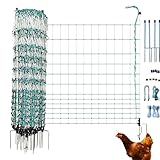
RentACoop makes sense when you want one long movable boundary around your flock without piecing together several short fence sections. The 48-inch by 168-foot size gives you enough length to create a useful grazing area beside the coop or move your birds around the yard as grass gets worn down.
This is poultry netting, not a complete powered kit. You still need the right energizer, grounding equipment, and a fence tester. That distinction is easy to miss when shopping online, and it matters. A long roll of netting needs enough energy behind it to keep the conductive strands working the way they should.
The included support pieces are helpful if your yard is not perfectly flat. Corners, dips, and soft soil are where portable netting tends to lean or sag, so guy lines and extra support can save you from constantly resetting posts.
- Features: 48″ × 168′ poultry net; FRP posts; double-spike support; repair kit and warning sign.
- Pros: Poultry-specific design, long perimeter, easy to relocate.
- Cons: Energizer, tester, grounding equipment, and gate accessories are separate.
- Best for: A backyard flock that needs a full-size movable electric-net perimeter.
Check RentACoop Electric Poultry Netting on Amazon
2. Premier 1 PoultryNet Plus 12/48/3 — Best When Sagging Drives You Crazy
As an Amazon Associate I earn from qualifying purchases. This article contains affiliate links. If you buy through these links, I may earn a commission at no extra cost to you.
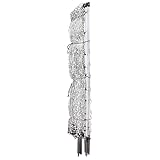
Anyone who has moved a long roll of poultry netting knows the annoying part: the fence can look great at the posts and droop badly in between them. Premier’s PoultryNet Plus addresses that with closer post spacing than the standard version.
That extra support is especially useful if your fence needs to bend around a garden, follow uneven ground, or stay tidy after repeated moves. The 48-inch height also gives you more physical barrier than a shorter net while still keeping the whole setup portable.
You still need to keep grass away from the live strands. Even a well-supported fence can lose useful voltage when green vegetation is constantly touching it.
- Features: 48-inch height; 3-inch vertical spacing; closer post spacing than standard PoultryNet.
- Pros: Less sag, better support through curves, good for regularly moved paddocks.
- Cons: More expensive than basic netting; energizer and ground system are separate.
- Best for: A portable setup where neat tension and extra post support are worth the added cost.
Check Premier 1 PoultryNet Plus on Amazon
3. Premier 1 PoultryNet 12/48/3 — Best Established 48-Inch Poultry Net

As an Amazon Associate I earn from qualifying purchases. This article contains affiliate links. If you buy through these links, I may earn a commission at no extra cost to you.
If you want Premier’s poultry-net design but do not need the closer post spacing of the Plus model, the standard 12/48/3 is the more straightforward option. The 164-foot roll is 48 inches high, with 12 horizontal strands and 11 conductive strands.
The post spacing is wider than on the Plus model, so corners and low spots may need more attention. On flatter ground, though, the standard version can give you plenty of usable perimeter without paying extra for more posts.
Premier’s own troubleshooting guidance is useful once the fence is running. If voltage drops below about 3,000 volts on the net, the company recommends finding the cause rather than assuming the fence is still performing normally. Treat that as Premier-specific guidance rather than a universal target for every brand.
- Features: 48″ × 164′; 12 horizontal strands; 11 conductive; 3-inch vertical spacing.
- Pros: Long established design, full-size roll, good height for poultry.
- Cons: Wider post spacing can mean extra support is needed at corners and dips.
- Best for: A medium or large portable poultry area on reasonably manageable ground.
Check Premier 1 PoultryNet on Amazon
4. Starkline Standard Electric Poultry Netting — Best 42-Inch Net for Easier Handling

As an Amazon Associate I earn from qualifying purchases. This article contains affiliate links. If you buy through these links, I may earn a commission at no extra cost to you.
A taller net is not automatically better for every yard. If you move fencing often, a 42-inch net can be easier to carry, unroll, and reset than a heavier 48-inch model.
Starkline’s 164-foot poultry net comes with 15 preinstalled posts, 11 horizontal strands, and 10 conductive strands. The 3-inch vertical spacing near the lower area keeps the mesh fairly tight where your chickens and ground predators are most likely to meet it.
The useful part of Starkline’s documentation is the energizer guidance. The company recommends at least 0.25 joules for its poultry netting and advises using more power when vegetation is likely to touch the fence. That gives you a real number to work from instead of guessing.
- Features: 42″ × 164′; 15 posts; 3-inch vertical spacing; 10 conductive strands.
- Pros: Easier to move than taller netting, clear power guidance, poultry-specific layout.
- Cons: Lower height; standard PVC posts may need extra support on rough ground.
- Best for: A portable run where easy handling matters more than maximum fence height.
Check Starkline Poultry Netting on Amazon
5. VEVOR Electric Poultry Netting — Best Budget Long-Perimeter Option

As an Amazon Associate I earn from qualifying purchases. This article contains affiliate links. If you buy through these links, I may earn a commission at no extra cost to you.
VEVOR is the value pick if the main thing you need is a lot of fence length without stepping up to a premium-priced net. The 48-inch by 168-foot size gives you a generous perimeter, and the double-spike posts help when the ground is soft enough to take them properly.
It still needs a compatible energizer and grounding system, so do not budget for the net alone. Before buying a charger, check the current VEVOR instructions and compare the required output with your total fence length and the amount of grass that will touch the lower strands.
This is a sensible choice for a fairly straightforward yard or pasture. If your fence route crosses steep dips, rocky soil, or lots of tight corners, stronger post support may matter more to you than saving on the initial price.
- Features: 48″ × 168′; fiberglass posts; double-spike stakes; repair kit and warning sign.
- Pros: Long perimeter and useful height at a value-oriented price point.
- Cons: Energizer is separate; difficult terrain may need extra support.
- Best for: A larger poultry area where cost and fence length are your main priorities.
Check VEVOR Electric Poultry Netting on Amazon
6. Patriot PE2 Electric Fence Energizer — Best Small Plug-In Energizer

As an Amazon Associate I earn from qualifying purchases. This article contains affiliate links. If you buy through these links, I may earn a commission at no extra cost to you.
When your chicken run is close to an outlet, plug-in power is usually less fussy than solar. You do not have to think about panel angle, cloudy weather, or battery charge every time you move the fence.
Patriot rates the PE2 at 0.1 joule output. That can work for a small, clean fence, but the advertised “2 mile” figure should not be read as two miles of poultry netting. Multi-strand netting creates much more electrical load than a clean single wire.
If the net manufacturer calls for 0.25 joules or more, step up to a stronger charger. The PE2 is useful when the fence load actually matches its output—not simply because it is convenient to plug in.
- Features: 110V AC; 0.1 J output; low-impedance design; LED indicator.
- Pros: Simple mains power, no solar panel or separate fence battery to manage.
- Cons: Requires an outlet and shelter; too small for poultry nets that demand higher output.
- Best for: A small clean fence near mains power when the fence manufacturer accepts this output.
Check Patriot PE2 Energizer on Amazon
7. Gallagher S6 Solar Electric Fence Charger — Best for Very Small Low-Load Fences
As an Amazon Associate I earn from qualifying purchases. This article contains affiliate links. If you buy through these links, I may earn a commission at no extra cost to you.
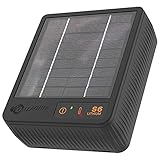
The S6 is the sort of solar charger that appeals when your chicken area is well away from the house. It is compact, self-contained, and easy to move along with a small portable fence.
Its size is also the reason to be cautious. Gallagher lists 0.06 joules of stored energy. That is well below the 0.25-joule minimum Starkline currently recommends for its poultry netting, so the S6 should not be treated as a universal charger for full-size poultry nets.
Use it only where the fence manufacturer’s required output fits within the S6 specification. For a short, clean, low-load fence, the portability can be useful. For a long net in tall grass, choose more power.
- Features: Solar power; internal lithium battery; 0.06 J stored energy; compact portable design.
- Pros: No outlet needed and easy to relocate.
- Cons: Too small for netting systems that require 0.25 J or more.
- Best for: A very small, low-load portable fence with compatible power requirements.
Check Gallagher S6 Solar Energizer on Amazon
8. Gallagher S12 Solar Electric Fence Charger — Best Step-Up Compact Solar Option
As an Amazon Associate I earn from qualifying purchases. This article contains affiliate links. If you buy through these links, I may earn a commission at no extra cost to you.
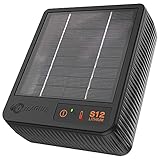
The S12 gives you more breathing room than the S6 without turning into a bulky fence charger. Gallagher lists 0.12 joules of stored energy and a built-in lithium battery, so it still fits the portable-fence idea well.
That extra capacity is useful, but it does not remove the need to size the charger properly. A poultry net that calls for 0.25 joules still needs more than the S12 can provide. Distance claims are not a substitute for checking the actual joule requirement of your net.
This model is a better fit when your fence is small, the lower strands stay clear of vegetation, and you need solar because the run is too far from mains power.
- Features: Solar power; lithium battery; 0.12 J stored energy; portable post-mounted design.
- Pros: More capacity than the S6 while remaining easy to move.
- Cons: Still below the minimum output specified by some poultry-net manufacturers.
- Best for: A small portable solar fence whose required output falls within the S12 specification.
Check Gallagher S12 Solar Energizer on Amazon
9. Briidea 2-Mile Electric Fence Energizer — Best Budget AC Energizer
As an Amazon Associate I earn from qualifying purchases. This article contains affiliate links. If you buy through these links, I may earn a commission at no extra cost to you.
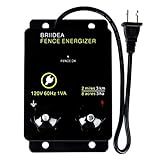
Briidea’s 2-mile unit is another simple plug-in option if your fence runs close to the house, barn, or another safe power source. The manufacturer lists a 120-volt supply and a 0.1-joule rating.
Again, do not let the “2-mile” name do the sizing for you. Poultry netting can load an energizer much more heavily than a clean single strand. If your net asks for more than 0.1 joule, this charger is not the right match no matter what the distance label says.
One useful detail is the manufacturer’s reminder about warning signs in places where people can approach the fence. In a backyard, that matters. Children, visitors, delivery workers, or neighbors may not realize a lightweight-looking mesh is electrified.
- Features: 120V AC; 0.1 J; separate ground and fence terminals.
- Pros: Straightforward plug-in operation at a lower price point.
- Cons: Not suitable for nets that require more output; depends on nearby mains power.
- Best for: A small compatible fence close to an electrical outlet.
Check Briidea 2-Mile Energizer on Amazon
10. My Animal Command MAC3ML Solar Electric Fence Energizer — Best 0.25-Joule Solar Replacement

As an Amazon Associate I earn from qualifying purchases. This article contains affiliate links. If you buy through these links, I may earn a commission at no extra cost to you.
If your chicken area is too far from an outlet and you want a solar charger with more usable output than the tiny 0.06- or 0.12-joule units above, the MAC3ML is a much stronger fit. My Animal Command rates it at 0.25 joules with a 9–11 kV pulse and a built-in 6W solar panel.
That 0.25-joule rating matters because it lines up with Starkline’s current minimum recommendation for its poultry netting. It still does not mean every long or heavily overgrown fence will perform perfectly, but it gives you a more realistic starting point for powering a poultry-net setup than an undersized solar charger.
The kit includes a 19-inch earthing rod, crocodile-clip leads, a wall adapter for manual charging, and a rechargeable lithium-ion battery. For a remote run or movable paddock, that makes it easier to keep the whole power side of your fence together instead of assembling every piece separately.
- Features: 0.25 J output; 9–11 kV pulse; 6W solar panel; rechargeable lithium-ion battery; earthing rod and connector leads included.
- Pros: Better matched to poultry netting that calls for 0.25 J; portable; solar powered; can also be manually charged.
- Cons: Grounding may still need upgrading for longer fence runs or difficult soil; total fence performance still depends on vegetation and setup.
- Best for: A remote poultry-net or small livestock fence where you want a solar energizer that starts at 0.25 joules rather than a very low-output charger.
Check My Animal Command MAC3ML on Amazon
What an Electric Chicken Fence Actually Does
An electric poultry fence is not a wall. It works by combining a visible barrier with a short electrical pulse. A compatible low-impedance energizer sends that pulse through the conductive strands.
If an animal touches the live fence and completes the circuit through the ground, it gets a short shock and learns that the boundary is a good thing to avoid.
That explains why the whole setup matters. The net, energizer, grounding, vegetation, and fence condition all work together. If one part is weak, the fence may still look fine while delivering much less of a deterrent than you expect.
Electric netting is best treated as an extra protection layer around your flock. Your chickens still need a secure coop at night. ChickenJournal’s guide to chicken predators explains why different predators need different defenses.
Electric Poultry Netting vs. Hardware Cloth
These two materials are often compared, but they solve different problems.
Electric poultry netting is useful when you need a boundary that moves. You can shift it onto fresh grass, reshape a paddock, or take it down when you are done with a section of yard.
Hardware cloth is the better choice for a permanent predator-resistant coop or run because it is a rigid physical barrier and does not depend on electricity.
Many backyard setups benefit from both: hardware cloth around the permanent coop and run, with electric netting farther out when the flock is grazing during the day.
How Much Energizer Power Do You Need?
This is where many first setups go wrong. The energizer box may advertise “2 miles,” “5 miles,” or more, but those numbers are usually based on favorable fencing conditions. Poultry netting has many conductive strands, so it creates a heavier electrical load than one clean wire.
Start with the net manufacturer’s minimum requirement. Starkline, for example, currently recommends at least 0.25 joules for its poultry netting and advises using more power when vegetation will touch the fence.
That is why the compact Gallagher S6 and S12 chargers above are described for lighter compatible fences rather than full-size poultry nets that demand more output.
Grass Is One of the Biggest Voltage Thieves
A fence can be standing perfectly straight and still be weak. The usual culprit is often right at ground level.
When green grass, weeds, or low branches rest against live strands, they drain energy toward the soil. A few blades may not cause a dramatic problem, but a long fence line buried in summer growth can pull the voltage down enough to matter.
Before blaming the charger, walk the perimeter. Trim grass, lift strands off the soil, remove fallen branches, and make sure conductive wires are not touching metal stakes or other grounded objects.
If you rotate your birds through lawn or pasture, mowing the new fence line before you move the net can save a lot of troubleshooting later.
How to Set Up Electric Poultry Netting
- Choose the route first. Avoid deep dips, standing water, sharp corners, and places where thick weeds will constantly press against the net.
- Clear the fence line. Short grass gives you a much easier starting point than trying to power a net through heavy vegetation.
- Unroll the net before setting posts. This makes twists and tangles easier to spot.
- Set the posts and support the corners. Add guy lines or extra support wherever the net changes direction or crosses uneven ground.
- Install the energizer and grounding exactly as the manufacturer instructs. Never improvise by connecting fencing directly to household mains electricity.
- Connect the net with the correct leads. Use compatible fence connectors rather than temporary household wiring.
- Test the fence before turning birds out. A fence tester tells you far more than trying to judge the system by sound or spark.
- Walk the perimeter one more time. Look for sagging conductors, vegetation contact, broken strands, loose corners, and metal contact.
- Recheck after storms and every move. Portable fencing changes every time you relocate it, so do not assume yesterday’s voltage is today’s voltage.
If your flock moves regularly, a portable chicken coop or tractor can pair nicely with a temporary electric perimeter.
How to Check the Fence Voltage
Do not wait for a predator problem before checking whether the fence is working. Test after installation, after moving the net, and whenever the grass gets tall around the bottom strands.
Premier’s PoultryNet troubleshooting guidance treats roughly 3,000 volts at the net as a point where low voltage needs attention. If the energizer tests strongly but the fence does not, split the fence into sections and look for shorts, wet vegetation, branches, soil contact, or conductive strands touching metal.
Use the voltage recommendation for your own fence brand. The aim is not to chase the highest number possible; it is to keep the system within the working range the manufacturer expects.
Solar or Plug-In Energizer?
If the run is close to the coop and you have a safe outlet nearby, plug-in power is usually the easiest choice. You get steady power without thinking about panel position, battery condition, or several cloudy days in a row.
Solar becomes more attractive when your flock is far from the house or you move the fence regularly. The charger can travel with the net, which works well for rotational grazing.
Neither power source is automatically better. The energizer still has to be strong enough for the net and conditions you are actually using.
Do Not Ignore the Grounding System
Grounding is easy to overlook because the ground rod is not the part of the fence you see every day. But the circuit depends on it.
If the ground system is poor, the shock at the fence can be much weaker than expected. Dry soil can make conventional grounding more difficult, and some systems use positive/negative designs to deal with challenging conditions.
Follow the instructions for your exact energizer and net. Grounding is not a place to copy a random setup just because it worked for someone else’s soil.
Electric Fence Safety Around Chickens and People
Only use a purpose-built electric fence energizer that sends intermittent pulses. Never connect poultry fencing directly to household mains electricity.
Warning signs are also a good idea anywhere people may approach the fence. In a backyard, that could mean children, visitors, delivery workers, neighbors, or anyone who does not know the mesh is live.
Young chicks need extra attention. Mesh that easily contains an adult hen may not contain a tiny chick, and loose netting can create an entanglement risk. Follow the manufacturer’s age or size guidance and supervise young birds when they first use the area.
Portable nets can also shift in bad weather. If storms are common where you live, see ChickenJournal’s guide to keeping chickens safe in high winds and storms.
Can Electric Netting Replace Locking Chickens Up at Night?
No. A powered net can discourage many ground predators, but it still depends on electricity, grounding, vegetation control, and an intact fence line.
A fallen branch, dead battery, tripped power source, damaged strand, or open gate can change the situation very quickly. Your flock should still sleep inside a secure coop with strong doors, reliable latches, and predator-resistant wire where needed.
Think of electric netting as an outer layer around your chickens, not the only thing standing between them and a nighttime predator.
How to Choose the Right Electric Chicken Fence
Measure the real route. Do not measure only the width and length of the yard. Corners around trees, sheds, gardens, and gates can use up a 164-foot roll faster than expected.
Decide how much height you need. A 48-inch net gives you more physical barrier than a 42-inch model, but it is also a little more to carry and support.
Look at your ground. Soft soil, hard clay, rocky patches, hills, and dips all affect how easily posts stay upright. Extra support at corners can matter more than the brand name on the net.
Think about summer grass now, not later. If your pasture grows fast, plan on trimming the fence line and choose enough energizer capacity to handle realistic conditions.
Choose power based on how you use the fence. A permanent run near the house may be easiest with plug-in power. A paddock that moves every week may be much easier with solar.
Keep the nighttime setup separate in your mind. Electric netting is not a replacement for secure housing. If you are also upgrading the permanent boundary, ChickenJournal’s chicken fencing ideas guide covers other options.
Final Verdict
For a long poultry-specific net that you can move around the yard, the RentACoop Electric Poultry Netting is the most balanced all-around choice in this list. If keeping the net tight and supported is more important than price, the Premier 1 PoultryNet Plus is better suited to that job.
If your fence is small and close to mains power, the Patriot PE2 keeps the power side simple—as long as your fence’s required output fits its 0.1-joule rating. For remote fencing, solar is convenient, but only after you match the charger’s output to the net. The Gallagher S12 is a useful compact option for lighter compatible loads, not a substitute for a higher-output charger when the net requires more.
The best system is the one you can keep upright, powered, clear of weeds, and matched to the real predator pressure around your flock.
FAQs About Electric Chicken Fences
Do electric poultry nets need an energizer?
Yes. The net only becomes an electric fence when it is connected to a compatible fence energizer and grounding system. Many poultry nets are sold without the energizer, so check the package contents before buying.
How many volts should an electric chicken fence have?
Use the recommendation for your fence brand. Premier’s PoultryNet troubleshooting guidance treats voltage below about 3,000 volts at the net as a sign that the system needs attention. Other brands may specify different working ranges.
Will electric poultry netting keep predators out?
It can strongly discourage many ground predators when it is properly powered and maintained, but it is not an absolute guarantee. Low voltage, poor grounding, heavy vegetation, damaged netting, power loss, or an open gate can reduce protection.
Can grass touching the fence make it weaker?
Yes. Green vegetation touching live strands can drain energy toward the soil and reduce fence voltage. Keep the fence line trimmed and remove branches or conductive strands resting on the ground or touching metal objects.
Is solar or plug-in power better for poultry netting?
Plug-in power is convenient for a permanent fence near an outlet. Solar is useful for remote or frequently moved fencing. The better choice is the one that supplies enough output for your specific net and conditions.
Can baby chicks use electric poultry netting?
Check the manufacturer’s age and size guidance. Very small chicks may fit through mesh openings or become tangled in loose netting, so young birds need closer supervision.
Can electric netting replace a secure coop at night?
No. Electric netting is an extra predator-deterrent layer, not a replacement for a secure nighttime coop. Power loss, vegetation, damage, poor grounding, or an open gate can reduce fence effectiveness.
