

An automatic chicken feeder sounds like one of those purchases that should make life easier immediately.
Sometimes it does.
But a feeder that holds 40 or 50 pounds of feed can still be a bad fit if rain gets into the openings, rats can reach the feed at night, or smaller hens are afraid to use the treadle.
That is why I would not choose one only by capacity.
The feeder has to work with your flock, your coop layout, your weather, and the pest pressure around your yard. A simple gravity feeder can be perfect for one setup. A treadle feeder can be worth the extra money somewhere else.
Utah State University Extension recommends keeping poultry feed dry, fresh, and protected from rodents and wild birds. It also notes that bucket-style feeders can hold several days of feed but still need regular cleaning so old feed does not sit inside and become stale or moldy.
If you are comparing regular feeder styles too, see our best chicken feeders guide. For everyday feeding basics, our chicken feeding guide is also useful.
As an Amazon Associate, Chicken Journal earns from qualifying purchases.
Quick Comparison
| Feeder | Type | Approx. capacity | Where it fits best | Amazon |
|---|---|---|---|---|
| OverEZ Chicken Feeder | Gravity / port | 50 lb | Larger backyard flocks | Check |
| Grandpa’s Feeders Automatic Feeder | Treadle | 20 lb | Rodent-control priority | Check |
| RentACoop Metal Treadle Feeder | Treadle | 25 lb | Outdoor treadle setup | Check |
| Omlet No-Waste Feeder | Port feeder | 12 lb | Small to medium flock | Check |
| Royal Rooster Automatic Feeder | Gravity / hanging | About 7 lb | Small flock | Check |
| Suplklz DIY Feeder Port Kit | DIY gravity ports | Depends on container | Custom bucket feeder | Check |
| ZINZINULER Feeder & Waterer Set | Port feeder set | About 16 lb feeder | All-in-one small flock setup | Check |
| JASDEGO 4-Port Metal Automatic Feeder | Metal gravity / port | 25 lb | Weather-oriented medium flock feeder | Check |
| Essilnn 6-Port DIY Kit | DIY gravity ports | Depends on container | Multi-port DIY feeder | Check |
| Terminalia Hanging Poultry Feeder | Hanging gravity | Compact | Simple hanging setup | Check |
1. OverEZ 50-lb Chicken Feeder

This site runs ads and contains Amazon affiliate links that help support my work at no extra cost to you, and I truly appreciate your support!
If your main problem is refilling feeders every day, the OverEZ is the obvious place to start.
It holds about 50 pounds of feed and uses three covered feeding ports rather than an open tray. That gives you much more storage without leaving a wide ring of feed exposed to rain and scratching.
I would use this for a medium or larger backyard flock where the feeder can stay in one place. Once it is full, it is heavy enough that you will not want to move it around every morning.
The ports help reduce feed flicking, but I would not call this rat-proof. A determined rodent can still investigate openings and spilled feed around the base.
If you keep it outdoors, make sure the feeder sits level and check the feed after heavy wind-driven rain. “Rainproof” and “nothing can ever get wet” are not the same thing.
Features: 50-lb hopper, three covered feeding ports, large refill opening, outdoor-oriented plastic body.
Pros: fewer refills, reduced feed scattering, useful for larger flocks.
Cons: heavy when full; not completely rodent-proof; large footprint for a tiny coop.
Check the OverEZ Chicken Feeder on Amazon
2. Grandpa’s Feeders Automatic Treadle Chicken Feeder

This site runs ads and contains Amazon affiliate links that help support my work at no extra cost to you, and I truly appreciate your support!
A treadle feeder solves a different problem.
Instead of leaving the feed opening available all day and night, the lid opens when a chicken steps on the platform.
That can make a big difference if wild birds or rodents are eating more feed than your hens are.
Grandpa’s standard feeder holds about 20 pounds. The galvanized steel body is built for outdoor use, and the anti-flick grill helps stop birds from sweeping feed onto the ground.
I would not install one and expect every hen to understand it immediately.
Training matters. Confident birds may learn quickly, while a timid hen can stand beside the feeder wondering where dinner went. During the training period, watch the whole flock and make sure lower-ranking birds are actually eating.
The treadle also has moving parts, so keep dirt and packed feed away from the mechanism.
Features: 20-lb hopper, galvanized steel, weight-activated treadle, covered feed access, anti-flick grill.
Pros: strong rodent and wild-bird deterrence, less exposed feed, sturdy construction.
Cons: expensive, flock needs training, shy birds may take longer to adapt.
Check Grandpa’s Treadle Feeder on Amazon
3. RentACoop 25-lb Automatic Metal Treadle Feeder

This site runs ads and contains Amazon affiliate links that help support my work at no extra cost to you, and I truly appreciate your support!
The RentACoop gives you the same basic idea as Grandpa’s feeder but with a larger 25-pound hopper and a different treadle design.
If rain and pests are both problems around your run, this is the type of feeder I would compare closely against the Grandpa’s model.
The lid and feeding section are covered, and the treadle keeps the feed shut when no bird is standing on the platform. Training hardware helps you introduce the mechanism gradually instead of asking the flock to figure it out in one day.
I would still expect some setup time.
Current versions use multiple panels and require assembly, and that is one of the more common complaints around this style. Take your time lining up the parts. A treadle feeder that rubs or binds is going to frustrate both you and the birds.
Features: 25-lb capacity, galvanized metal construction, weight-activated door, training setup, outdoor-oriented design.
Pros: good pest control, larger hopper than many treadle feeders, feed stays less exposed.
Cons: assembly takes more effort; heavier than a plastic feeder; birds still need training.
Check the RentACoop Treadle Feeder on Amazon
4. Omlet 12-lb No-Waste Chicken Feeder
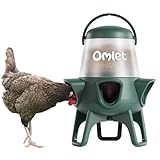
This site runs ads and contains Amazon affiliate links that help support my work at no extra cost to you, and I truly appreciate your support!
If a 50-pound hopper feels ridiculous for your flock, the Omlet is a much neater size.
It holds about 12 pounds of feed and gives the birds five protected eating ports. You can use it freestanding or hang it, which helps when floor space inside the run is limited.
The enclosed-port design is useful for birds that like to rake feed out of an open trough with their beaks.
I would still put it somewhere reasonably sheltered if your yard gets sideways rain. Port covers help, but dry feed lasts longer when the whole feeder is not sitting in the worst weather.
This also makes more sense for a modest flock than for a dozen hungry hens. The 12-pound size means you will refill it more often than the OverEZ, but it is easier to lift, move, and wash.
Features: five protected feeding ports, around 12-lb capacity, hanging or freestanding setup.
Pros: tidy footprint, reduced feed flicking, easier to handle than very large feeders.
Cons: smaller capacity; premium price for its size; not a rodent-locking treadle design.
Check the Omlet Feeder on Amazon
5. Royal Rooster Automatic Gravity Feeder

This site runs ads and contains Amazon affiliate links that help support my work at no extra cost to you, and I truly appreciate your support!
The Royal Rooster is for the keeper who wants something smaller and simpler than a treadle feeder.
It uses a narrow vertical hopper with a covered feeding section at the bottom and holds roughly 7 pounds of feed.
You can mount it to a wall or coop wire instead of leaving another feeder on the floor. That is useful in a cramped run, and raising the feed opening can also reduce bedding being kicked into it.
I would choose this for a small flock where you still check the birds every day but do not want to refill a little trough morning and evening.
Do not expect treadle-level pest protection. The feed is still available through the lower opening, so nighttime rodent pressure needs to be handled separately.
Features: compact vertical hopper, rain hood, wall or wire mounting, roughly 7-lb capacity.
Pros: good for small flocks, saves floor space, simple gravity system with no moving mechanism.
Cons: smaller capacity; feed opening remains accessible to pests; mounting position matters.
Check the Royal Rooster Feeder on Amazon
6. Suplklz 4-Port DIY Chicken Feeder Kit

This site runs ads and contains Amazon affiliate links that help support my work at no extra cost to you, and I truly appreciate your support!
If you already have a good bucket or storage bin, you may not need to buy another complete feeder.
This kit gives you four covered feeding ports and a hole saw so you can turn your own container into a gravity feeder.
The big advantage is flexibility.
Use a 5-gallon bucket for a small flock. Use a larger food-safe bin if you want more storage. You control the hopper size instead of accepting whatever capacity the manufacturer chose.
Installation is simple, but measure twice before cutting. If one port sits too low or the bucket is not level, feed can spill more easily, or moisture can work its way inside.
I also would not assume a plastic bucket full of feed is automatically rodent-proof. Store and position it with the same care you would use for any other feeder.
Features: four feeder ports, included hole saw, works with buckets and larger bins.
Pros: inexpensive way to build a high-capacity feeder, customizable container size, easy parts replacement.
Cons: you supply the container; cutting is required; final weather resistance depends on your installation.
Check the Suplklz DIY Feeder Kit on Amazon
7. ZINZINULER Automatic Feeder and Waterer Set

This site runs ads and contains Amazon affiliate links that help support my work at no extra cost to you, and I truly appreciate your support!
This set makes sense if you are setting up a small coop from scratch and need both feed and water equipment.
The feeder holds roughly 16 pounds and uses covered ports to reduce feed scattering. The matching waterer means you do not have to piece together two completely different systems.
I would buy a combo like this for convenience, not because one set automatically makes both jobs maintenance-free.
You still need to check the feeder for damp or stale feed and the waterer for dirt, algae, and leaking fittings.
That daily glance matters. Utah State specifically warns that old feed can accumulate in larger hoppers and become stale or moldy if it is not cleaned out often enough.
Features: covered-port feeder, matching poultry waterer, about 16-lb feed capacity.
Pros: convenient all-in-one setup, useful for new small flocks, fewer open-trough spills.
Cons: more parts to clean; not a treadle system; both feeder and waterer still need routine checks.
Check the ZINZINULER Set on Amazon
8. JASDEGO 4-Port Metal Automatic Chicken Feeder
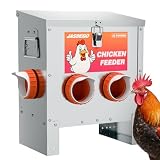
This site runs ads and contains Amazon affiliate links that help support my work at no extra cost to you, and I truly appreciate your support!
If you want more weather protection than a DIY bucket feeder but do not want to train the flock on a treadle, the JASDEGO sits in a useful middle ground.
It holds about 25 pounds of feed and gives the flock four covered feeding ports, so several hens can eat without crowding around one open trough.
The metal body and sloped top make more sense outdoors than an open plastic trough. A locking lid and carry handle also make refilling and moving the empty feeder easier.
I would use this for a medium backyard flock when you want more capacity than a small hanging feeder but do not need a 50-pound hopper.
The open ports mean I still would not call it rodent-proof. If rats are active around the coop, a treadle feeder gives you better nighttime feed protection.
Even with the sloped top and covered ports, I would still check the feed after heavy wind-driven rain. Covered openings help, but no outdoor feeder should be treated as completely waterproof without inspection.
Features: 25-lb metal hopper, four covered feeding ports, sloped top, locking lid, carry handle.
Pros: useful mid-size capacity, several hens can eat at once, sturdier outdoor-oriented body than a basic bucket feeder.
Cons: heavier than plastic; open ports are not rodent-proof; newer product with a shorter track record than long-established treadle feeders.
Check the JASDEGO Automatic Chicken Feeder on Amazon
9. Essilnn 6-Port DIY Feeder and Waterer Kit

This site runs ads and contains Amazon affiliate links that help support my work at no extra cost to you, and I truly appreciate your support!
Four feeding ports are enough for many small flocks.
If you have more birds trying to eat at the same time, six ports can make the feeder less crowded.
The Essilnn kit is another DIY option. You add the ports to your own bucket or bin, so the final capacity depends on the container you choose.
I like DIY ports when you already own a sturdy food-safe container and want to keep the cost down. I like them less when someone uses a flimsy bucket, leaves it completely exposed to storms, and then expects the ports to fix every weather problem.
Your container matters just as much as the kit.
Features: six DIY feeding ports with companion watering parts, customizable hopper size.
Pros: more feeding positions, flexible capacity, economical if you already own containers.
Cons: installation required; final durability and weather protection depend on your bucket or bin.
Check the Essilnn DIY Kit on Amazon
10. Terminalia Hanging Poultry Feeder

This site runs ads and contains Amazon affiliate links that help support my work at no extra cost to you, and I truly appreciate your support!
Not every automatic feeder needs a pedal, phone app, or complicated mechanism.
A hanging gravity feeder is still “automatic” in the practical sense that feed drops down as the birds eat.
The Terminalia is the simplest option in this list. Hang it at the right height, keep it filled, and let gravity do the work.
That simplicity is useful if you keep a small flock and do not have a serious rodent problem.
Height matters. Utah State recommends positioning feeders roughly around the mid-to-upper breast level of the birds. Too low, and chickens can scratch bedding into the tray and waste more feed. Too high, and smaller birds struggle to reach it.
Features: hanging gravity design, simple trough-style feeding, no powered parts.
Pros: easy to use, easy to move, inexpensive compared with treadle systems.
Cons: open feed is easier for wild birds and rodents to reach; less weather protection than covered-port designs.
Check the Terminalia Feeder on Amazon
Gravity or Treadle: Which One Makes More Sense?
I would make this decision based on the problem you are trying to solve.
If the problem is simply “I am tired of refilling the feeder every day,” a large gravity feeder is easier.
If the problem is “rats and wild birds are eating half the feed,” a treadle feeder makes more sense.
Gravity feeders have almost nothing to learn. Chickens find the opening and eat. They also have fewer moving parts.
Treadle feeders can protect the feed much better when nobody is eating, but the birds need to learn how to open them.
If you have a mixed flock with small bantams and heavy standard hens, pay extra attention to treadle weight settings. A platform that opens easily for a large hen may not open for the smallest bird.
Rodents Can Turn an Open Feeder Into a Nighttime Buffet
This is one of the biggest reasons to think beyond feeder capacity.
Utah State Extension advises removing feeders and waterers at night when rodents are a problem, cleaning up spilled feed, and storing chicken feed in rodent-resistant containers. It also notes that metal is harder for rodents to chew through than plastic or wood.
A treadle feeder can reduce nighttime access, but I would still clean spilled pellets and grain around it.
Rats do not need the feeder to open if there is already dinner all over the ground.
If rodents are already established around the coop, see our rat and mouse trap guide for chicken coops.
Keep the Feed Dry, Even in a “Weatherproof” Feeder
A feeder can survive rain without keeping every pellet perfectly dry.
Wind can blow water through ports. Condensation can form inside a sealed bin. A leaking lid can wet the top layer without you noticing.
Check the feed with your hand when you refill.
If it smells musty, feels damp, or has clumped together, do not just pour fresh feed on top.
Utah State recommends removing stale, rancid, or moldy feed and storing poultry feed away from heat, moisture, direct sunlight, and rodents.
A Bigger Hopper Is Not Always Better
A 50-pound feeder sounds convenient until you put it in a coop with three hens.
Those birds can take a long time to empty it.
If you keep topping off old feed instead of letting the hopper empty and cleaning it, stale feed can collect at the bottom.
I would size the feeder so you get fewer refills without storing weeks and weeks of feed outdoors unnecessarily.
What About Photocell or Wi-Fi Smart Chicken Feeders?
You will see DIY projects and a few specialty products that use timers, motors, light sensors, or Wi-Fi controls.
I would not make those the default choice for a backyard flock.
Chickens usually do very well with free-choice access to a balanced ration during the day. A reliable gravity or treadle feeder has fewer electronic parts to fail, and it keeps working during a power or internet outage.
A timed feeder can make sense for a specialized setup, but it should solve a real management problem rather than add electronics for the sake of it.
How I Would Clean an Automatic Chicken Feeder
You do not need to scrub the whole feeder every day.
You do need to look at it every day.
Check for wet feed, droppings, insects, clumps, and feed packed into corners.
When the hopper gets low, empty the remaining feed into a clean container and brush out dust and crumbs. Wash removable parts when needed, rinse them well, and let everything dry completely before adding fresh feed.
For treadle feeders, keep the pedal and moving joints free of packed dirt. If the mechanism starts sticking, fix it before birds lose access to feed.
Frequently Asked Questions
Are automatic chicken feeders worth it?
They are useful if you want fewer refills, less feed waste, or better pest control. A simple small flock may not need an expensive treadle feeder, while a coop with heavy rodent pressure may benefit from one immediately.
Will an automatic feeder keep rats away?
A treadle feeder can greatly reduce access because the feed closes when chickens step away. Gravity feeders are easier for rodents to investigate. Even with a treadle feeder, clean up spilled feed and store bags in rodent-resistant containers.
How much feeder space does each chicken need?
Utah State suggests about 2 to 3 linear inches of feeder space per adult chicken. Port-style feeders work differently, so watch the flock at feeding time and make sure timid birds are not constantly pushed away.
Can I leave an automatic feeder outside?
Many are designed for outdoor use, but I still prefer some shelter from direct rain. Check the feed after storms and make sure the feeder sits level so water cannot pool around the ports or lid.
Do chickens need training for a treadle feeder?
Usually, yes. Follow the feeder’s training steps and make sure every bird learns to use it before removing other feed access. Timid and low-ranking hens may take longer.
Can chicks use an automatic feeder?
Use chick-sized equipment instead. Large ports, tall feeding openings, and treadle mechanisms designed for adult hens can be difficult or unsafe for very young chicks.
Final Verdict
If your main goal is fewer refills, I would start with the OverEZ 50-lb feeder.
If rodents and wild birds are the bigger problem, I would look first at Grandpa’s Feeders or the RentACoop treadle feeder.
For a smaller flock, the Omlet or Royal Rooster options are easier to manage than a giant hopper.
And if you already have a good bucket or bin, a DIY port kit such as the Suplklz or Essilnn can give you a lot of feeder capacity without buying another large plastic body.
Whatever style you choose, still look inside it regularly.
An automatic feeder should save you work. It should not make wet feed, rodents, or a stuck mechanism easier to ignore.
Sources and Further Reading
- Utah State University Extension — Basics for Raising Backyard Chickens
- Utah State University Extension — Rodents and Backyard Chickens
- Penn State Extension — Small Scale Poultry Housing
- Penn State Extension — Raising Fowl in Urban Areas
- University of Minnesota Extension — Caring for Chickens in Cold Weather