

A chicken coop can turn uncomfortable surprisingly fast when the afternoon sun hits the roof and the air inside stops moving. You may have plenty of vents and still find your hens panting, holding their wings away from their bodies, or crowding near the doorway looking for a breeze.
That is where a good coop fan can help. The goal is not to make the coop feel like an air-conditioned room. You want to move stale, hot air out, bring fresher air through the building, and give your chickens enough air movement to shed body heat more comfortably.
For this guide, I separated true exhaust fans from circulation fans and portable options. That matters because a fan that feels powerful when you stand in front of it may still do very little to remove heat and moisture from a closed coop.
10 Best Chicken Coop Fans at a Glance
| Product | Best for | Amazon |
|---|---|---|
| iLIVING 12″ Shutter Fan | Automatic exhaust | Check |
| KEN BROWN 12″ Fan | Simple high-airflow exhaust | Check |
| iLIVING 18″ Wall Fan | Large-coop circulation | Check |
| Maxx Air 18″ Wall Fan | Dusty protected coops | Check |
| DEWALT DCE512B | Battery-powered cooling | Check |
| AC Infinity AXIAL 1225 | Small quiet vent | Check |
| Hurricane Classic 16″ | Oscillating airflow | Check |
| iPower 24″ Shutter Fan | Very large coops & barns | Check |
| BILT HARD 18″ Wall Fan | Heavy-duty barn airflow | Check |
| Drchop Solar Fan | Off-grid backup airflow | Check |
If your coop already has poor vent placement, fix that first. A fan works best when it supports good passive airflow rather than trying to compensate for a sealed building. Our chicken coop ventilation guide explains where vents should go and why moisture control matters year-round.
1. iLIVING 12-Inch Shutter Exhaust Fan — Best Overall Coop Exhaust Fan

As an Amazon Associate I earn from qualifying purchases. This article contains affiliate links. If you buy through these links, I may earn a commission at no extra cost to you.
The iLIVING 12-inch shutter fan is the one I would look at first for a medium-size coop that needs real powered exhaust. It is not just a fan blowing air around the room. Installed in a wall or gable, it actively pulls hot air out so fresh air can enter elsewhere.
The ILG8SF12V-ST is rated around 960 CFM and includes automatic shutters plus iLIVING’s Thermospeed controller. You can adjust fan speed and set the temperature at which you want the fan to work, which is much more useful than walking out to the coop every time the weather changes.
Why it works well: The combination of exhaust airflow, automatic shutters, and temperature control makes it practical for daily summer use instead of only emergency cooling.
Keep in mind: You need a proper wall opening and a safe electrical setup. Also make sure there is enough intake area on the opposite side of the coop; an exhaust fan cannot move its rated airflow if fresh air has nowhere to enter.
Best for: Medium to large backyard coops that become noticeably hotter than the outside air on warm afternoons.
Check iLIVING 12-Inch Shutter Fan on Amazon
2. KEN BROWN 12-Inch Shutter Exhaust Fan — Best Simple High-Airflow Exhaust Fan

As an Amazon Associate I earn from qualifying purchases. This article contains affiliate links. If you buy through these links, I may earn a commission at no extra cost to you.
The KEN BROWN 12-inch fan is for chicken keepers who want a straightforward exhaust fan without paying for built-in temperature controls. It comes with automatic gravity shutters and a power cord, so once the opening and mounting are ready, the setup is relatively simple.
Current specifications put airflow around 1,400 CFM. That is a lot of air for a 12-inch fan and makes this model more appropriate for larger walk-in coops, sheds, and small barn-style buildings than for tiny four-hen coops.
Why it works well: You get strong exhaust airflow and simple plug-in operation without an app, remote, or complicated controller.
Keep in mind: This model does not give you the automatic temperature control of the iLIVING above. If you add an external controller, make sure it is electrically compatible with the fan rather than assuming any inexpensive thermostat plug will work safely.
Best for: Larger coops where airflow matters more than automation.
Check KEN BROWN 12-Inch Fan on Amazon
3. iLIVING 18-Inch Weatherproof Wall Fan — Best for Large Coop Circulation

As an Amazon Associate I earn from qualifying purchases. This article contains affiliate links. If you buy through these links, I may earn a commission at no extra cost to you.
This second iLIVING product earns a place for a completely different reason. The 12-inch model above is a shutter exhaust fan. This 18-inch model is a high-output wall circulation fan designed to throw a strong breeze across a much larger space.
The ILG8E18-15 is rated up to about 6,360 CFM, has three speeds, a sealed motor, corrosion-resistant construction, and an indoor/outdoor weatherproof design. For an open-sided coop, covered run, barn aisle, or large walk-in poultry house, that kind of air movement can make a major difference on still summer days.
Why it works well: It moves much more air than a small household fan and keeps the motor and blades off the litter when mounted on a wall.
Keep in mind: This is a circulation fan, not a substitute for exhaust ventilation. A powerful fan can move hot air very effectively without actually getting that hot air out of the building.
Best for: Large, open, or semi-open chicken areas where birds need a strong cooling breeze.
Check iLIVING 18-Inch Wall Fan on Amazon
4. Maxx Air 18-Inch Wall Mount Fan — Best for a Dusty Protected Coop
As an Amazon Associate I earn from qualifying purchases. This article contains affiliate links. If you buy through these links, I may earn a commission at no extra cost to you.
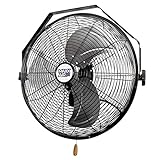
Chicken dust gets everywhere. That is one reason I prefer a rugged fan with an enclosed motor over a lightweight bedroom fan when equipment is going to live near a coop.
The Maxx Air 18-inch wall fan has a totally enclosed motor, steel construction, three speeds, and a head that tilts so you can aim the airflow where the birds actually spend time. The current model is rated up to about 1,450 CFM.
Why it works well: The enclosed motor and wall-mount design are a better match for dusty farm spaces than a typical tabletop fan.
Keep in mind: Maxx Air specifies this model for indoor use. A protected coop interior is fine, but do not hang it on an exposed exterior wall where rain can reach it.
Best for: Enclosed or roofed coops, barns, and sheds where dust resistance matters but direct weather exposure is not expected.
Check Maxx Air 18-Inch Fan on Amazon
5. DEWALT DCE512B 20V MAX Jobsite Fan — Best Battery-Powered Coop Fan

As an Amazon Associate I earn from qualifying purchases. This article contains affiliate links. If you buy through these links, I may earn a commission at no extra cost to you.
If your coop is far from the house, a long extension cord is not always the answer. The DEWALT DCE512B gives you useful airflow wherever you need it without permanent wiring.
This model runs on DEWALT 20V MAX batteries and is cordless only. It offers variable speed control, several hanging and mounting positions, and IP54 resistance to dust and splashing water. DEWALT rates it up to about 650 CFM.
With a 5Ah battery, DEWALT states up to roughly 4.5 hours of runtime at maximum airspeed. That makes it especially useful during a power outage or a dangerous late-afternoon heat spike.
Why it works well: It is portable, rugged, and much more powerful than many small camping or disposable-battery fans.
Keep in mind: The common DCE512B listing is tool-only. If you are not already using DEWALT 20V batteries, the battery and charger add to the total setup.
Best for: Remote coops, power outages, temporary cooling, and chicken keepers already using DEWALT batteries.
Check DEWALT DCE512B on Amazon
6. AC Infinity AXIAL 1225 — Best Quiet Fan for a Small Vent
As an Amazon Associate I earn from qualifying purchases. This article contains affiliate links. If you buy through these links, I may earn a commission at no extra cost to you.
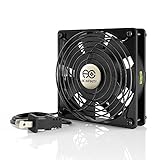
Not every coop needs hundreds or thousands of CFM. If you have a small protected coop and simply need gentle continuous airflow through a vent, the AC Infinity AXIAL 1225 is a much more sensible size.
This compact 120V fan moves about 51 CFM, uses around 8 watts, and is rated around 30 dBA. Its dual-ball-bearing motor is designed for long running life, and the square frame is easy to mount behind a protected vent opening.
Why it works well: It is quiet, inexpensive to run, and small enough that it does not blast birds with unnecessary airflow.
Keep in mind: This is an indoor electronics-style fan, not a waterproof farm fan. Keep it dry and make sure chickens cannot reach either side of the blades.
Best for: Small protected coops and vent openings where low, steady airflow is all you need.
Check AC Infinity AXIAL 1225 on Amazon
7. Hurricane Classic 16-Inch Oscillating Wall Fan — Best Oscillating Fan

As an Amazon Associate I earn from qualifying purchases. This article contains affiliate links. If you buy through these links, I may earn a commission at no extra cost to you.
A fixed fan is great when one roosting or loafing area needs steady airflow. An oscillating fan makes more sense when you want the breeze to sweep across a wider section of a covered coop or run.
The Hurricane Classic is a 16-inch wall fan with three speeds, adjustable tilt, and roughly 90-degree oscillation. Wall mounting keeps it above litter and lets you spread airflow through the occupied area instead of creating one narrow blast of air.
Why it works well: Oscillation distributes air across more birds, and the simple pull-cord controls are easy to use without relying on Wi-Fi or remotes.
Keep in mind: Treat this as a protected circulation fan. Do not expose it to rain, and do not depend on oscillation as a substitute for actual exhaust ventilation.
Best for: Covered runs and larger protected coop interiors where several birds share the same cooling area.
Check Hurricane Classic Wall Fan on Amazon
8. iPower 24-Inch Shutter Exhaust Fan — Best for Very Large Coops and Barns
A 24-inch exhaust fan is overkill for a small backyard coop, but it can be exactly what you need in a large walk-in building, poultry shed, or barn where summer heat collects under a big roof.
The iPower 24-inch shutter fan is rated around 3,400 CFM and uses automatic shutters. Its large opening can exchange air quickly, which is useful when you are ventilating a much bigger space than the typical six- or eight-hen coop.
Why it works well: Large diameter and high airflow make it suitable for barn-scale exhaust jobs that smaller wall fans cannot handle efficiently.
Keep in mind: Bigger is not automatically better. Before installing a fan this powerful, make sure your intake openings are large enough and that birds are not forced to sit directly in a high-speed air path.
Best for: Large walk-in coops, chicken sheds, and small barn setups.
Check iPower 24-Inch Shutter Fan on Amazon
9. BILT HARD 18-Inch Industrial Wall Fan — Best Heavy-Duty Barn Fan

As an Amazon Associate I earn from qualifying purchases. This article contains affiliate links. If you buy through these links, I may earn a commission at no extra cost to you.
The BILT HARD 18-inch fan is built more like shop equipment than a household fan. That is a useful distinction when a fan has to live around dust, feathers, and daily farm mess.
It has three airflow settings—about 2,600, 3,400, and 4,300 CFM—plus a fully enclosed ball-bearing motor, powder-coated steel housing, aluminum blades, and 180-degree tilt. The manufacturer specifically lists barns among its intended indoor uses.
Why it works well: The sealed motor and heavy metal construction make it a better fit for a dusty poultry building than many residential fans.
Keep in mind: This particular model is not rated for outdoor exposure. Mount it under a roof or inside the building where rain cannot reach it.
Best for: Barn-style coops and large protected poultry areas where you want rugged high-volume circulation.
Check BILT HARD 18-Inch Wall Fan on Amazon
10. Drchop Rechargeable Solar Fan — Best Off-Grid Backup Fan

View this product on Amazon.com
This is not a permanent exhaust fan, and I would not pretend that it is. The reason the Drchop makes the list is that it gives you a practical portable option when the coop has no outlet and you still want airflow after the sun goes down.
The unit combines an 8-inch rechargeable fan with a separate solar panel and an internal battery. That is more useful for emergency chicken care than a direct-solar fan that stops as soon as a cloud passes or evening arrives.
Why it works well: Battery storage means you can charge during the day and keep a breeze moving later, which is helpful during hot nights or short power outages.
Keep in mind: It is still a portable consumer fan, not a permanently installed poultry ventilation system. Keep it dry, secure it where chickens cannot knock it over, and do not use it as the only ventilation plan for a closed coop.
Best for: Small off-grid coops, temporary cooling, camping-style setups, and emergency backup.
Check Drchop Rechargeable Solar Fan on Amazon
Exhaust Fan vs. Circulation Fan: Know the Difference
This is the most important buying decision in the whole guide.
An exhaust fan such as the iLIVING 12-inch, KEN BROWN, or iPower is installed in an opening and pushes coop air outside. As it does that, fresher air enters through windows and vents elsewhere in the building. This is what you want when the coop itself is trapping heat, humidity, or stale air.
A circulation fan such as the Maxx Air, Hurricane, or BILT HARD mainly moves air inside the space. Chickens can benefit from that breeze because moving air helps them release body heat, but the fan cannot remove moisture or ammonia if there is no path for stale air to leave.
In a larger coop, using both types can work very well: exhaust high on one side of the building and circulation lower down where the birds spend time.
How Much CFM Does Your Chicken Coop Need?
CFM means cubic feet per minute. It tells you how much air a fan can move, but it does not tell the whole story.
A 50-CFM fan can be useful on a small vent. A 900–1,400 CFM exhaust fan may suit a medium or large backyard coop. A 3,000+ CFM fan belongs in a much larger enclosure. The correct choice depends on the volume of the coop, how many birds you keep, the size of the intake vents, local heat and humidity, and whether the fan is exhausting air or simply circulating it.
Do not buy the highest-CFM fan simply because the number looks impressive. Oversized airflow can create a strong draft and may perform poorly if your intake vents are too small.
Where Should You Install a Chicken Coop Fan?
Mount an exhaust fan high on a wall or gable where hot air collects. Fresh-air openings should be on another part of the building so air actually travels through the coop before leaving.
Mount a circulation fan high enough that chickens cannot peck the cord or reach the blades. Aim the airflow across the space rather than directly into nest boxes or blasting the nighttime roost at close range.
Your birds should always have somewhere to step out of the strongest breeze. That becomes especially important with industrial fans that can move several thousand CFM.
Chicken Coop Fan Safety Tips
- Secure every fan so chickens cannot tip it over or reach moving blades.
- Use a suitable guard or hardware cloth if the factory grille still leaves openings large enough for a beak or toe.
- Keep cords and plugs away from waterers, wet bedding, and pecking birds.
- Use GFCI-protected power where electrical equipment may be exposed to damp conditions.
- Respect indoor/outdoor ratings. A good indoor barn fan can still fail or become unsafe if rain reaches the motor or plug.
- Clean feathers and dust from guards, shutters, blades, and intake openings. A dirty fan moves less air and runs harder.
- Do not close permanent vents just because you installed a powered fan.
- Keep an eye on extension cords. For permanent electrical service to a coop, proper wiring is safer than leaving a temporary cord across the yard all season.
If summer outages are common where you live, read our chicken coop power-outage backup guide. It explains why ventilation, brooders, water systems, and automatic doors need different backup plans.
Electric, Battery, or Solar: Which Power Source Is Better?
Plug-in fans are still the most practical choice when the coop has safe electrical service. They can move much more air continuously and are easier to automate with thermostatic controls.
Battery fans make sense for temporary cooling, outages, and remote buildings. The drawback is obvious: once the battery is empty, the airflow stops.
Solar fans sound perfect for a hot chicken coop because the sun that heats the building also powers the fan. The problem is that many inexpensive direct-solar kits slow down in clouds and stop completely at night. For that reason, I prefer a rechargeable solar/battery option for backup rather than filling this list with several mediocre direct-solar exhaust kits.
If you want to run a proper exhaust fan, camera, automatic door, or water pump from solar, our solar-powered chicken coop guide explains how to size panels and batteries.
Fans Help With Heat, but They Are Not the Whole Plan
When the weather becomes dangerously hot, airflow is only one part of keeping chickens safe. Shade, plenty of clean drinking water, lower stocking density, cool ground, and watching for early signs of heat stress are just as important.
Chickens do not sweat. When they are overheating, you may see open-mouth panting, wings held away from the body, reduced activity, pale combs, or birds lying in cooler soil. Our summer chicken cooling guide covers what to do before heat stress becomes an emergency.
Frequently Asked Questions
Do chickens really need a fan in summer?
Not always. A shaded coop with excellent passive ventilation may stay comfortable without powered airflow. A fan becomes much more useful when the air is hot, humid, and still or when the coop consistently feels hotter than the outdoors.
Does a fan actually cool the air inside a chicken coop?
A circulation fan does not refrigerate the air. It helps birds lose heat by increasing air movement around them. An exhaust fan can also stop hot air from building up above outdoor temperature by replacing trapped coop air with outside air.
Should I run a chicken coop fan at night?
During a hot, humid night, continued airflow can help chickens release heat accumulated during the day. If nighttime temperatures drop sharply, reduce unnecessary direct airflow rather than leaving a high-speed fan pointed at the roost.
Is it safe to use a fan around chicken dust and feathers?
Yes, if you choose suitable equipment and maintain it. Fans with enclosed motors are better suited to dusty environments, and all fans need regular cleaning. Keep electrical parts dry and keep blades, cords, and plugs out of the birds’ reach.
Can a solar fan ventilate a chicken coop all day and night?
Only if the system includes enough battery storage. A direct-solar fan usually slows when sunlight weakens and stops after sunset. For nighttime ventilation, use a battery-backed system, rechargeable fan, or reliable AC-powered fan.
Final Verdict
For a typical medium-size coop that genuinely needs powered exhaust, the iLIVING 12-Inch Shutter Exhaust Fan is the most complete option because it combines useful airflow with automatic shutters and temperature/speed control.
If you want straightforward exhaust without extra controls, the KEN BROWN 12-Inch Fan is easier to keep simple. For very large buildings, the iPower 24-Inch Shutter Fan makes more sense than trying to make several small fans do the same job.
For circulation rather than exhaust, choose according to the space. The iLIVING 18-Inch Wall Fan provides very high airflow, the Hurricane Classic spreads a gentler breeze by oscillating, and the BILT HARD 18-Inch Wall Fan is the better heavy-duty choice for a dusty barn-style setup.
For a coop without electricity, the DEWALT DCE512B is my preferred battery option, while the Drchop Rechargeable Solar Fan is better treated as an off-grid backup than as permanent ventilation.
No fan fixes a poorly designed coop. Keep permanent vents open, provide shade and water, control moisture, and give chickens enough space to move away from the strongest airflow.
References
- University of Minnesota Extension: preventing heat stress in poultry
- Mississippi State University Extension: fan selection for poultry housing
- Mississippi State University Extension: preparing poultry houses for summer weather
- iLIVING fan specifications
- Maxx Air 18-inch wall fan specifications
- DEWALT DCE512B specifications
- AC Infinity AXIAL 1225 specifications
- BILT HARD 18-inch industrial wall fan specifications
