
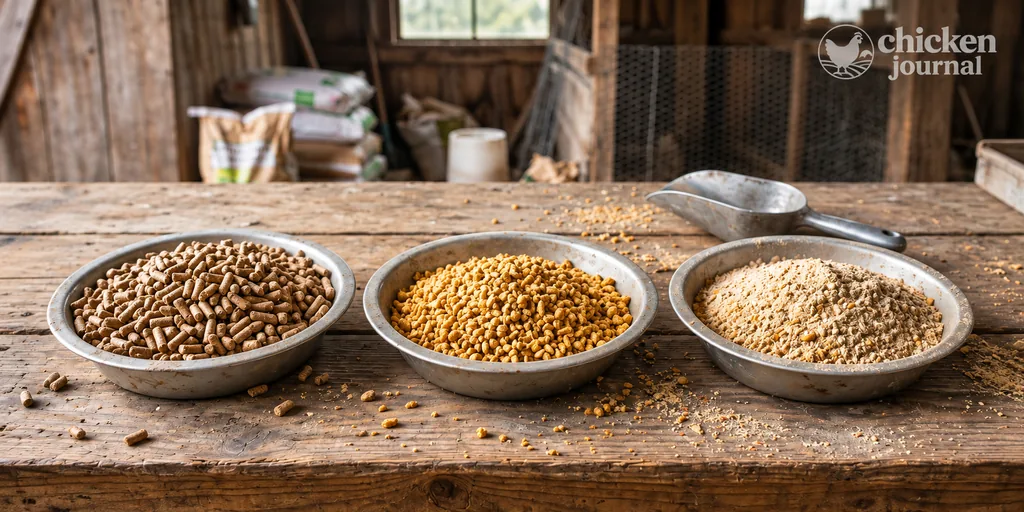
If you walk into most farm supply stores, you’ll find chicken feed available as pellets, crumbles, and mash. However, it can be confusing for beginners to know which type to use.
All three forms look different, and they’re often recommended for chickens of different ages. This can leave you wondering whether one type is healthier, whether crumbles are only for chicks, or whether mash is simply cheaper.
The good news is that all three forms can work well when the ration is appropriate for your chickens’ age and nutritional requirements. The main differences are texture, processing, ease of eating, waste, and compatibility with different feeders.
Small chicks may struggle to eat large pellets, whereas adult hens can usually eat appropriately sized pellets easily. Fine mash can create more dust, while pellets can help prevent birds from picking through individual feed ingredients.
However, pellets aren’t necessarily more nutritious, and changing feed forms alone may not improve egg production.
This guide explains the differences between chicken feed pellets, crumbles, and mash. We’ll discuss the benefits and drawbacks of each type and help you choose the right feed for your backyard flock.
If you’re new to poultry feeding, check our complete guide to feeding chickens.
Chicken Feed Pellets, Crumbles, and Mash: Quick Comparison
The main differences between these feed forms are how they’re processed, their particle size, and how easy they are for chickens to eat.
| Feature | Pellets | Crumbles | Mash |
|---|---|---|---|
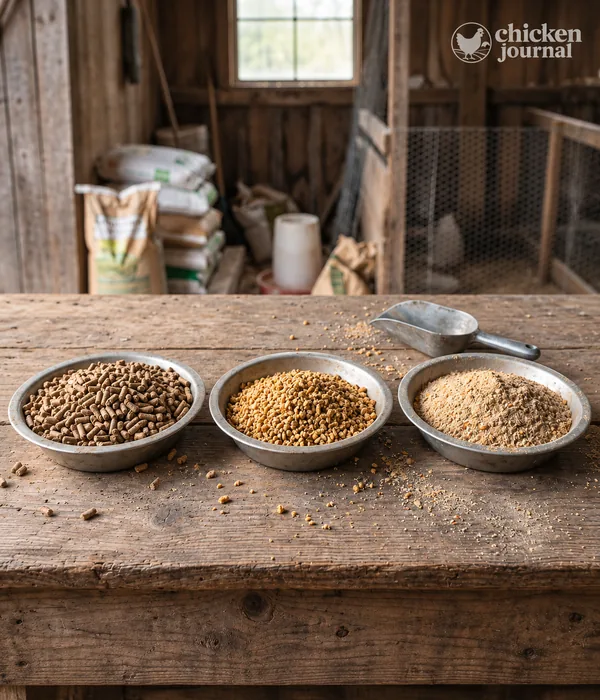
| Appearance | Short cylindrical pieces | Small, irregular granules | Loose ground ingredients |
| Processing | Ground feed compressed into pellets | Pellets broken into smaller pieces | Ingredients ground and mixed |
| Commonly used for | Adult hens and growing meat birds | Chicks, growers, smaller birds | Chicks, growers, adult birds |
| Ease of eating | Good when pellet size fits the bird | Easier for smaller beaks | Depends on particle size |
| Ingredient sorting | Usually limited | Usually limited | More possible |
| Dust | Usually less when intact | Can contain fine particles | Can be dusty |
| Waste | Often easier to manage | Usually manageable | Can increase with very fine feed or unsuitable feeders |
| Processing cost | Usually higher | Usually higher | Usually lower |
| Main drawback | Large pellets may not suit chicks | May contain excessive fines | Dust or ingredient separation |
 Share on Pinterest
Important: Starter, grower, and layer feeds are defined by their nutritional formulation. Pellets, crumbles, and mash describe the physical form of the feed. A layer pellet isn’t suitable for a baby chick simply because the chick can eat it.
What Are Chicken Feed Pellets?
Chicken feed pellets are small cylindrical pieces made from ground and mixed feed ingredients. During processing, the feed ingredients are ground and mixed together. The mixture is then processed into pellets using moisture, heat, and pressure.
Finished pellets are usually fairly uniform in shape. Their diameter and length vary depending on the manufacturer and the size of the birds they’re intended for.
Because the ingredients have been pressed together, chickens can’t easily pick through individual components of intact pellets. This is one reason pellets are commonly used in commercial poultry feeding.
They can also be a good option for backyard chicken keepers because they usually flow well through hopper feeders and are less dusty than very fine mash.
Benefits of Chicken Feed Pellets
- Less ingredient sorting: Chickens can’t pick through the feed as easily.
- Easy to dispense: Pellets usually flow well through good-quality gravity feeders.
- Less dust: Intact, good-quality pellets are generally less dusty than fine mash.
- Potentially less waste: Their compact shape may reduce scattered feed when the feeder is set up correctly.
- Suitable for adult chickens: Most standard-sized laying hens can eat appropriately sized pellets easily.
Drawbacks of Chicken Feed Pellets
- Large pellets can be difficult for newly hatched chicks to eat.
- Pellets can cost more to manufacture.
- Poor-quality or damaged pellets can create excessive fines (powder and broken pieces).
- Pellets won’t necessarily increase egg production.
- Some feeding systems may need adjustment.
Are Pellets Suitable for Laying Hens?
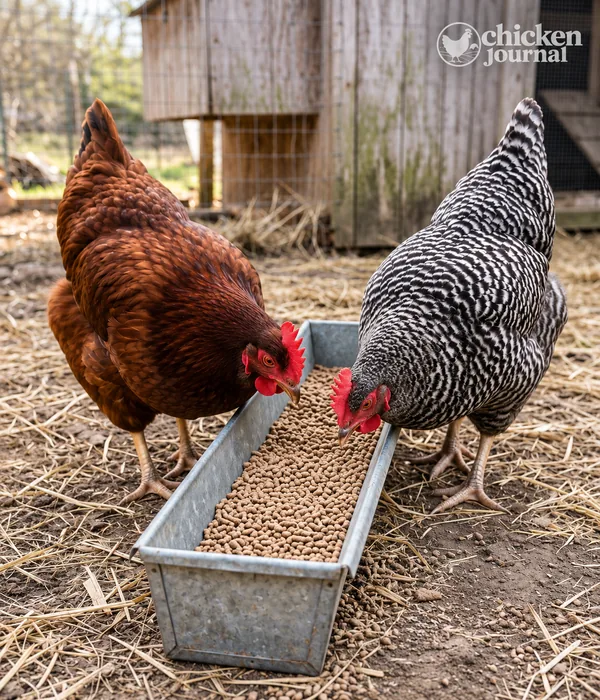
Pellets can be a good option for adult laying hens. They are convenient to feed and, when sold as a complete layer ration, can provide balanced nutrition with relatively little ingredient sorting.
 Share on Pinterest
However, the key is the nutritional formulation. Simply pressing an unsuitable diet into pellets won’t make it nutritionally balanced. Choose a complete layer ration designed for laying hens and check its protein, calcium, and other nutritional specifications.
Our guide to protein requirements in chicken feed explains why chickens’ nutritional needs change as they mature.
What Are Chicken Crumbles?
Chicken crumbles are essentially pellets that have been broken into smaller pieces. The feed is processed into pellets and then passed through equipment that breaks the pellets into smaller granules. This makes crumbles easier for small chickens to pick up and eat.
Crumbles are commonly used for young chicks, although adult chickens can eat them too. Many commercial chick starter feeds are available as crumbles. Growers and adult layers can also receive complete crumble feeds when the ration is correctly formulated for their stage of life.
Benefits of Chicken Crumbles
- Smaller pieces: Appropriately sized crumbles are easy for chicks and small birds to eat.
- Less ingredient sorting: Processing the ingredients together reduces the chance of picking through individual components.
- Widely available: Many commercial chick starter feeds come in crumble form.
- Flexible: Smaller crumbles may suit adult birds that struggle with large pellets.
- Easy to feed: Good-quality crumbles usually work well in chick trays and suitably designed feeders.
Drawbacks of Chicken Crumbles
- Poor-quality crumbles may contain excessive powder.
- Additional processing can increase manufacturing costs.
- Small particles can spill from poorly designed feeders.
- Very fine crumbles may be dusty.
- Crumble size varies, and not every product is suitable for newly hatched chicks.
Are Crumbles Better for Baby Chicks?
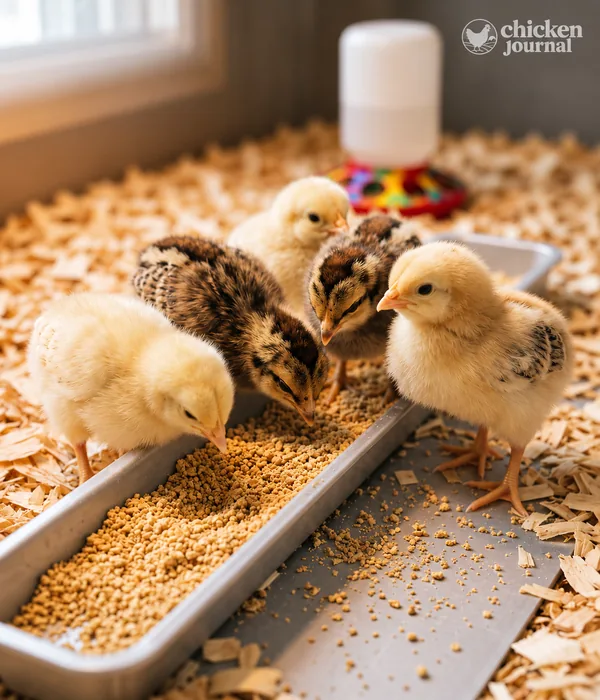
Crumbles are often a convenient option for baby chicks because their small pieces are easy to eat. However, crumbles aren’t the only suitable option.
 Share on Pinterest
A properly formulated chick starter mash with an appropriate particle size can also be used. Organizations such as the University of Maine Cooperative Extension describe feeding programs for young chicks that include mash.
When choosing starter feed, always check the manufacturer’s recommended age range and nutritional formulation. Our guides to raising baby chicks and brooding chickens explain other important aspects of early chick care.
What Is Mash Chicken Feed?
Mash is a loose mixture of ground feed ingredients. Unlike pellets and crumbles, it hasn’t been compressed into uniform pieces. Grains and other ingredients are ground to suitable particle sizes and mixed to provide the intended nutritional content.
Depending on the manufacturer, mash may look like coarse flour, fine grain particles, or a slightly uneven mixture. Mash can be formulated as starter, grower, or layer feed. It has been used for many years and remains a practical option for small and commercial flocks.
Benefits of Chicken Feed Mash
- Less processing: It doesn’t require the additional pelleting step.
- Potentially lower cost: Mash is often cheaper to manufacture.
- Suitable for different ages: Appropriate complete mash rations can be offered to chicks, growers, and adult hens.
- Works in suitable feeders: Mash can be used successfully in troughs and feeders designed for loose feed.
- No large-pellet problem: Birds don’t need to swallow compressed adult-sized pellets.
Drawbacks of Chicken Feed Mash
- Very fine mash can be dusty.
- Ingredients may separate during transport and handling.
- Chickens can pick through larger particles and leave finer components.
- Some hopper feeders don’t dispense mash as reliably.
- Poor feeder setup can lead to more scattered feed.
Can Adult Chickens Eat Mash Daily?
Yes. Adult hens can eat a complete layer mash every day if it has been formulated for their nutritional needs. There is no general rule that healthy laying hens must be switched to pellets.
A 2025 study of 252 Lohmann Brown laying hens compared mash, pellets, and crumbles over 16 weeks. Researchers found no significant differences in egg production, egg quality, nutrient digestibility, or the organ measurements studied under those conditions.
This doesn’t mean physical feed form never matters, but it does mean mash shouldn’t automatically be considered an inferior option for laying hens.
Nutrition, feed quality, feeder setup, and flock management are all important.
Which Chicken Feed Form Is Most Nutritious?
This is probably the most important question when comparing the different types of feed. None of these forms is automatically more nutritious simply because of its shape.
A complete layer ration can be manufactured as pellets, crumbles, or mash and formulated to provide comparable levels of protein, energy, calcium, vitamins, and minerals.
However, some feed forms may allow more ingredient sorting. Mash may contain larger particles that chickens prefer. If birds repeatedly leave behind fine particles, their actual nutrient intake may differ from the intended ration. Pellets and crumbles generally reduce this opportunity.
Processing can also affect feed characteristics and nutrient utilization, but the results vary with bird type, formula, particle size, and production conditions.
What Does the Research Say?
University extension publications recognize that pellets can be useful for handling feed and reducing selective feeding. Studies have also found that pelleted diets can improve growth performance in broiler chickens under some conditions.
However, results from meat chickens shouldn’t automatically be applied to backyard laying hens. A 2025 study involving 432 laying hens found that feed form and particle size affected some feed-conversion and egg-mass measurements, but neither significantly changed overall egg production.
Another 2025 study of 252 laying hens found no significant differences in egg production or egg quality between mash, pellets, and crumbles under its tested conditions.
Overall, choose the correct nutritional formulation first, then select a feed form that works well for your birds and feeding setup. Learn more about the consequences of an inadequate ration in our guide to nutritional deficiencies in chickens.
Which Feed Is Best for Chickens of Different Ages?
The best feed form depends on the age of your chickens and their ability to eat it. However, nutrition must always come first.
| Chicken group | Suitable feed form | Nutritional priority |
|---|---|---|
| Newly hatched chicks | Fine starter crumbles or suitable mash | Complete chick starter |
| Growing pullets | Grower mash, crumbles, or appropriately sized pellets | Complete grower/developer |
| Adult laying hens | Layer mash, crumbles, or pellets | Complete layer ration |
| Adult roosters | Suitable mash, crumbles, or pellets | Appropriate complete ration |
| Meat chickens | Starter crumbles or mash; pellets often used later | Stage-appropriate meat-bird ration |
| Bantams and small breeds | Mash, small crumbles, or appropriately sized pellets | Age- and purpose-appropriate complete ration |
The age when chickens move from starter to grower or layer feed depends on the birds, their feeding program, and the manufacturer’s recommendations.
Baby Chicks: Starter Crumbles or Mash
Newly hatched chicks need a complete starter feed with the nutrients required for early growth. Fine crumbles and appropriately prepared starter mash are commonly used.
Don’t feed standard adult layer pellets to young chicks. The pieces may be too large, and the formulation is unsuitable. Layer feed contains much more calcium than young chicks need, which can cause serious health problems.
If you use medicated starter feed, follow the package directions and veterinary advice, particularly if the chicks have been vaccinated against coccidiosis.
Growing Pullets: Grower Feed
As pullets grow, their nutritional requirements change. They should move to a grower or developer ration at the stage recommended by the feed manufacturer.
That feed may come as mash, crumbles, or appropriately sized pellets. Make sure every bird can eat it comfortably.
Laying Hens: Complete Layer Feed
Once pullets reach the appropriate stage for layer feed, usually around the onset of laying, they need a ration designed to support egg production. Layer feeds contain additional calcium for eggshell formation.
Pellets are convenient, but complete layer crumbles and mash can work well too. See our guide to raising chickens for eggs and our article about oyster shell for chickens for calcium-related guidance.
Meat Chickens: Follow a Meat-Bird Feeding Program
Meat chickens have different growth rates and nutritional requirements from laying hens. Many commercial meat-bird feeding programs begin with starter crumbles and move to pellets as birds grow. Research has shown performance benefits from pelleted feed in some meat-bird systems.
Pellet size and feeding stage still matter. Follow the meat-bird feed manufacturer’s directions instead of using a standard layer ration.
Which Chicken Feed Form Causes Less Waste?
Feed waste depends on many factors besides texture, including feeder design, feeding behavior, flock size, particle size, and how the feed is handled.
Pellets
Intact pellets can be easier to contain in a properly adjusted feeder. Because they’re compact, chickens may scatter less fine material. However, pellets don’t guarantee less waste. Birds can still pull them from feeders and scatter them, while damaged pellets can break into dust and fines.
Crumbles
Crumbles can be easier for young birds to eat, but pieces that are too small or damaged may collect at the bottom of the feeder. A high proportion of powder can reduce their practical advantages.
Mash
Mash may require more attention to feeder design. Fine particles can blow or scatter more easily, and some chickens may pick through larger ingredients. Nevertheless, mash can be fed successfully with the right equipment.
How to Reduce Feed Waste
Whatever feed you choose:
- Adjust the feeder height for the birds using it.
- Don’t overfill troughs.
- Use feeders that discourage scratching and scattering.
- Keep feed protected from rain and droppings.
- Check regularly for accumulated powder and fines.
- Clean up spilled feed.
If your flock spills a lot of feed, see our guides to the best chicken feeders and automatic chicken feeders.
Which Feed Form Works Best in Different Feeders?
Not every feeder works equally well with pellets, crumbles, and mash.
- Gravity feeders: Pellets and crumbles usually flow better through many tube-style feeders. Fine mash may collect in corners or become stuck.
- Long trough feeders: Properly designed troughs can work with all three forms. Make sure the height and depth suit your birds.
- Chick feeding trays: Small trays or shallow feeders are useful for appropriately sized starter mash and crumbles.
- Automatic feeders: Check the manufacturer’s specifications. Some systems are designed for particular pellet sizes, and fine mash can clog narrow openings.
Before changing feed forms, check whether your feeder needs adjustment. A feeder that works well with pellets may not work as well with fine mash.
Do Chickens Need Grit With Pellets, Crumbles, or Mash?
Grit helps chickens to grind up certain foods in their muscular gizzard. However, chickens eating only an appropriately processed complete feed generally do not need extra insoluble grit solely to digest that ration.
If they’re eating whole grains, fibrous forage and/or coarse feeds then providing an appropriate source of insoluble grit may help. Pellets, crumbles and mash are all processed feeds. Scratch is not a complete feed.
See our guides to grit for chickens and chicken scratch feed for more information.
How to Switch Chickens From Mash to Pellets or Crumbles
When changing your chickens’ feed form, they may need a little time to adjust to the new texture. For example if they’re used to eating mash they may need to investigate the pellets.
If you are changing only the physical form while keeping an appropriate nutritional formula, a gradual introduction can help you confirm that all birds are eating. A practical transition checklist:
Do not keep chickens on an inappropriate ration during a prolonged transition. When changing nutritional stages, follow the manufacturer’s directions.
- Make sure the new feed is appropriate for your chickens’ age and purpose.
- Provide a small amount of the new feed alongside their current feed.
- Gradually increase the new feed if they are happy to eat.
- Watch to ensure that any smaller or less dominant birds are able to eat easily.
- Check for uneaten feed and confirm that the birds are acting normally and eating.
- Ensure they have access to clean and fresh water.
If they stop eating, become weak or show any signs of illness don’t assume it is due to them not liking the new texture.
Are Pellets Cheaper Than Mash?
Mash can be cheaper to produce because it doesn’t require the additional pelleting step, which uses equipment and energy. Crumbles require extra processing.
However, just because the bag is cheaper doesn’t mean it will be cheaper to feed. If you have a cheaper mash but it is creating a lot of dust, spilling and/or not being eaten then it may actually be more expensive.
A more expensive pelleted feed may be worth it if it reduces any handling issues or works better with your feeders. Look at how much usable feed you are getting.
A Simple Cost Comparison
| Item | Feed A | Feed B |
|---|---|---|
| Bag price | $20 | $23 |
| Weight | 40 lb | 40 lb |
| Cost per pound | $0.50 | $0.58 |
Feed A is cheaper per lb. However if Feed A is creating a lot more waste in your setup it may not be as cost effective. These are example prices and are not reflective of current retail prices or how much waste you would get from each feed type.
To estimate your real feed costs, track how long each bag lasts, how much stays in the feeders, and how much gets wasted.
Can You Mix Pellets, Crumbles, and Mash?
Yes, but it depends on what you are feeding. Generally if you are mixing different textures of the same correct complete feed it is fine. However if you are mixing different feeds for different ages it may not be suitable.
For example if you are mixing starter crumbles with layer pellets it may not create a suitable diet. Mixing a complete feed with excessive scratch grains or treats can dilute the overall nutritional balance.
If you want to give your flock some treats then make sure they’re only a small supplement to their complete feed. See our chicken treats guide to learn what to offer and why moderation matters.
How to Choose Good-Quality Chicken Feed
Whether you are choosing pellets, crumbles or mash you should look past the bag.
1. Read the Feed Label
Check the feeding instructions, bird type and age. A starter feed and layer feed are not interchangeable.
2. Check the Nutritional Information
Look at the guaranteed analysis and product details. Look at the protein, calcium and nutritional purpose of the feed. If you are looking for organic chicken feed, check the certification and labeling.
3. Check Feed Quality
Pellets should not be very dusty. Crumbles should be the correct size. Mash should not have excessive dust or obvious separation. Pay attention if birds repeatedly refuse particular particles.
No matter what type of feed you are choosing it should not be moldy, smelly or show any signs of dampness.
4. Buy the Right Amount
Poultry feed can spoil. The quality of feed can be affected by heat, dampness and how long it has been stored for. Buy enough for your flock to eat before it goes off. Follow the manufacturer’s recommendations for how long you should store it for.
See our guide to the best chicken feed storage containers for more detailed information.
5. Watch for Contamination
Before topping up feeders, inspect the feed, especially if the bag has been open for a while. Insects, damp, strange smells and/or rodent contamination may be an issue.
See our guide to bugs in chicken feed to understand the difference between intentionally included insect ingredients and unwanted contamination. Never feed any moldy or contaminated feed to your flock.
Common Chicken Feed Mistakes to Avoid
Choosing Feed Only by Texture
Pellets aren’t always layer feed and crumbles aren’t always chick starter feed. Always check the label.
Feeding Adult Layer Pellets to New Chicks
Standard adult pellets may be too big for young chicks. Adult layer feeds will also have incorrect nutrient levels for growing birds. Choose an appropriate complete starter feed.
Assuming Pellets Always Produce More Eggs
Research does not support a universal claim that pellets always produce more eggs than mash or crumbles. Egg production depends on nutrition, age, health, management, and lighting.
Ignoring Dusty or Damaged Feed
If the feed has a lot of fine material in it then it may not be as easy to feed as whole pellets or correctly sized crumbles. Check the quality.
Using the Wrong Feeders
If you have a feeder for pellets then it may not be suitable for feeding fine mash. Ensure the feed holes are correct for the texture of your feed.
Overfeeding Treats
Scratch, table scraps and other treats shouldn’t be used instead of a complete commercial feed. If your chickens are eating too much of an unbalanced supplement then the nutritious feed may not be as effective.
Frequently Asked Questions
Are Pellets Better Than Crumbles?
Not necessarily. Pellets are a good option for larger birds and often work well in gravity feeders. Crumbles are smaller and may be easier to eat for chicks or smaller chickens. As long as they’re complete feeds and suitable for your birds then they can both be suitable.
Are Pellets Better for Laying Hens?
They can both be suitable. Pellets may reduce sorting and make them easier to handle. Mash may be cheaper and work well in the correct trough feeders. As long as they’re a complete feed formulated correctly for layers then it doesn’t matter if they’re pellets.
Can Baby Chicks Eat Pellets?
Newly hatched chicks should be fed a correctly formulated starter feed that is the correct size for them to eat. Standard adult pellets are generally too large. There may be finely crumbled chick starter, correctly formulated starter mash or specially formulated small starter pellets depending on the manufacturer.
Do Chickens Prefer Mash or Pellets?
This can depend on your flock, their previous experience, size and formulation. Some birds may be more used to one texture than another. Monitor how much they’re eating.
Do Pellets Increase Egg Production?
Not necessarily. Some research has shown improvements in certain production factors however studies have also shown no significant differences between egg production from pellets, crumbles and mash. A balanced diet and correct management will be more important.
Is Mash Harder to Digest?
Not necessarily. The size and formulation will affect how easy it is to eat. Some studies on commercial broilers have shown benefits from pelleting however this doesn’t mean all mash feeds will be difficult to digest for backyard layers.
Can I Feed Dry Mash?
Yes. Dry complete mash is a traditional feed for poultry. Unless stated by the manufacturer you don’t need to soak it. If you do want to moisten it then only make a manageable amount. Ensure you are using clean equipment and remove any uneaten feed quickly to prevent spoilage.
Do Crumbles Spoil Faster?
Both can spoil if exposed to damp, heat, pests and/or left for too long. The size may affect how easy it is to handle however it shouldn’t be used as a substitute for storing it correctly. Follow the manufacturer’s guidelines.
Can Bantams Eat Standard Layer Pellets?
Some bantams can eat the correct sized pellets easily. Others may benefit from smaller crumbles or mash. Watch to ensure they can pick up and swallow the feed easily. Choose a complete feed that is suitable for their age and production.
What if My Chickens Won’t Eat the New Feed?
Check that the feed is fresh, correctly formulated, and an appropriate particle size. If suitable, offer the new texture alongside the familiar feed and monitor intake. Persistent refusal, weakness, or abnormal behavior should not be dismissed as pickiness.
Final Verdict: Pellets, Crumbles, or Mash?
There isn’t one feed type that is best for your chickens. For baby chicks, finely crumbled starter or correctly formulated starter mash will be a practical choice as they’re easier to eat for small beaks.
For growing chickens choose a complete feed in the correct texture for them to eat easily.
For adult laying hens all three can work as long as they’re nutritionally balanced. Pellets may be easier to handle and reduce sorting. Crumbles will be smaller and can be useful for young or small birds. Mash can be a valid option and can be cheaper if handled correctly.
If your chickens are healthy, eating their complete feed and maintaining the correct body condition and production there may be no need to change their feed. Just because another texture seems more popular doesn’t mean you should.
Choose a feed with the correct nutritional formulation and then consider the texture, feeders, wastage and how your flock like to eat. The best chicken feed will provide them with the nutrients they need, be fresh and they will be consistently eating with little wastage.
Research and Sources
This article uses university extension guidance and published poultry-nutrition research. The recommendations are based on documented feeding principles rather than personal feed trials.
- University of Maine Cooperative Extension — Nutrition for Backyard Chicken Flocks
- University of Maryland Extension — Feeding the Flock
- University of Maine Cooperative Extension — Giving Chicks a Good Start
- University of Minnesota Extension — Raising Layer Chicks and Pullets
- Penn State Extension — Feeding Pellets for Broiler Performance Improvements
- Park, Kim & Kim (2025) — Study on Feed Form and Laying Hens
- Poultry Science (2025) — Particle Size and Feed Form in Laying Hens
