
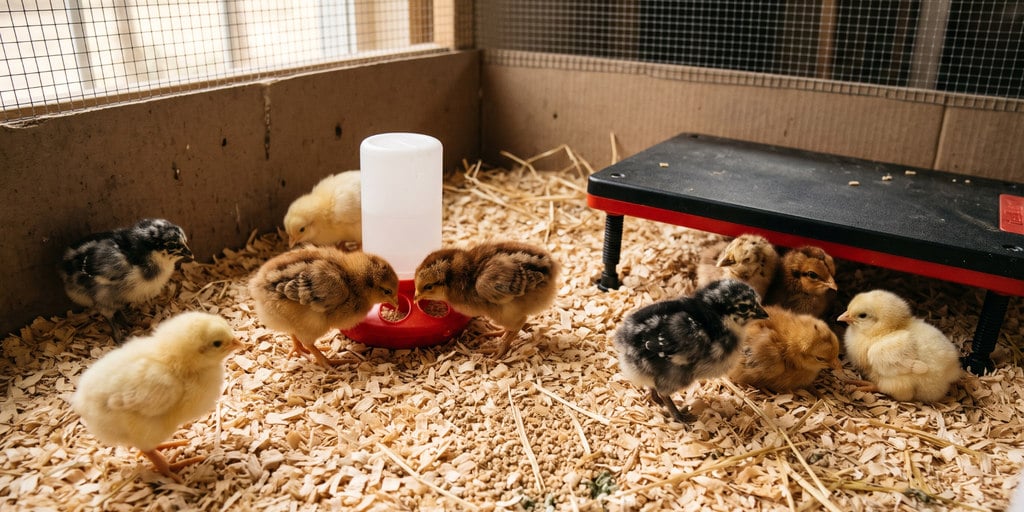
Baby chick behavior can seem unpredictable during the first two weeks. One moment, chicks may be active and exploring; a few seconds later, they may become completely still with their eyes closed.
For someone raising chicks for the first time, this can be worrying.
In fact, many of the behaviors displayed by baby chicks are quite normal. These include napping, peeping, exploration, stretching and short periods of play.
There are, however, some behaviors which require further investigation. Constant peeping, lack of strength, breathing difficulties, and an inability to stand or pass droppings are all potentially indicative of underlying issues.
This guide explains normal baby chick behavior from days 1–14, which signs need attention, and what to do when something seems wrong.
Normal vs. Abnormal Baby Chick Behavior at a Glance
| Normal baby chick behavior | When to worry |
|---|---|
| Frequent naps | Difficult to wake, weak, or unresponsive |
| Soft peeping | Continuous loud distress calls |
| Sleeping together | Tight piling or crowding that may injure chicks |
| Exploring and pecking at feed | Eating bedding or refusing available starter feed |
| Brief wing flapping | Wing injury, poor balance, or loss of strength |
| Running and hopping | Repeated falling or inability to walk |
| Gentle social pecking | Persistent attacks, injuries, or bleeding |
| Scratching bedding | Persistent agitation along with other signs |
| Lying on one side while relaxed | Unable to stand or unresponsive |
| Wing feathers developing | Skin damage or poor feather development |
| Occasional variations in droppings | Blood, persistent diarrhea, or a blocked vent |
| Resting beneath a heat source | Never leaving to eat or drink |
| Exploring warmer and cooler areas | Panting, weakness, or persistent heat avoidance |
Note: As with many areas relating to chicken health, no single behavior is conclusive for determining whether a chick is well or unwell. Age, temperature, appetite, behavior, and droppings should all be evaluated to assess a chick’s health.
Normal Baby Chick Behavior
Unlike many newborn animals, chicks hatch with open eyes, down feathers, and the ability to walk.
Chicks are precocial birds, meaning they can move and begin finding feed and water soon after hatching. They still need warmth, shelter, and care.
As they mature, healthy chicks will typically establish routines for feeding, drinking, sleeping, and exploring. They will also engage in social behavior.
What are healthy chicks like?
Generally, healthy baby chicks will:
- Have bright open eyes.
- Be alert and interested in their environment.
- Stand and walk.
- Regularly access feed and water.
- Sleep soundly at suitable times.
- Have clear nostrils and normal breathing.
- Have a clean and unblocked vent.
- Grow and develop feathers.
While most chicks will share similar characteristics, there is often variation in their levels of activity. Some chicks are more lively and others are calmer. Likewise, chicks may differ in how quickly they adapt to a new brooder.
It is important that chicks are able to undertake key functions and that their behavior does not change unexpectedly.
For a general overview of how chicks develop, please see our baby chick raising guide.
Baby Chick Behavior by Day: Days 1–14
Within the first two weeks, chicks will typically become better at locating feed and water and further develop their coordination. They will also start to become more independent.
However, this will differ for different breeds and even for individual chicks.
Day 1 – Post-hatching recovery
Newly hatched chicks can often spend a great deal of time sleeping.
As hatching is a physically intensive process, chicks then need to dry off and recover. They will also need to adapt to their new surroundings.
Normal behavior will include:
- Napping.
- Initial slightly wobbly standing and walking.
- Peeping.
- Sleeping in a warm area.
- Exploring feed and water.
- Alternating between periods of activity and napping.
Although chicks will often still have some of the yolk that they had absorbed prior to hatching, as soon as they are placed into a brooder, fresh water and suitable chick food should be made available for them.
Watch out for chicks that are weak, cannot stand, display irregular breathing, are bleeding or have a swollen navel. Also, be aware if a chick is unable to access feed and water.
Following hatching, a chick will temporarily have an egg tooth which it uses to help itself to break out of the egg. Further information on this can be found in our baby chick egg tooth guide.
Days 2 and 3 – Eating, drinking and exploring
From days two and three, chicks are often more regular in their drinking and eating habits.
Chicks frequently follow each other to food. Usually, if one chick starts to peck at food, then others are attracted to the area.
Normal behavior will include:
- Pecking at chick starter food.
- Drinking from a chick waterer.
- Scratching and exploring.
- Shifting between the heating and feeding areas.
- Napping.
- Responding to movement and sound.
Ensure that all of your chicks are accessing both feed and water.
Watch out for a chick that continually stays apart from the group. Also, be aware if another chick’s crop is empty even though the rest of the group has been feeding. Persistent peeping, weakness or failure to access feed and water are also areas concerning.
Days 4 and 5 – Increasing confidence and mobility
Many chicks will typically improve their coordination during this time. They may also become more confident in running and will often explore a larger section of the brooder.
Normal behavior will include:
- Short running.
- Flapping and stretching of wings.
- Pecking at small items.
- Following other chicks.
- Increased confidence.
- Brief social behavior and pecking.
Furthermore, you may begin to observe feather development on the wings.
Watch out for persistent falling, an awkward leg position, poor balance, or a chick becoming less confident rather than more mobile.
Days 6 and 7 – Increasing independence
Towards the end of the first week, chicks are often more familiar with their surroundings.
They will usually know where feed and water can be found and may spend increased amounts of time away from the heating source, provided that they are sufficiently comfortable.
Normal behavior will include:
- Increased independent exploration.
- Regular feeding and drinking.
- Small group sleeping.
- Increased wing movement.
- More marked feather development.
- Initial scratching and exploration.
Despite appearing increasingly independent, at this age chicks still require suitable heating.
Watch for persistent tight huddling, panting, reduced feed intake, or poor growth. Be concerned if one chick stays hunched with its eyes closed while the others are active.
Days 8 to 10 – Further coordination and social behavior
Chicks frequently become more lively during the second week.
They will often explore more, leap over small items, and engage in greater social behavior.
Normal behavior will include:
- Improved walking and running skills.
- Increased wing flapping.
- Exploration.
- Soft pecking between chicks.
- Scratching.
- Longer periods of activity between naps.
Some chicks may also begin to demonstrate dust-bathing behavior if suitable, dry bedding is available.
Watch out for persistent bullying behavior towards one chick. Also be aware of bleeding, feather damage or respiratory sounds. Finally, note if a chick fails to engage in normal behavior.
Days 11 to 14 – More lively chicks
Generally by the end of the second week, chicks differ in both behavior and appearance from those of day one.
Wings tend to display more developed feathers, and their coordination is typically further improved. Chicks are often also more confident.
Normal behavior will include:
- Increased exploration.
- Increased scratching behavior.
- Short leaps and wing-assisted movement.
- Soft self-preening.
- Initial dust-bathing behavior.
- Greater social behavior.
- More regular feeding and sleeping times.
Despite being more mobile, two-week old chicks are still susceptible to issues such as cold, heat, dehydration and disease. They should not therefore be treated in the same way as fully-feathered pullets or adult chickens.
Why Do Baby Chicks Sleep So Much?
 Share on Pinterest
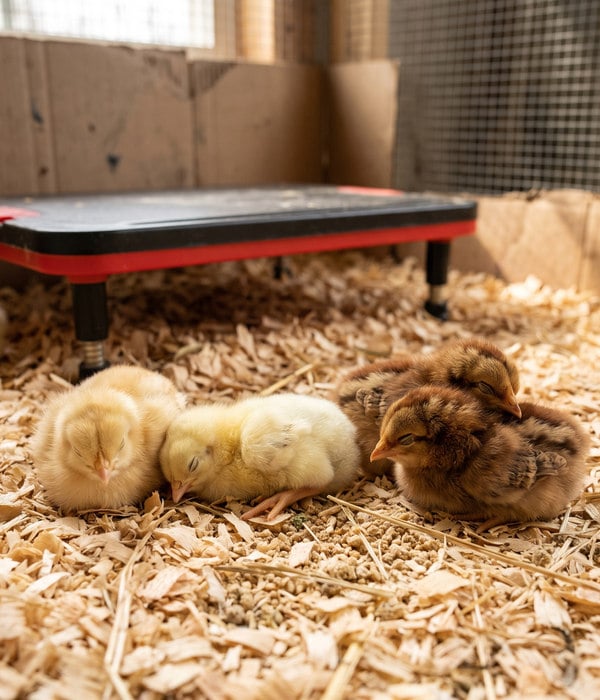
One of the most commonly raised concerns for people new to chicken-keeping is that their chicks appear to be constantly sleeping.
However, high levels of napping are quite typical for chicks within their first two weeks.
As chicks grow so fast, sleep is an important element of their development.
Normal chick sleeping postures
Chicks can be observed sleeping:
- Upright with their heads lowered.
- On their stomachs.
- On their sides with relaxed legs.
- In a group.
- Underneath a brooder heater.
- Shortly after eating.
Sometimes chicks appear to fall asleep extremely suddenly.
This can be normal if the chick is relaxed, breathing easily, and wakes and moves normally.
When should sleeping be concerning?
Concern should be aroused if a chick:
- Cannot easily be aroused.
- Is unable to stand.
- Continues to sleep with its eyes shut, despite other chicks being active.
- Does not approach feed and water.
- Appears weak, cold, or less responsive.
- Displays irregular breathing or exhibits other issues.
Whereas a healthy chick can be aroused and will then behave in a normal manner, a sick chick may continue to appear less responsive even when lightly stimulated. Therefore, do not continually arouse healthy chicks just to confirm that they are sleeping.
Further information on how chickens sleep can also be found in our chicken sleeping guide.
Understanding Baby Chick Peeping and Chirping
Chicks both communicate with each other and with their mother in a naturally brooded situation. Even when chicks are kept under artificial heating, their peeping behavior can differ.
Soft Peeping
Loud or Persistent Peeping
Constant and loud peeping often indicates that a chick is uncomfortable or is in distress.
Common causes for this can be:
- An unsuitable brooder temperature.
- Separation from other chicks.
- Inaccessibility of feed and water.
- Unexpected environmental change.
- Over-handling or exposure to alarming sounds.
- Injury or ill-health.
Initially, check the temperature, ventilation, feed, and water supply. Also, ascertain whether another chick is trapping or pecking at the affected chick.
Why is one chick continually peeping?
If one chick is persistently peeping in distress, extra attention should be given to it — particularly if the rest of the group is appearing content.
Establish whether the chick can stand, eat, drink, and gain access to warmth.
Should a chick continue to peep constantly and also appear weak or isolated, it should ideally be assessed as soon as possible by a poultry veterinarian.
Further information on other chicken sounds can be found in our chicken noises and sounds guide.
Baby Chick Huddling: Normal Behavior or Too Cold?
 Share on Pinterest
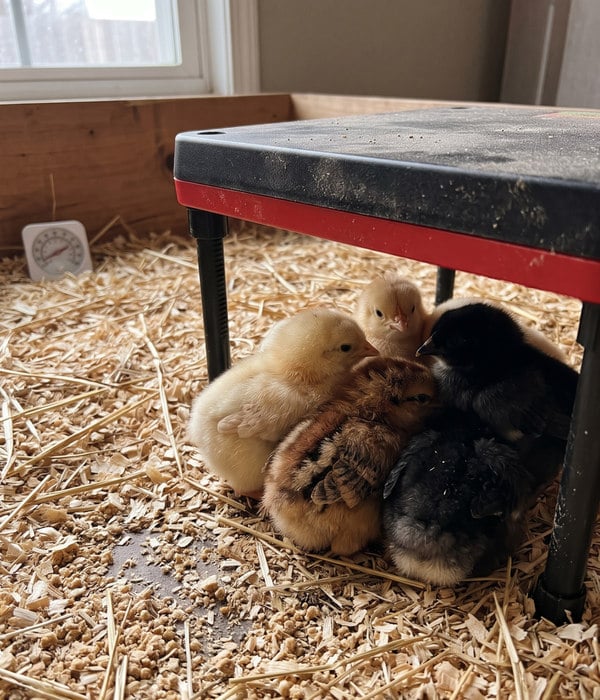
Grouping is a highly informative behavior to assess in relation to a brooder’s suitability.
While it is natural for chicks to group together, excessive and persistent grouping can suggest that the environment is not ideal.
Signs that chicks may be cold
- Grouping closely around a heat source.
- Stacking on top of one another.
- Constant and loud peeping.
- Reduced movement away from a warm area.
- Seeking warmth and therefore avoiding feed and water.
- Grouping away from a cold draft.
Cold can cause weakness, and stacking can result in injury or suffocation for the chicks in the stack.
Signs that chicks may be too hot
- Maximizing distance from a heat source.
- Panting or opening of the beak.
- Wings being held away from the body.
- Unusually spreading out and showing discomfort.
- Appearing weak or distressed.
Panting can indicate overheating, but breathing difficulties can also be caused by respiratory disease.
Persistent mouth-breathing — particularly if accompanied by neck-stretching, irregular breathing or weakness — should be investigated urgently by a veterinarian.
How to recognize a suitably set up brooder
Generally, in a brooder fitted with a top-mounted heater, healthy chicks will freely move between warmer and cooler areas and will not excessively group together or display distress. They should also be able to comfortably access food, drink, explore, and sleep.
With a radiant heater plate, chicks will typically spend time underneath it. They will, however, also exit to access feed and water. Unlike with a heater lamp, it is not essential for the air temperature within the brooder to match that of the heat source.
Appropriate positioning of a heat source, as well as general brooder setup, is explained in further detail in our chicken brooding guide.
Ideal Brooder Temperature for the First Two Weeks
Compared to older chickens, younger chickens are not as good at regulating their own body temperature.
Typically, the following temperatures are recommended for brooding with a traditional heat source:
| Age | Warm area in a traditional brooder |
|---|---|
| Days 1–7 | 90–95°F (32–35°C) |
| Days 8–14 | About 85–90°F (29–32°C) |
Again, these are only initial temperature guidelines for brooding with a traditional heat source. They are not necessarily applicable for the whole room.
Assess the temperature at chick height within the warm section of the brooder. Adhere to the manufacturer’s instructions for your chosen heating equipment and then modify the temperature according to the chicks’ behavior.
Heater plates differ from heater lamps, and so a thermometer may not give a true indication of the temperature that chicks experience under a plate. The temperature of the air should not therefore be used as the definitive measure.
For information on suitable heater plates and lamps for brooding, please see our best heat lamps for chicks guide.
Having a good quality thermometer is also a good idea for daily temperature assessment. Further information on what to look for in a good thermometer for a chicken coop can be found in our chicken coop thermometers and hygrometers guide.
Normal Baby Chick Eating and Drinking Behavior
 Share on Pinterest
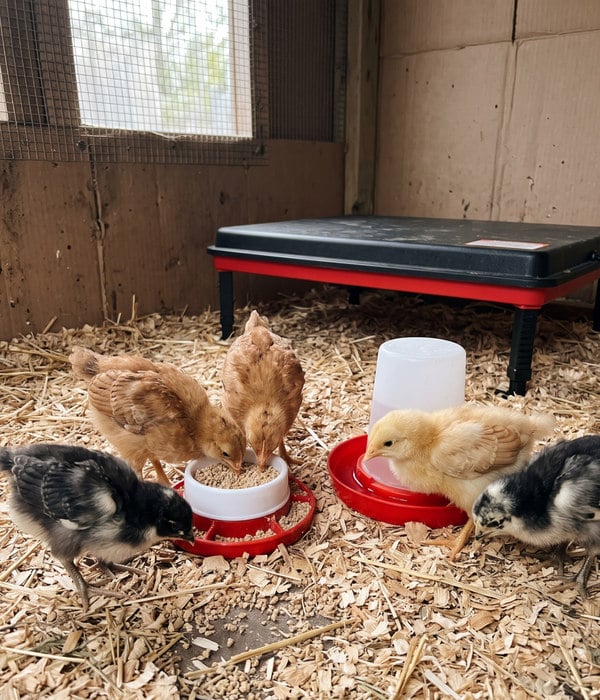
Generally, healthy chicks will regularly access feed and water during their active times.
Nevertheless, newly arrived chicks can sometimes require assistance in locating a water source.
How to Encourage New Chicks to Drink
- Add fresh water to a clean, appropriately sized chick waterer.
- Position the waterer so that it is easily reachable for chicks.
- Lightly touch the tip of a chick’s beak to the water in order to demonstrate where the water is.
- Allow the chick to drink at its own volition.
- Observe whether the chick independently re-approaches the water.
Never pour water into a chick’s mouth or throat. Incorrectly doing so can lead to aspiration.
What should chicks eat?
During the first two weeks, offer chicks food which is specifically formulated for their age and use. Chick starter food is often used as it is easier for young chicks to manage in crumble form rather than in pellet form.
Avoid incorporating non-specific foods such as kitchen waste, grain, or treats into a chick’s diet, as this can displace essential nutrients within a correctly formulated starter feed.
Our chicken feed pellets vs. crumbles vs. mash guide provides further information regarding the differing types of chicken feed.
When should eating behavior be concerning?
Investigate if a chick:
- Fails to consistently eat available chick starter food.
- Does not seem to drink.
- Struggles to swallow.
- Has a crop that is abnormally empty in comparison to other regularly feeding flock members.
- Gradually becomes weaker or smaller.
- Cannot stand at a food source.
Young chicks can quickly become unwell if they are unable to locate and access feed and water.
Further information can also be found in our fresh water for growing chicks guide.
Normal and Abnormal Baby Chick Droppings
Droppings can be informative in relation to a chick’s digestive and hydration status and can also provide an indication of its health.
However, it is not possible to determine precisely which illness a chick may be suffering from, simply from evaluating its droppings.
Normal chick droppings
Depending on a chick’s diet, hydration, and digestive function, healthy chicks can produce a variety of fecal colors and consistencies.
Typically, droppings will:
- Be brown or tan in color.
- Contain white urate.
- Be soft yet formed.
- Occasionally be darker or softer in consistency.
White material is often present within a chicken’s droppings. This is generally normal and is known as urate. It is a by-product of a chicken’s excretory system.
Abnormal chick droppings
If you observe any of the following, then consult a veterinarian:
- Blood in the droppings.
- Persistent, runny droppings.
- Consistently abnormal droppings in conjunction with weakness.
- A distended or painful abdomen.
- Evidence of dehydration.
- Blockage of the vent by droppings.
While not all loose droppings are necessarily a result of coccidiosis or another particular infection, it is important not to jump to conclusions. A veterinarian may wish to examine a fresh fecal sample to help to identify a chick’s illness.
What is pasty butt?
Pasty butt (or pasted vent) is when a chick’s vent area becomes coated and then dries out in droppings.
This can impede normal excretion and can prove hazardous.
If a chick’s vent is blocked:
- Ensure that it is warm and handle it carefully.
- Apply a soft cloth and comfortably warm water to the area to moisten the dried droppings.
- Carefully remove the softened material, taking care not to tug at any feathers or skin.
- Dry the area.
- Return the chick to suitable warmth and monitor it.
Never attempt to forcibly remove droppings that are firmly attached, as this may damage sensitive skin.
Should a blockage fail to resolve, if a chick is weak or if there is skin protrusion, then again, it is advisable to consult a poultry veterinarian. The pasty butt issue may also recur. Please see our pasty butt in chickens guide for more detailed information on this topic.
Why Do Baby Chicks Peck Each Other?
Baby chicks will typically begin to explore their surroundings very soon after hatching.
Their beaks can then be used to both examine and consume food, scratch, and also peck at other chicks.
Not all pecking behavior is necessarily aggressive.
Normal early pecking behavior
Chicks may:
- Peck at another chick’s down.
- Scratch at another chick’s feet.
- Peck at moving items.
- Follow another chick to food.
- Briefly compete for an interesting location.
Such behavior may be both exploratory and socially relevant.
while there is a more structured pecking hierarchy in older chickens, this is not fully in place on day one. Rather, it is developed over time.
When does pecking become problematic?
Interfere if:
- A chick continually becomes the target of pecking.
- Pecking results in a chick bleeding or sustaining skin damage.
- A chick is unable to access feed and water.
- Other chicks persistently pursue or corner a chick.
- Pecking is directed at a wound or sore vent area.
Investigate whether the brooder is overcrowded. Also, assess whether there is sufficient feeding space. Too much light can also be an issue. Additionally, examine the chicks for signs of injury or assess the environment for other potential stress factors.
If required, isolate and safely house the affected chick in a warm area and then seek veterinary advice.
Further information on preventing and managing pecking behavior can be found in our guide to why chickens peck each other.
Normal Baby Chick Running, Hopping, and Wing Flapping
As chicks develop, they often display bursts of energetic behavior.
They can run, hop, and flap.
Normal behavior
- Can include:
- Running.
- Flapping (one or both wings).
- Hopping over minor obstructions.
- Flapping on waking.
- Scratching and pecking.
- Balancing.
Chicks can be especially lively if they are in a good environment and have had a rest.
Abnormal behavior
This can consist of persistent falling, lameness, extreme lack of balance, or inability to stand.
Possible reasons for these issues include trauma, disease, poor foot placement, or nutrition.
Ensure that the floor is not too slippery. Also check that your chick has access to suitable heating, food and water.
Do not attempt to manually manipulate a chick’s legs or make homemade leg supports — only do so on the recommendation of someone qualified.
A chick that cannot stand or walk should be assessed promptly. See our chicken unable to stand or walk guide for important warning signs.
Why Do Baby Chicks Stretch Their Wings and Legs?
Flapping and extending are both common behaviors.
Chicks can flap one wing, extend a leg, or flap both wings on waking.
Provided a chick soon resumes normal behavior, this is typically not a cause for concern.
Normal behavior
- Is brief.
- Does not seem to cause discomfort.
- Tends to occur alongside other behavior.
- Does not impede a chick’s walking.
- is not associated with extreme lack of energy.
Abnormal behavior
Be concerned if a chick continually turns its head, is unable to keep its head upright, walks round in circles, or suffers from a continuing lack of coordination.
There are several possible reasons for these symptoms, and they should not be diagnosed based on appearance alone.
For possible causes, warning signs, and veterinary care, see our wry neck in chickens guide.
Baby Chick Scratching, Preening, and Early Dust Bathing
Scratching and floor investigation are natural behaviors for chickens.
Chicks will often peck at and scratch at their bedding. They may also investigate items within a brooder.
Is scratching normal for a two-week-old chick?
Yes. Even at a young age, chicks can demonstrate early scratching behavior. More advanced floor investigation behavior tends to develop as they age.
Supply suitable, non-slip and dry bedding so that chicks do not ingest excessive unsuitable material.
Why do chickens preen?
Preening involves using the beak to reshape and clean a chicken’s feathers.
Chicks may preen their wings, touch their down with their beak, or preen following a rest period.
This is generally normal behavior for an active chick with healthy skin.
Can two-week-old chicks dust-bathe?
Around one to two weeks of age, some chicks will demonstrate early dust-bathing behavior.
They may sit in dry, loose material, flap their wings or rub themselves against their bedding.
There is no need to put a chick in a dusty container to encourage dust-bathing behavior. Also avoid supplying materials that create excessive levels of airborne dust and ensure that young chicks are not exposed to dirty soil.
Why Is One Baby Chick Smaller or Less Active?
Chicks can all develop at slightly different rates.
Factors such as breed, genetics, date of hatching, and personal development can all influence a chick’s initial size and activity level.
Even if a chick is naturally more petite, it can still be healthy so long as it is able to eat, drink, walk, and grow.
However, if a chick is gradually becoming less active or more petite or less lively than the rest of the flock, then this should be addressed.
What to look for
- Can the chick access the feeder?
- Is it drinking adequately?
- Is its vent clear?
- Can it stand and walk easily?
- Is it being bullied by other chicks?
- Is it maintaining suitable body temperature?
- Is it gaining weight?
Regularly weighing a chick (using a suitable small scale) can be a good way of assessing its growth, as this can at times be hard to determine visually.
Do not give extra vitamins or medications without understanding why a chick is growing unwell. Nutrition may be one factor, but other conditions are possible. Our nutritional deficiencies in chickens guide explains why diagnosis matters.
Normal and Abnormal Baby Chick Breathing
Well chicks should be able to breathe easily. They should not continuously gasp or struggle to breathe and should not make atypical breathing sounds.
A chick’s breathing can alter in response to its level of activity and the ambient temperature.
Abnormal respiration
- Open-mouth breathing.
- Continuous gasping.
- Extending the neck to aid respiration.
- Wheezing or atypical noises.
- Discharge from the nose or eyes.
- Respiratory issues together with lack of energy.
Initially establish whether the brooder is either too hot or inadequately ventilated. However, temperature is by no means always the root cause of respiratory concerns.
Similar symptoms can also be caused by respiratory disease or other serious conditions.
Prompt veterinary attention should be sought for a chick that is having breathing difficulties.
For more details, see our chicken gasping for air guide and chicken sneezing and coughing guide.
Early Signs of Illness in Baby Chicks
Occasionally, chicks can seem well but then become unwell.
As prey, chickens may even instinctively hide any signs of poor health.
Carefully watching a peaceful, undisturbed flock can be highly informative.
Important behavior to recognize and investigate promptly is
- Persistent inactivity, despite the rest of the flock being active.
- Repeated refusal to eat or drink.
- Excessively hunched body.
- Keeping eyes shut during times when a chick should generally be awake.
- Abnormal droppings.
- Pasted vent.
- Lack of good body balance or lameness.
- Poor growth.
- Being bullied.
- Constant vocalisation concerning.
Urgent situations to address
Please consult your poultry veterinarian as a matter of urgency if a chick:
- Is unable to stand or is unresponsive.
- Is gasping or having breathing difficulties.
- Suffers from major bleeding or has sustained serious injuries.
- Has a visibly blocked vent and is also lacking energy or is vocalising in concern.
- Experiences fits, paralysis, or extreme lack of coordination.
- Is rapidly becoming unwell.
If several chicks suddenly fall ill or die, then again please seek urgent poultry veterinary advice. Alternatively, contact the relevant animal health body.
Never randomly administer antibiotics or pain relief and other drugs. Appropriate action will depend on the underlying issue.
What to Do When a Baby Chick Acts Abnormally
It is best to adopt a uniform course of action.
Assess the brooder temperature
Observe the behavior of the whole flock.
Are they clustering together, avoiding the heat source, panting, or comfortably shifting between different areas?
Ensure that the temperature of the ‘warm area’ is correct. Refer to the operating instructions for your heating appliance.
Assess food and water availability
Confirm that your chick can access clean water and starter feed.
Check for a toppled waterer, empty feeder, damp litter, or larger chicks blocking access.
Gently assess the chick
Investigate its eyes, nose, legs, and body shape. Also assess its respiration and check for fecal vent blockage.
Do not excessively press on a chick’s crop. Avoid over-handling.
Shield the chick (if required)
Should a chick become the target of bullying behavior, place it in a safe, temporary area. Ensure that this has suitable heating and ventilation.
Maintain good hygiene and do not allow a potentially infected chick to mix with another flock.
Obtain suitable veterinary care
Seek urgent veterinary advice for a chick which is lacking energy, unresponsive, unable to stand or experiencing breathing difficulties.
Even for less immediately obvious but continuing concerns, it is better to book a veterinary appointment rather than wait several days in the hope that a chick’s condition will not then rapidly worsen.
How to Encourage Healthy Baby Chick Behavior
Good brooder husbandry encourages good behavior and can help to avoid numerous avoidable issues.
Heat
Ensure that there is both a suitable warm and a cooler area. Follow the safety guidelines for your heating appliance and daily check its operation.
Water
Provide fresh water in a clean, shallow, chick-safe waterer.
Ensure that the smallest chick can access the water without becoming wet or becoming stuck.
Food
Offer a complete chick starter feed and make sure feeders are easy to access. Do not replace balanced starter feed with treats.
Bedding
Suitable bedding should provide traction, absorb moisture, and support hygiene. For material choices, see our pine shavings for chickens guide.
Avoid using flooring which is too slippery. Also do not use plastic, newspaper or litter which is too smooth or damp. Steer clear of loose materials which present safety risks.
Space
Ensure that all chicks can easily access food, water and heat and are not continually being bullied off of these.
As chicks grow, increase the available space. Do not use a brooder that soon becomes overcrowded.
Rest
Provide a quiet environment and minimize unnecessary handling.
Lighting
Provide enough light for chicks to find food and water, while allowing normal rest once they are established. Lighting needs depend on chick age and the brooder setup.
Assess each chick
While it is often reasonable to assume that a flock is well, it is important to recognize if one chick is continually lagging behind or displaying different behavior from the rest.
For more on social and environmental care, see our chicken behavior guide.
Daily Baby Chick Health Checklist
Many emerging issues can be recognized through morning and evening assessment.
| What to check | Healthy signs | Concerning signs |
|---|---|---|
| Activity | Alert when awake | Persistent weakness |
| Temperature comfort | Moving between warm and cooler zones | Tight huddling, distress, or panting |
| Feed | Regular visits to the feeder | Refusing feed |
| Water | Drinking normally | Not drinking or showing dehydration signs |
| Walking | Normal balance | Limping or repeated falling |
| Breathing | Easy and quiet | Gasping or wheezing |
| Vent | Clean and open | Hardened droppings or swelling |
| Droppings | Some normal variation | Persistent diarrhea or blood |
| Social behavior | Normal interaction | Bullying or isolation |
| Growth | Gradual weight gain | Poor growth or weight loss |
Observe the chicks quietly first, then check their feed, water, bedding, temperature, and individual behavior.
Note any unusual behavior, particularly if this is recurring.
Common Baby Chick Care Mistakes
While not always infection-related, environmental factors can also cause behavioural issues. Avoid making the following common errors:
- Overheating the brooder. Chicks should be able to move away from a heat source.
- Disregarding persistent clustering. This can be an indication of cold, drafts or other concerns.
- Supplying a slick floor. Poor grip can contribute to leg issues.
- Providing one hard-to-access feeder. Smaller chicks can experience difficulties in reaching food.
- Permitting damp bedding to form. Dampness promotes both cooling and poor hygiene.
- Over-handling chicks. This can adversely affect rest.
- Assuming that all inactive chicks are sleeping. Nevertheless, continued inactivity can sometimes be an early indicator of poor health.
- Administering unnecessary vitamins or drugs. This can hinder accurate diagnosis.
- Do not ignore differences in growth. If one chick consistently grows unwell, investigate the cause.
- Introducing chicks to the outside too soon. Although two-week-old chicks may wish to go outdoors, they are not automatically ready to do so without supplementary heating.
The right time to move chicks outdoors depends on feathering, weather, age, and shelter. See our moving chicks outdoors guide for safe transition steps.
Frequently Asked Questions About Baby Chick Behavior
Is it normal for baby chicks to sleep for long periods?
Although baby chicks often nap, particularly during the initial days following hatching, they should also regularly become active. They should eat, drink and engage with their surroundings. A chick that is persistently lacking energy, cannot easily be aroused or has no interest in feed and water should be addressed.
Why does a baby chick suddenly fall asleep?
Chicks can swiftly move from activity to rest. Even seemingly fully alert chicks can seemingly instantly fall asleep, particularly after eating or investigating. Usually this is not concerning if a chick then resumes normal behavior.
Why is my baby chick lying on its side?
Some chicks lie on their sides when asleep. Confirm that your chick is breathing normally, can be aroused, and can stand without difficulty. Should your chick fail to respond, be unable to stand, or continue to lack good body balance, then veterinary advice should be sought.
Why are my baby chicks constantly peeping?
Continuous loud peeping can be an indication that a chick is cold, isolated, hungry, thirsty or unwell. Assess the temperature, water, food and bedding. Additionally, check the positioning of the chicks. If one chick persists in peeping and also appears to be unwell or behaves abnormally, then veterinary advice should be obtained.
Why do baby chicks run so fast?
Short running and hopping spurts are often typical behavior for young chicks. As they improve their coordination, chicks commonly investigate more confidently and will frequently practice their balancing and wing-flapping skills.
Is it normal for baby chicks to peck at each other?
Gentle pecking behavior can be normal. However, persistent aggressive pecking which leads to wounds or results in a chick being excluded from feed and water is unacceptable and should be rectified.
Do baby chicks require periods of darkness in order to sleep?
while it is important for chicks to rest, the ideal lighting regime will depend on a chick’s age, food requirements, and brooder set-up. Newly arrived chicks can benefit from extended light exposure so that they can learn to find food and water. Once a flock is well-established, implement a suitable light and dark schedule, but do not disrupt essential heating. Never turn off an essential heating appliance purely to darken a brooder.
Why is one chick continually beneath the heat plate?
While chicks naturally seek out a heat plate for both warmth and rest, a chick which is persistently underneath it may be feeling too cold, or may lack energy or be unwell. It may also be infrequently eating or drinking. Investigate the heating provision and carefully monitor the chick.
Why is one chick smaller than the others?
While some initial size variation can be normal, gradual poor growth, lack of energy, food avoidance or mobility issues should be investigated. As well as visually assessing a chick, it is also important to monitor both its behavior and weight.
Can two-week-old chicks dust-bathe?
Yes. Around one to two weeks of age, some chicks will exhibit early dust-bathing behavior. They may flap their wings or rub themselves against appropriate dry and loose bedding. Do not supply dusty or dirty materials solely for the purpose of encouraging dust-bathing behavior.
How can I tell if my baby chicks are content?
Generally, content chicks will happily eat, drink, investigate, and rest. They should also be able to comfortably move between warm and cooler areas. Furthermore, they should steadily grow and respond well when awake. Unfortunately, there is no single indicator of good health for all chicks. Behavior should therefore be evaluated alongside regular health assessment.
When should I consult a veterinarian for my baby chick?
Urgent veterinary attention should be sought if a chick is having breathing difficulties, is unable to stand, is unresponsive, or has suffered serious injury. Also, rapidly worsening conditions should be addressed urgently. Prompt veterinary assessment should additionally be arranged for a chick that is persistently lacking energy, is growing poorly, has atypical droppings, is not eating or is experiencing ongoing issues. Compared with adult chickens, young chicks can become seriously ill much more quickly.
Final Thoughts
Within the first 14 days of raising, baby chicks undergo many changes. Frequent napping, mild peeping behavior, scratching and bursts of activity are often all typical of a chick’s early development.
Above all, it is important to be able to discern between comfortable and persistently uncomfortable behavior.
Observe how a chick moves between areas of differing temperatures, as well as to and from food and water. Assess respiration, body shape, and droppings. Pay particular attention to behavior if one chick starts to act differently from the others.
By ensuring good brooder husbandry, supplying suitable chick starter food and providing clean water, and by carrying out regular assessment, you can both encourage good behavior and identify potential concerns.
While observation is a valuable tool, it should never replace veterinary diagnosis. Should a chick become unwell, experience breathing difficulties, be unable to stand, or rapidly worsen, professional veterinary advice should be sought.
Sources and Further Reading
The following poultry extension and veterinary information sources provide further details on brooding, chick development, health and behavior.
- University of New Hampshire Extension — Brooding and Caring for Chicks
- Penn State Extension — Brooding of Domestic Fowl
- Poultry Extension — Brooding Poultry Hatchlings
- Poultry Extension — Normal Behaviors of Chickens
- Merck Veterinary Manual — Behavior of Poultry
- Poultry Extension — Common Signs of Illness in Poultry
- CDC — Backyard Poultry and Human Health
