
A chicken run can look fine when dry, but once it rains heavily, you will find your chickens start scratching in the wet soil. You will also see muddy footprints around the feeder, and it can become difficult to keep clean around the coop door.
Choosing the best chicken run flooring requires you to consider how well it drains, how comfortable it is, how easy it is to keep clean and how it will hold up in the weather.
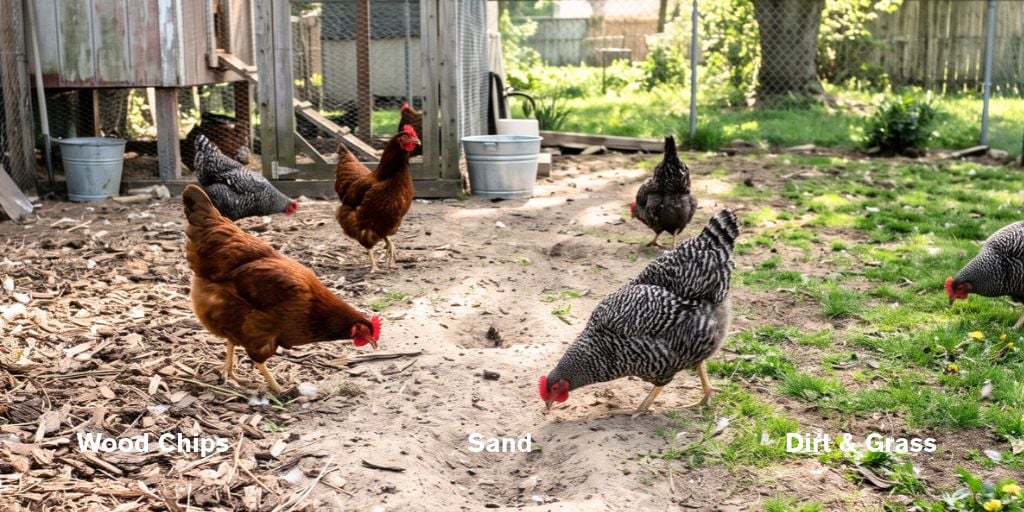
For most backyard flocks, coarse untreated wood chips will work well for an outdoor run. If you have a covered run, sand may work better. Gravel can be useful for drainage but may not be as comfortable.
Dirt and grass can work well, but if you have a small permanent run and lots of daily traffic, it may not be the best choice.
In this post I will show you the main options for flooring your chicken run. I will explain the pros and cons of each option and how much they will likely cost. I will also look at some useful products available from Amazon.com and how to choose the best option. I will also show you common flooring mistakes.
Affiliate Disclosure: As an Amazon Associate, I earn from qualifying purchases. This post may contain affiliate links.
What is the Best Flooring for Chicken Runs?
The best flooring will depend on whether your run is covered, how well the soil drains, and how much time your chickens spend in the run. Something that works well in a dry covered run may not be pleasant in an open run with frequent rain.
Overall, I would start with untreated coarse wood chips. If you have a typical outdoor run with reasonable drainage, this will work well. If you have a consistently dry covered run, coarse washed sand can be easier to scoop.
Gravel can be a good option for drainage and high-traffic areas but may not be as comfortable. Grass and dirt will be a better option if your chickens have enough space.
It is important to remember that outdoor poultry flooring should be dry, durable, and easy to manage (University of Kentucky Cooperative Extension). High traffic earthen flooring can become compacted and muddy.
Quick Comparison Table
| Material | Cost | Drainage | Maintenance | Best for |
| Coarse untreated wood chips | Low–medium | Good if base drains well | Raking and topping up | Outdoor runs |
| Coarse washed sand | Medium–high | Depends on underlying drainage | Frequent scooping | Dry, covered runs |
| Gravel | Medium–high | Useful as drainage base | Difficult if exposed to droppings | Base layers and high-traffic areas |
| Natural dirt | Very low | Depends on soil | Scraping and leveling | Large or dry runs |
| Living grass | Low initial cost | Good until compacted | Resting, mowing and reseeding | Large rotational runs |
| Raised poultry flooring | High per sq. ft. | Some separation from wet ground | Clean above and below | Small targeted areas |
Note: Costs are relative and will vary depending on delivery, depth, labor, and availability locally.
1. Wood Chips – Best Overall for Many Outdoor Runs
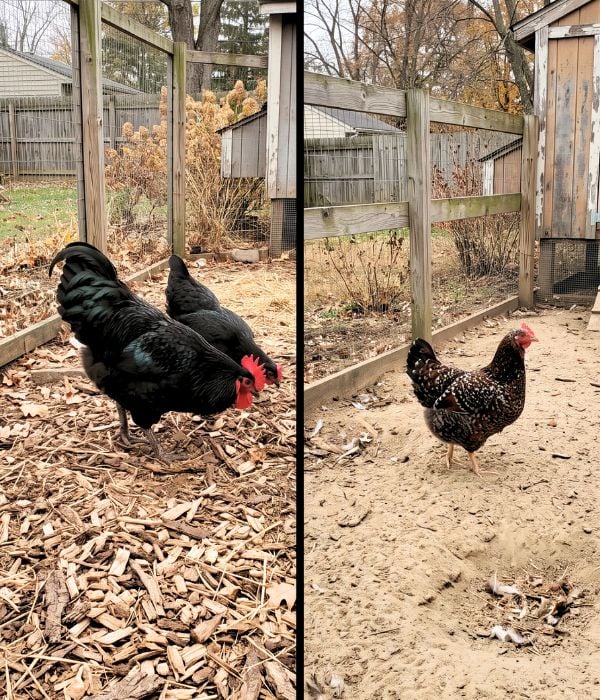
Wood chips are a popular option as they give a nice loose surface for your chickens to scratch and explore. The gaps between large chips can help drain water if the base has good drainage.
A good surface can make your run more comfortable than compacted dirt. However, it will not fix drainage issues and will eventually rot or get dirty.
What Wood Chips to Choose?
Choose clean untreated wood chips. Choose a coarse option with minimal fine dust. Avoid any wood chips that have paint, building waste, chemicals, sharp objects, and anything else you can’t identify.
Arborist chips can be a cost-effective option if you can get them locally. Just make sure you know what trees and other materials have been chipped. Be cautious of fresh, wet, or moldy wood chips. Never introduce dirty wood chips into your poultry area.
Pine and hard wood can both be used in the right environment for your poultry. Just make sure they are clean, dry and have the right particle size. Wood chips can be used as litter for poultry, but if they are too wet, it can cause problems (University of Georgia Extension).
Pros
- Provides a loose surface for scratching.
- Often available from local tree services or landscaping companies.
- Can be spread and topped up easily.
- More comfortable than sharp exposed aggregates.
- Organic material can be removed for composting or disposal.
Cons
- Will rot and need topping up.
- Can become moldy and smelly if constantly wet.
- Can hide build up of droppings.
- Fine chips can mix with mud.
- Quality and type can vary with delivery.
My Recommendation
If you have a permanent outdoor run and have controlled roof water and standing water, wood chips can be a good starting point. Keep the depth to a manageable level and regularly check. Remove any that becomes constantly wet or moldy.
For more information on preventing mold see our Mold in Chicken Coops Guide. If you are using an organic deep litter system the same principles apply but an outdoor run will not be managed in the same way as an indoor coop.
2. Sand – Best for Covered Runs with Good Drainage
Sand can be a good option as droppings will be easily identifiable. If it stays dry you can easily scoop dirty areas without having to replace all of the sand.
Chickens will naturally use loose mineral material for dust bathing. A meta-analysis published in Frontiers in Veterinary Science found chickens generally preferred to dust bathe in sand or peat moss.
However, if there is water collecting underneath it may not be the best option. If the base doesn’t allow water to drain away the sand can become wet, heavy and difficult to manage.
What Sand to Choose?
Choose coarse washed sand with minimal fine dust. Don’t assume all sand labeled as play sand, masonry sand or building sand will be the same. Ask the supplier what is in the sand.
Check for any contamination, excessive dust or sharp objects. Try to avoid getting sand in your feeders and waterers.
Pros
- Easier to identify droppings.
- No rotting.
- Good for dust bathing if dry.
- Easy to level.
- Suitable for small covered runs that can be cleaned frequently.
Cons
- Can be heavy and costly to move.
- Doesn’t improve poor drainage.
- Can become damp and difficult to manage after frequent rain.
- Fine or dusty can affect air quality.
- Can be labor intensive to remove.
My Recommendation
I would only consider using sand if you have a covered run with a stable well-drained base. If you have an open run with clay soil that becomes standing water after every rain it won’t be as appealing.
Ensure you have good ventilation around your run even if the roof is covered. See our Chicken Coop Ventilation Guide for practical tips.
3. Gravel – Best for Drainage or Specific Areas
Gravel can be a good option if you need a more stable base. With the right design you can use aggregate to help support your surface and manage water. However, loose stones may not be the best option for your chickens to walk on. They need to be able to scratch and sharp, rough or unstable stones can cause unnecessary worries.
Pea Gravel or Crushed Gravel?
Pea gravel will generally have smoother edges but can trap droppings and feed between the stones. Crushed aggregate can be useful for some base applications but may not be as comfortable for your chickens.
Often it makes more sense to use gravel as a base with a suitable top layer. The right design will depend on your soil type, drainage and intended use.
Pros
- Useful for some drainage and base applications.
- No rotting.
- Can help stabilize high-traffic areas.
- Available in different sizes from local suppliers.
- Can help create a more durable flooring system.
Cons
- Uncomfortable to walk on.
- Can trap droppings.
- Difficult to fully clean.
- Heavy and costly to move.
- Doesn’t fix standing water without proper drainage.
My Recommendation
Use gravel if you need it for a specific drainage or structural reason. If your chickens are scratching the majority of the time consider using a suitable soft top layer.
If you are also rebuilding your run see our Chicken Fencing Ideas Guide for practical fencing ideas. Don’t worry about the flooring as it won’t necessarily stop predators digging under.
4. Dirt (Natural) – Cheapest but Not Always the Easiest
If you already have suitable ground this will be almost free. Your chickens can scratch, peck and dust bathe in dry soil.
However, if you have too many birds scratching in a small area the surface can become poor. All vegetation will disappear, the soil will become compacted and manure and water can build up where they stand frequently.
Pros
- No major purchase.
- Supports natural scratching and dust bathing.
- Easy to start with in a dry large run.
- No heavy bulk material to move.
Cons
- Can become muddy in the rain.
- Compacted so drainage is poor.
- Difficult to fully sanitize.
- Needs leveling periodically.
- May not hold up to heavy use in a small permanent run.
My Recommendation
If you have a large area or naturally well-drained ground this will be a more practical option. If you have a small permanent run plan to add extra drainage or a replaceable surface.
5. Grass – Best for Large or Rotational Runs
A grass run will look nice and give your chickens the chance to forage. This can be a great option if you are rotating your chickens.
The issue is keeping the grass alive with constant scratching. Once the grass disappears you will be left with compacted soil.
Pros
- Natural surface for foraging.
- Comfortable if healthy.
- No permanent artificial cover.
- Can be a great option for rotational poultry.
Cons
- Difficult to maintain in a small permanent run.
- Can disappear quickly with a large flock.
- Needs resting and reseeding.
- Can become muddy if wet or damaged.
- Some areas will need extra shade or seasonal protection.
My Recommendation
Use grass if you have enough space to rotate your flock. See our Guide to Raising Free-Range Chickens for more information.
Remember in the summer you will need to provide your chickens with the right shade and water. See our Summer Chicken Cooling Guide.
Why Chicken Runs Get Muddy
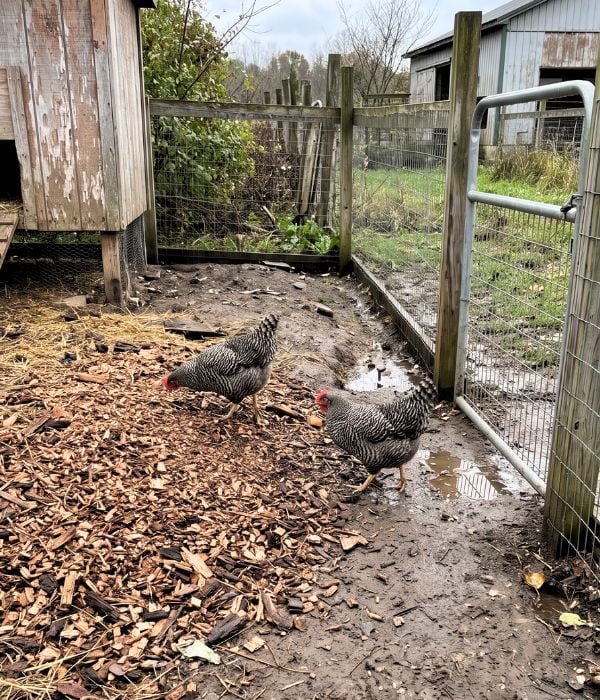
It can be helpful to understand why your run is getting muddy. It could be due to the run being in a low area, poor soil or water running into the run.
Another common issue is roof water. If your gutters or drainage aren’t set up correctly water can run into your run. Leaky waterers can also cause constantly wet areas, often around your feeders and coop door.
A thick layer of fresh material may help temporarily but over time the soil can become saturated. The droppings and flooring will also mix.
Improving Drainage
- Check after rain to see where water is pooling.
- Check the surrounding area to see if water is running in from elsewhere.
- If possible redirect roof water away from the run.
- Fix any leaky waterers and move equipment away from constantly wet areas.
- Consider if you need to regrade the ground or install a properly designed drainage system.
- Only choose a suitable top layer once you have resolved the water issue.
Don’t dig trenches or install underground drainage without considering where the water is going. This can just cause the problem elsewhere in your yard or cause erosion.
A good first step is to check your watering system. If you are getting a lot of mud around one of your waterers see our Best Chicken Waterers Guide.
Best Amazon Products For Chicken Run Flooring
While it is not necessary to buy bagged flooring products, the cost can be significantly cheaper to buy in bulk to lay a large area. The following are more like accessories for maintaining, laying and protecting your flooring.
1. Walensee Heavy Duty Dual-Sided Bow Rake – Best For Spreading
As an Amazon Associate I earn from qualifying purchases. This article contains affiliate links. If you buy through these links, I may earn a commission at no extra cost to you.
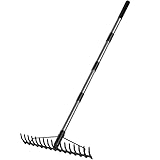
This bow rake is designed to help to loosen soil and level materials like mulch or gravel. The bow can be used on both sides and has a long metal handle to help to spread new wood chips or maintain uneven flooring.
This has a long 63″ handle and 17 steel tines. If you regularly top up your flooring this can be a better option than trying to spread with a small shovel.
Pros
- Dual sided bow
- Can be used on multiple landscaping products
- Long handle
- Metal for outdoor use
- Can be used outside the chicken area
Cons
- Not suitable for small droppings in sand
- Metal tines can dig up buried fabric or shallow barriers
- Can be bulky for small enclosed areas
Best For: Those with a medium or large sized run who regularly spread wood chips, gravel or soil.
Not Best For: Small runs with a covered sandy area who need a fine cleaner.
Check Walensee Bow Rake on Amazon.com
2. Gorilla Carts GOR4PS Poly Garden Dump Cart – Best For Moving

As an Amazon Associate I earn from qualifying purchases. This article contains affiliate links. If you buy through these links, I may earn a commission at no extra cost to you.
This four-wheel garden cart has a polyethylene tray with a quick dump function. It can be used to move soil, mulch, gravel or other landscaping products.
The tray will hold 4 cubic feet of material and has a maximum load of 600 lb. Depending on the ground, weight distribution, tire condition and manufacturer instructions this may vary.
If you are replacing your entire flooring this can be one of the most labor intensive parts. Using a dump cart can help to reduce the amount of awkward trips with a shovel and bucket.
Pros
- Large tray
- Quick dump function
- Four wheels so easier to pull
- Can be used for other garden projects
- Tray can be cleaned
Cons
- More expensive than a basic bucket or shovel
- Needs to be stored
- Tyres require maintenance
- Heavy items can still be difficult on slopes or muddy ground.
Best For: Those with a large run or regular garden maintenance.
Not Best For: Those with a small run who can easily move one or two bags.
Check Gorilla Carts GOR4PS on Amazon.com
3. DuraScoop Jumbo Metal Litter Scoop – Best For Cleaning Dry Sand

As an Amazon Associate I earn from qualifying purchases. This article contains affiliate links. If you buy through these links, I may earn a commission at no extra cost to you.
The DuraScoop is an aluminum litter scoop that will help to separate solid material from granules. While it is for cat litter it can be useful for spot-cleaning a small dry sandy area if the gaps are the right size for the sand.
The deep scoop and fairly wide head can help to pick up visible droppings. However, poultry droppings aren’t the same as cat litter so you may not get a clean separation.
This is one of those products that only makes sense if you have chosen a certain flooring type. If you have a sandy run with coarse wood chips there isn’t much point in using a sand scoop.
Pros
- Metal
- Reusable & Washable
- Can help to separate larger waste from suitable granules
- Relatively small for storage
- Good for regular cleaning.
Cons
- Designed for cat litter not chickens
- Depends on the size of the sand granules and moisture
- Not suitable for large wood chips or gravel
- Too small for major flooring replacement.
Best For: Small covered sandy runs and those wanting to try a reusable cleaner.
Not Best For: Managing wet, muddy or wood chip covered ground.
4. CARTMAN 10 x 12ft Waterproof Tarp 2-Pack – Best For Temporary Rain Protection

As an Amazon Associate I earn from qualifying purchases. This article contains affiliate links. If you buy through these links, I may earn a commission at no extra cost to you.
This tarp comes in a 2-pack of polyethylene with reinforced edges and metal eyelets. This one is around 8 mil thick and suitable for general outdoor use.
A properly installed tarp can help to reduce the direct rain hitting part of the chicken run. However it shouldn’t be used as a permanent roofing solution. Water should be directed away from the run.
It will need to be securely supported, sloped and protected from wind. Having loose edges, water pooling and poorly secured cords can be a risk to your poultry.
Pros
- Provides temporary rain protection.
- Multiple attachment points.
- Can be used for other outdoor projects.
- Can help keep a small covered area drier.
- 2-Pack gives flexibility.
Cons
- Not a permanent roofing solution.
- Can easily be torn or blown away if not properly supported.
- Water can pool and overload the support.
- Can reduce airflow if not installed correctly.
- Will need to be checked regularly.
Best For: Those who need to provide temporary protection to part of your run.
Not Best For: Expecting a loose tarp to be a safe and durable roofing solution.
Check CARTMAN Tarp on Amazon.com
5. Amagabeli 1/2 Inch Galvanized Hardware Cloth – Best For Securing The Run

As an Amazon Associate I earn from qualifying purchases. This article contains affiliate links. If you buy through these links, I may earn a commission at no extra cost to you.
This welded wire mesh comes in a 48″ wide roll that is 50’ long. It has 1/2″ gaps and the wire is galvanized for outdoor use and animal enclosures.
This isn’t intended to be used as a direct flooring solution. However it can be used as part of a properly installed barrier to the walls of the run or around the edge if you have digging predators.
Any buried aprons should be installed so there are no sharp edges, cut ends or loose wire that could be accessed by the birds. The quality of installation will be as important as the wire itself as predators will look for gaps and poorly attached items.
Pros
- 1/2″ gaps
- Welded wire
- Outdoor use
- Can be cut to fit different sized perimeters
- Can be used for run and coop protection.
Cons
- Will need the correct tools and gloves.
- Edges can be sharp.
- Can be heavy to handle.
- Won’t replace secure doors/latches.
- Not intended to be walked on.
Best For: Those looking to improve ground-level security or replace poor poultry wire.
Not Best For: Those who only need a top layer that will absorb.
Read our Chicken Wire vs Hardware Cloth Guide to find out how to choose the right protective mesh.
Check Amagabeli Hardware Cloth on Amazon.com
6. Hatching Time Poultry Slat Flooring – Best For Specific Raised Flooring

As an Amazon Associate I earn from qualifying purchases. This article contains affiliate links. If you buy through these links, I may earn a commission at no extra cost to you.
Hatching Time provide a range of raised plastic poultry flooring. The polypropylene panels will allow some material to fall through the gaps.
This is a specific product and shouldn’t be seen as a default option for your backyard run. Raised flooring can be expensive per square foot, can make scratching difficult and will still need cleaning underneath.
Make sure to check the panel size, gap size, height of the support, assembly and whether it will be suitable for your birds. This may not be the best option if you have one type of poultry housing but may not be suitable for young chicks, small bantams or uneven ground outdoors.
Pros
- Designed for poultry flooring.
- Reusable plastic.
- Raised floor can help to separate birds from some contamination.
- Panels can be cleaned.
- Good for specific installations.
Cons
- More expensive than natural bulk flooring.
- Not natural for scratching.
- Careful sizing and support required.
- May not be suitable for small birds.
- Waste can build up underneath.
Best For: Those with experience who want to create a small carefully designed raised section.
Not Best For: Those looking to cover a large natural outdoor run cheaply or provide a fully scratchable surface.
Check Hatching Time Poultry Flooring on Amazon.com
How To Choose The Right Chicken Run Flooring Products
Before purchasing any products consider what issue you are trying to overcome. Mud, drainage issues, difficulty cleaning, worn grass and predators may all require completely different products.
1. Will The Run Be Covered?
An uncovered run will get direct rain. A covered run will be more protected from surface water. Sand and certain dry litter options will be easier to manage if the run is reasonably dry.
2. What Type Of Soil Do You Have?
If you have clay soil this can cause surface water to pool. If you have sandy or structured soil this can drain quicker. However this will depend on the location.
3. How Many Chickens Do You Have?
If you have a few hens in a large run this won’t have the same effect on the surface as a run full of chickens. If chickens are scratching heavily every day this can cause vegetation to be lost and wear quicker.
4. Will It Be Difficult To Clean?
If you have a sandy run this can be a lot of work to scoop regularly. Wood chips will need to be raked and replaced occasionally. Gravel can last longer but separating droppings from the exposed stones can be more difficult.
5. Work Out The Total Cost.
Don’t just look at the price of one bag. Consider how deep you want the flooring to be, delivery, installation, cleaning tools, how often you’ll need to replace and any drainage.
6. Put The Chickens First.
Avoid any sharp items, treated wood, contaminated soil, unstable plastic panels and excessive dust. Consider how your chickens will scratch, walk, peck and dust bathe.
How Much Flooring Will You Need?
Depending on how large your run is and how deep you want the flooring to be. Measure the internal size of your run.
- For a rectangular run:
- Square Feet = Length x Width
- Cubic Yards = (Square Feet x Depth (in inches)) / 324
For example, if you have a run that is 10 ft × 10 ft this will be 100 square feet. If you want it 4 inches deep you will need around 1.23 cubic yards (before taking into account settling, uneven ground and waste).
This is just a quantity and the right depth will depend on the type of flooring, soil and run design.
Chicken Run Flooring Cost Comparison
Prices can vary a lot across the US. Local bulk materials can be a big difference. Whether you already have suitable materials or need them delivered.
| Material | Material cost | Labor | Ongoing maintenance |
| Local wood chips | Often cheap | Low to moderate | Occasional replacement |
| Bagged wood chips | Often more expensive | Low to moderate | Occasional replacement |
| Coarse sand | Moderate to high | Moderate to high | Cleaning and occasional replacement |
| Gravel base | Moderate to high | High | Occasional repairs |
| Existing dirt | Low | Low | Maintenance and possible drainage work |
| Grass | Varies | Moderate | Resting, reseeding and maintenance |
| Raised panels | High | Moderate | Cleaning and replacement |
While a cheap option can become expensive if you have to replace regularly or clean heavily. An expensive option may not make your run dry if the original drainage issue isn’t fixed.
Ask local suppliers how much they charge per cubic yard or ton for delivery. Make sure you know what specification you are getting. Compare this to the coverage of the bagged products.
How To Lay Wood chips In An Outdoor Chicken Run
Wood chips are often one of the easiest to lay. However it is important to prepare the area. Adding a thick layer on top of standing water without fixing the drainage issue won’t be a long-term solution.
1. Remove Any Debris Or Contaminated Items.
Remove any sharp items, strings, broken plastic or anything that your chickens could eat. Remove any heavily contaminated or moldy flooring.
2. Check For Water Issues.
Check for leaking waterers, roof runoff and water coming into the run from the surrounding area. Make any adjustments to drainage or surface.
3. Check The Edges.
Check the bottom of the fencing, doors and corners for any gaps that predators could get into. See our Predator Proof Chicken Coop Guide to see why it is important to exclude them.
4. Spread Suitable Untreated Wood chips.
Spread the material to the desired depth. Don’t cover any drainage outlets and don’t pile up loose material against structures.
5. Rake.
Use a suitable rake to spread the wood chips evenly. This will help to break up any obvious piles. The chickens should be able to walk comfortably without any sharp or unstable items.
6. Watch Your Chickens.
When you put your chickens back in watch to make sure they can scratch and walk comfortably. If they are avoiding an area, seem uncomfortable or are walking on unsafe items investigate.
7. Maintain.
Remove any wet or heavily contaminated areas. Add clean material where needed. If there is regularly moisture build up fix the drainage issue.
Common Chicken Run Flooring Mistakes
Some flooring issues can be due to the wrong choice of flooring and others due to not considering the location. Avoid these to save you money and extra work.
Adding Sand Over Mud
Sand won’t make the soil underneath drain. If the base is very wet this can become difficult to manage.
Using Sharp Gravel
While gravel can be a useful part of a drainage system the exposed stones won’t be comfortable for scratching. Consider how this will affect the chickens’ feet, activity and how easy it will be to clean.
Using Contaminated Wood chips
Unknown recycled wood can contain paint, glue, treatments and building waste. Ensure you get suitable material from a reliable source. If the load looks contaminated don’t use.
Leaving Organic Material Wet
If the wood chips or litter are constantly wet this can become unpleasant and moldy. Remove any contaminated material and fix the moisture issue.
Fully Covering With Artificial Grass
While this can look neat it can become difficult to remove droppings from the backing and grass. Damaged or loose plastic can cause issues with maintenance and ingestion.
Ignoring Protection From Predators
Having a good flooring system doesn’t mean your run is predator proof. Foxes, raccoons and other animals can get into vulnerable gaps. Check the entire run.
See our Chicken Predators Guide to find out what common threats there are and what signs they may leave.
How To Keep Chicken Run Flooring Clean
Having a flooring system won’t be useful if you can’t keep it clean. This will depend on the type of flooring, number of chickens, weather and how much manure builds up.
Wood chips can be cleaned by removing contaminated areas. Sand can be spot cleaned if it is dry and the granules are suitable for sifting.
Don’t assume you can rinse gravel. Check for any manure getting stuck, blocked drainage and any persistent smells.
Don’t transfer contaminated footwear and equipment between different poultry areas. See our Chicken Biosecurity Guide to find out how regular management can help reduce some disease risks.
Does Flooring Affect Chicken Health?
The flooring can affect how your chickens walk, scratch, rest and forage. If the flooring is wet, heavily contaminated, abrasive or unstable this can cause them to be uncomfortable and cause health issues.
It is important to consider how your chickens will scratch and dust bathe. While it may be easy to clean for you it may not be a good choice if it stops them doing normal behaviors.
Regularly having uncomfortable flooring can affect how your flock are feeling. Especially if they don’t have much else to go to. See our Stress In Chickens Guide to find out other everyday management factors to consider.
If your chickens are suffering from swollen feet, lameness, injuries or regularly struggling to walk don’t assume changing the flooring will fix the issue. See our When To Call A Vet For Chickens Guide and get some advice from a vet.
FAQs About Chicken Run Flooring
What is the best material for an outdoor chicken run?
Clean, coarse, untreated wood chips can be a good option for many outdoor chicken runs. However, what’s best will depend on your level of rainfall, soil type, number of birds and how much you want to maintain.
Is sand or wood chips best?
Sand can be easier to scoop up if it is kept dry. Wood chips are good for providing a loose scratch area. If you have an open run and often get rain, ensure drainage issues are resolved.
Can I use pea gravel?
Pea gravel can be used in some drainage or landscaping systems. However, you may find it difficult to clean. Consider using an appropriate aggregate and cover with something more comfortable.
Is bare soil safe?
Bare soil can be a good option for an open, dry well managed run. However, if you have lots of chickens and they are constantly scratching in a small area the soil can become hard, muddy and dirty.
Can chickens live on a grassy floor?
Chickens can be kept on grassy areas outside. However, they should have plenty of space and the ground should be able to recover. If they have a small run that they constantly use, the grass can quickly be lost.
How can I stop my chicken run getting muddy?
Firstly make sure that any waterers are not leaking, there is no roof runoff, the ground is not low and the soil is not poorly drained. Once this has been sorted, ensure you use an appropriate flooring material and keep it maintained.
Are wood chips safe?
Clean, untreated wood chips can be a good option. Make sure you use good quality wood chips that are not dirty, treated with chemicals, moldy or too dusty.
Should I put landscape fabric underneath?
Landscape fabric can be used in some engineered drainage systems. However, it should not be used where the chickens can peck, scratch or get tangled in damaged fabric. It will not solve drainage issues or cleaning.
How often should I change my chicken run flooring?
There is no set time frame. If your flooring is heavily contaminated with organic material, change as required. If you use sand, keep it maintained. If you have a permanent flooring, check for any drainage or cleaning issues.
What is the cheapest flooring?
Usually the cheapest option will be using the existing soil. However, if you are in a wet area you may find you have to maintain it more. Using clean wood chips from a local source can be a good long-term option for some runs.
Final Verdict – What Flooring Should I Use?
For many backyard chicken keepers, clean, coarse, untreated wood chips would be a good starting point. As long as the run is well-drained, they provide a good scratch area, can be replaced and are fairly easy to maintain.
If you have a covered run and it is always dry, coarse sand could be a good option. However, it will need to be kept clean and will not resolve any wet soil underneath.
Gravel is often best used as part of a drainage system. If you have bare soil or grass, make sure the chickens have plenty of space and the ground is not constantly heavily used.
When buying from Amazon, try to buy tools that will solve an issue. A practical rake, cart, scoop, secure covering or protective mesh may be more useful than an expensive pre-made flooring.
The best flooring will be one that makes your run easy to manage, allows the chickens to behave naturally and is practical for varying weather.
Sources and Further Reading
University of Kentucky Cooperative Extension – Planning and Designing Suburban-Urban Poultry Housing
Ask Extension – What is the right material for a chicken run?
University of Georgia Cooperative Extension – Litter Quality and Broiler Performance
Frontiers in Veterinary Science – Preference of Floor Substrates by Chickens: A Meta-Analysis
USDA APHIS – Defend the Flock – Poultry Biosecurity
Note: Products are recommended based on descriptions provided. We have not tested these products ourselves. Check Amazon for availability of products, variations, stock and specifications.
This article is for general information only. It should not replace advice on drainage, construction or veterinary advice.
