

Cleaning a tiny chicken coop while crouched in the doorway gets old fast. You reach for a waterer, bump your shoulder, and still cannot get to the back corner. That is why a walk-in setup sounds so appealing.
There is one catch when you shop online. Many products advertised as a “walk-in chicken coop” are actually metal runs with a roof cover. They give your birds daytime space, but they have no enclosed sleeping room, nesting boxes, or proper roosts. You still need a secure henhouse for nighttime.
This guide separates the two. You will find enclosed OverEZ coops first, followed by walk-in runs you can attach to a suitable henhouse. I have kept the list to nine Amazon.com U.S. product listings. Always check the selected size and delivery availability on Amazon before ordering, since variants and sellers change.
Do not trust a bird-count claim without measuring: a manufacturer’s advertised capacity may leave your flock crowded. Check the usable floor area of the sleeping coop and outdoor run separately.
Quick Comparison: Walk-In Chicken Coops vs. Runs
| Product | What You Get | Useful For | Amazon |
|---|---|---|---|
| 1. OverEZ Classic Large Chicken Coop | Enclosed henhouse | A ready-made sleeping coop | Check |
| 2. OverEZ Classic XL Chicken Coop | Enclosed henhouse | A larger flock’s night shelter | Check |
| 3. PawHut 24-Foot Metal Chicken Run | Run only | A longer fenced exercise area | Check |
| 4. PawHut 10 × 26-Foot Walk-In Run | Run only | A large rectangular run | Check |
| 5. VEVOR 19.6 × 9.8-Foot Dome-Top Run | Run only | Wide outdoor exercise space | Check |
| 6. VEVOR 13.1 × 9.8-Foot Dome-Top Run | Run only | A medium-to-large run | Check |
| 7. VEVOR 6.5 × 9.8-Foot Spire-Top Run | Run only | A compact walk-in area | Check |
| 8. VEVOR 6.56 × 6.56-Foot Spire-Top Run | Run only | A small square run | Check |
| 9. VEVOR 9.8 × 3.3-Foot Narrow Walk-In Run | Run only | A narrow yard or extension | Check |
Run-only warning: Products 3 through 9 need a separate weatherproof night coop with roosts, nest boxes, ventilation, and secure latches. A tarp over a wire pen is not a sleeping house.
9 Walk-In Chicken Coops and Runs for Backyard Flocks
1. OverEZ Classic Large Chicken Coop — Enclosed Henhouse
This site runs ads and contains Amazon affiliate links that help support my work at no extra cost to you, and I truly appreciate your support!
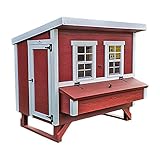
You may want a real building rather than a wire pen. The OverEZ Large is a panel-built wooden henhouse with nesting space, windows, and a floor you can clean. It arrives as a kit, so you need room to unload and assemble it.
This is the sleeping-coop half of your setup. It does not give your birds a large outdoor exercise area by itself. Pair it with a properly sized run or secure yard access.
The brand advertises space for up to 15 chickens, but you should compare the actual usable indoor floor area with your flock size, especially if you keep large breeds or birds spend long periods indoors.
The advantage: You get the essential enclosed housing features instead of buying a run and discovering later that it has no place for hens to sleep or lay.
The tradeoff: Higher initial expense, kit assembly, and an additional run to plan. Check the doorway measurements too. A large henhouse is not automatically one you can enter standing fully upright.
For you if: You want a ready-made enclosed coop and can build or purchase the outdoor portion separately. Check the Amazon listing.
2. OverEZ Classic XL Chicken Coop — Larger Enclosed Henhouse
This site runs ads and contains Amazon affiliate links that help support my work at no extra cost to you, and I truly appreciate your support!
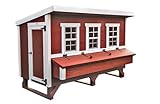
If your flock has outgrown a small prefabricated hut, the XL gives you more room for roosts, nest boxes, and cleaning. Its larger wooden structure is meant to be a permanent backyard henhouse, not a lightweight seasonal pen.
You still need to plan your outdoor area separately. A roomy sleeping building does not make up for a crowded run, particularly when you have birds that cannot range freely all day.
What you gain: More interior room and nesting provision than in a compact coop. The brand markets it for as many as 20 chickens, but that is a seller figure, not a guaranteed comfortable count for your particular flock.
Before buying: Check the actual entrance height, delivery access, foundation, and whether the selected listing includes any run at all. Do not assume it arrives ready to use.
For you if: You need the enclosed building first and want room to grow. View the U.S. listing.
3. PawHut 24-Foot Metal Chicken Run — Long Walk-In Pen

This site runs ads and contains Amazon affiliate links that help support my work at no extra cost to you, and I truly appreciate your support!
The PawHut run is for the part of chicken keeping where you want to walk inside, change the water, rake the ground, and still have room to turn around. The long layout is easier to divide into feeding and scratching areas than a tiny square pen.
It is a frame-and-mesh enclosure with a cover, not an insulated or solid-walled henhouse. Your birds need somewhere dry and secure to roost overnight.
What works: Walk-in access, a long footprint, and a covered portion for some shade or rain protection.
What needs attention: Check the exact size option, supplied mesh openings, door latch, tie-downs, and roof-cover attachment. Reinforce predator-vulnerable sections with properly fastened hardware cloth and protect the perimeter against digging.
For you if: You have a suitable henhouse already and want a large adjacent run. Check Amazon.
4. PawHut 10 × 26-Foot Walk-In Run — Extra-Long Yard Layout

This site runs ads and contains Amazon affiliate links that help support my work at no extra cost to you, and I truly appreciate your support!
If your yard has a long open strip, this PawHut model can use that space instead of forcing everything into a short, deep enclosure. A human-height door makes daily chores far less awkward than crawling through a chicken-sized hatch.
The generous advertised footprint sounds appealing, but measure your site and leave space outside the fence to mow, repair the mesh, and inspect the base.
Worth noting: It is an outdoor run only. You are buying the frame, fencing, and partial weather cover, not nest boxes, a roosting room, or a solid floor.
Weak spot to plan for: Large flexible mesh panels and standard closures may need upgrades where raccoons, foxes, dogs, or digging predators are common. Anchor it to suit your soil and local wind exposure.
For you if: You want a long run attached to a separate secure sleeping coop. See the product.
5. VEVOR 19.6 × 9.8-Foot Dome-Top Run — Wide Exercise Space
This site runs ads and contains Amazon affiliate links that help support my work at no extra cost to you, and I truly appreciate your support!
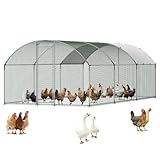
This larger VEVOR gives you roughly 190 square feet of nominal ground footprint. That can make chores easier when you need room for feeders, waterers, shaded spots, and places for the flock to scratch.
The dome-like roof leaves walk-in clearance through much of the center. A tarp covers only part of the structure, so it should not be mistaken for a completely dry shed.
Useful detail: The long frame lets you separate enrichment areas rather than crowding every item against one wall.
The catch: VEVOR’s standard hexagonal mesh is not the same thing as 1/2-inch hardware cloth. Reinforcement around the lower walls, door edges, and roof is important if you need serious predator protection.
For you if: You have room for a larger walk-in run and a separate henhouse. Check the exact size.
6. VEVOR 13.1 × 9.8-Foot Dome-Top Run — Mid-Size Walk-In Choice
This site runs ads and contains Amazon affiliate links that help support my work at no extra cost to you, and I truly appreciate your support!
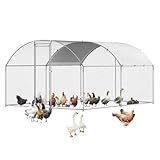
Not every flock needs a giant enclosure. This version has a roughly 128-square-foot nominal footprint and a roof shape that gives you space to enter and clean.
It is a middle ground if the largest run would swallow your whole yard but a small pen would leave too little room for daily exercise.
What you get: Galvanized frame pieces, mesh, door, and a partial weather cover. You will need time to assemble and secure all the joints.
Check before assembly: Decide where your enclosed coop will connect, add a dig-resistant perimeter, and replace or reinforce weak mesh where needed. This kit itself has no enclosed nighttime sleeping compartment.
For you if: You want walk-in space for a modest backyard flock without buying the longest option. View it on Amazon.
7. VEVOR 6.5 × 9.8-Foot Spire-Top Run — Compact Rectangular Run

This site runs ads and contains Amazon affiliate links that help support my work at no extra cost to you, and I truly appreciate your support!
This is a more manageable size if you have a small yard and still want to step inside to reach the feeder or clean around the edges. It offers roughly 64 square feet of nominal run space.
The pitched roof gives the frame some center clearance, although you should verify door height if you are tall. Do not mistake the waterproof tarp for an enclosed sleeping roof.
Nice part: A smaller frame can be easier to place beside an existing coop and less work to maintain.
Limitation: The ground area is much smaller than it first appears in marketing photos, once you add the feeder, dust-bath spot, and any sheltered corner.
For you if: You already have a proper henhouse and want a compact, human-accessible run. Check Amazon.
8. VEVOR 6.56 × 6.56-Foot Spire-Top Run — Small Square Run

This site runs ads and contains Amazon affiliate links that help support my work at no extra cost to you, and I truly appreciate your support!
A square run can fit a corner of the garden better than a long one. This VEVOR has about 43 square feet of nominal ground area, so it is a limited exercise enclosure rather than a big permanent living area for a large flock.
You can use it as an addition to an existing coop or a supervised daytime space, depending on the improvements you make.
Why it is useful: Compact footprint and enough center height to make access easier than with a low hutch-style run.
What you must provide: A separate enclosed sleeping coop, solid anchoring, proper predator-resistant mesh, and adequate shade. The stock tarp will not cover every weather condition.
For you if: Your backyard layout is tight and you know exactly how much run space your birds need. See this model.
9. VEVOR 9.8 × 3.3-Foot Walk-In Run — Narrow-Space Option

This site runs ads and contains Amazon affiliate links that help support my work at no extra cost to you, and I truly appreciate your support!
A long, narrow side yard sometimes cannot take a wide enclosure. This model is designed for that kind of space. Its nominal footprint is only about 32 square feet, so plan the number of birds carefully.
The big advantage is practical access along a skinny area. It can also help you extend an existing run rather than buying an entire new setup.
Good for: Using a narrow strip of ground that would otherwise go unused.
Not good for: Housing a full backyard flock in the enclosure all day. The narrow width leaves limited room once you put the essentials inside, and it is still a run, not a henhouse.
For you if: You need a modest extension and can supervise or provide other exercise space. Check the U.S. listing.
What Does Walk-In Actually Mean?
A walk-in run is tall enough for you to enter through a human-sized door. A walk-in sleeping coop is an enclosed building where you can reach the roosts, nests, floor, and corners. Some large henhouses still have a low entrance that makes you duck. Check the actual door opening, not just the roof height.
The Amazon category sometimes calls both of these products a “chicken coop.” You need to look at what is included in the box, not just the listing title.
How Much Space Do You Need?
A useful planning target for standard adult laying hens is about 3–4 square feet each inside a sleeping coop and 8–10 square feet each in an outdoor run. Your actual needs can change with breed size, climate, how often birds can range, and how long they remain confined. More space gives you more flexibility.
For six hens, that means thinking in terms of roughly 18–24 square feet indoors and at least 48–60 square feet outside, rather than relying on the largest bird count printed on a sales page. Our chicken space guide explains coop, run, and nest-box planning in more detail.
Do the math separately. A 100-square-foot outdoor run does not count as 100 square feet of enclosed nighttime housing.
Predator-Proofing Before Your Chickens Move In
A tall run looks secure from a distance, but many affordable metal kits use wide hexagonal mesh. That can contain chickens without reliably stopping small predators, reaching raccoons, or determined dogs.
- Use appropriately sized, securely fastened hardware cloth around vulnerable walls, openings, and vents. Half-inch mesh is a common choice for small-predator exclusion.
- Protect the base with an anchored or buried outward-facing apron against digging, and inspect it after heavy rain.
- Add secure latches that an animal cannot easily lift or slide.
- Check every door corner, panel overlap, wire end, and connection to the enclosed coop.
- Make sure your birds can be locked inside a proper sleeping coop at night, even if the run has a roof.
- Anchor the frame and follow local wind and snow-load considerations; a tarp is not a substitute for a designed roof.
You can compare mesh choices in our chicken wire and hardware cloth guide and use our predator-proof coop guide for the bigger construction checklist.
Do These Walk-In Runs Come With Nest Boxes and Roosts?
Usually not. The PawHut and VEVOR models above are wire enclosures. They do not replace the enclosed coop your chickens use at night, or the nest boxes your hens need for egg laying.
Plan an actual roosting area, dry bedding, safe upper ventilation, and enough nest boxes. Our nest-box guide is useful if you are adapting an existing shed into a henhouse.
And if you are adding a new roof cover, read our chicken run tarp guide before assuming the thin cover supplied with a kit will last through every season.
A Simple Setup Checklist for Your Backyard
Before you assemble the frame, choose a well-drained spot. Mud that sits under the run for weeks is miserable for your chickens and annoying to clean.
- Measure both the ground footprint and the door opening before ordering.
- Check your city and HOA rules about placement, setbacks, and the number of hens.
- Put the enclosed coop where you can reach the pop door from the run.
- Leave space outside the enclosure for mowing and repairs.
- Install water and feed where rain will not soak them.
- Keep ventilation high in the sleeping coop rather than sealing it tight.
- Test every latch and inspect for sharp wire ends before letting the flock in.
- Walk around the entire perimeter at ground level after installation.
For the weekly routine, our coop-cleaning guide covers bedding, moisture, and waste management.
Should You Buy a Run Kit or Build Your Own?
A run kit saves you some measuring and cutting. It is often a good choice if you already have a solid coop and simply want more protected outdoor space. But a low-cost kit may still need hardware-cloth upgrades, stronger anchors, a better latch, and more shade.
A custom build takes more planning, but you can choose the door height, predator-resistant wire, roof coverage, and layout from the beginning. Do not compare the kit price with bare lumber alone. Include the cost of security upgrades when you make your decision.
If moving your birds to fresh ground is more important than a permanent walk-in structure, see our portable chicken coop guide instead.
FAQs About Walk-In Chicken Coops
Is a walk-in chicken run the same as a chicken coop?
No. A run is an outdoor enclosure. A sleeping coop is an enclosed, ventilated shelter with roosts and usually nest boxes. Many online run kits are marketed as coops, so check what is included.
Do VEVOR and PawHut walk-in run kits include a henhouse?
The metal run models in this comparison do not include a separate solid-walled sleeping henhouse. You need to provide one.
How much space does a walk-in coop need for six hens?
A useful starting point is roughly 18–24 square feet of indoor coop floor and at least 48–60 square feet of outdoor run, with more space when birds spend long periods confined.
Are the included wire panels predator-proof?
Do not assume so. Check mesh opening size, wire strength, latches, roof edges, and the ground perimeter. Many budget runs need additional hardware cloth and dig protection.
Can chickens sleep in a covered metal run?
A partial tarp and mesh do not replace a dry, ventilated, enclosed sleeping coop. Give your birds protected roosts and secure nighttime housing.
Is a taller chicken run worth buying?
It can make cleaning, filling waterers, and checking the flock much easier. Measure the door opening as well as the maximum roof height before ordering.
Should I buy based on the seller’s advertised chicken capacity?
Use the actual usable floor area, breed size, and your management plan instead. Seller capacity figures may be more crowded than your flock would find comfortable.
Sources and Further Reading
- University of Delaware Cooperative Extension: Chicken Housing and Coop Maintenance
- Oregon State University Extension: Backyard Chicken Coop Design
- University of Maryland Extension: Housing Requirements